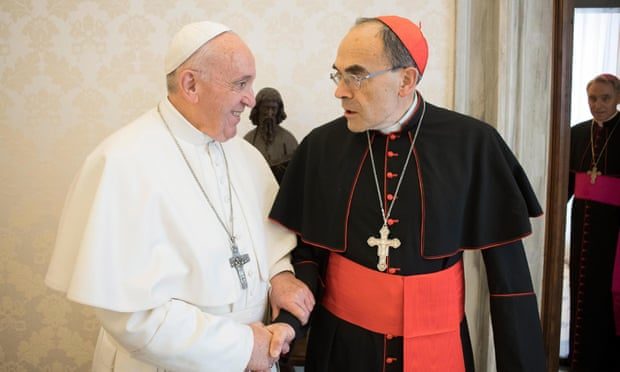
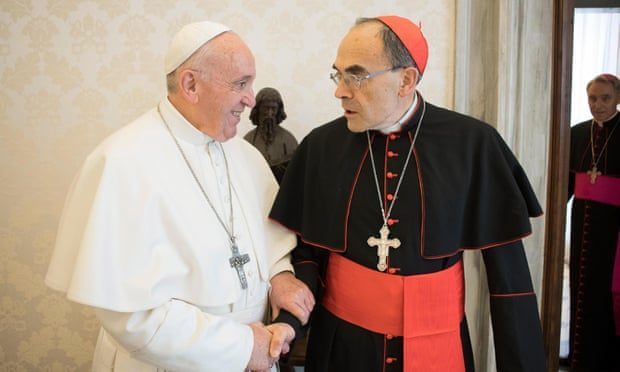
© Vatican/EPAPope Francis receives Cardinal Philippe Barbarin in Vatican City on 18 March 2019.
Philippe Barbarin, the French Roman Catholic cardinal convicted this month of failing to report sexual abuse allegations, said on Tuesday that Pope Francis had turned down his offer to resign.
"On Monday morning, I put forward my resignation to the hands of the Holy Father.
Invoking the presumption of innocence, he declined to accept this resignation," said Barbarin, the archbishop of Lyon, in a statement.
Barbarin is appealing against the verdict that he failed to report abuse claims.In a statement on Tuesday, the Vatican's spokesman, Alessandro Gisotti, said the Vatican remained close to sexual abuse victims and the French faithful "who are living in a particularly painful moment".
Barbarin, 68, is the most senior French cleric caught up in the global child sexual abuse scandal that has rocked the Catholic church.
On 7 March a Lyon court ruled that Barbarin, a cardinal since 2003, was guilty of failing to report allegations of abuse of boy scouts committed by a priest, Bernard Preynat, in the 1980s and 1990s. He was given a six-month suspended prison sentence.



















Comment:
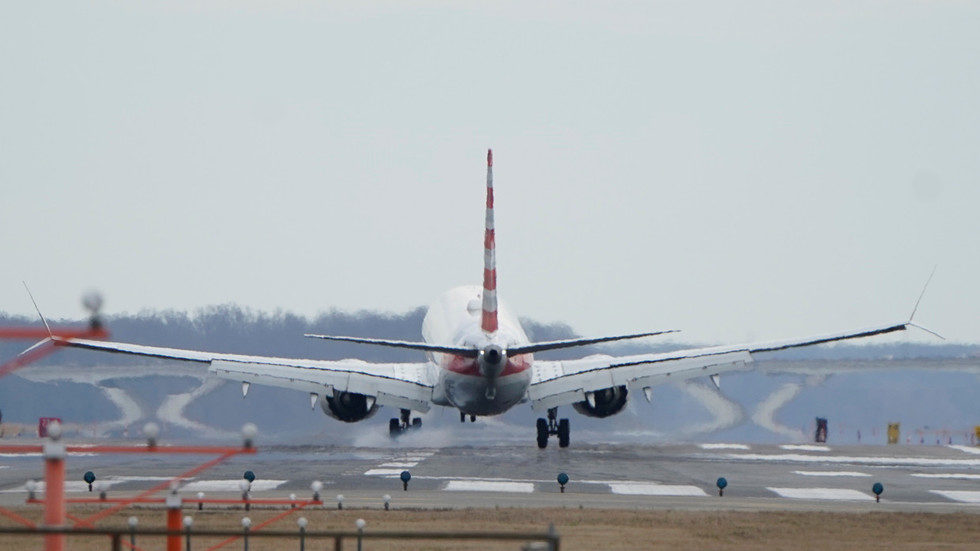
Meanwhile, Russian airlines have suspended the purchases of Boeing 737 MAX jets indefinitely. As reported by RT: In the US, President Trump appoints Steve Dickson, the former chief of Delta Airlines' flight operations, to run the FAA: See also: Flawed analysis, failed oversight, greed: How Boeing & FAA certified faulty 737 MAX