Fire in the SkyS


Attention

Aurora Whirlpool

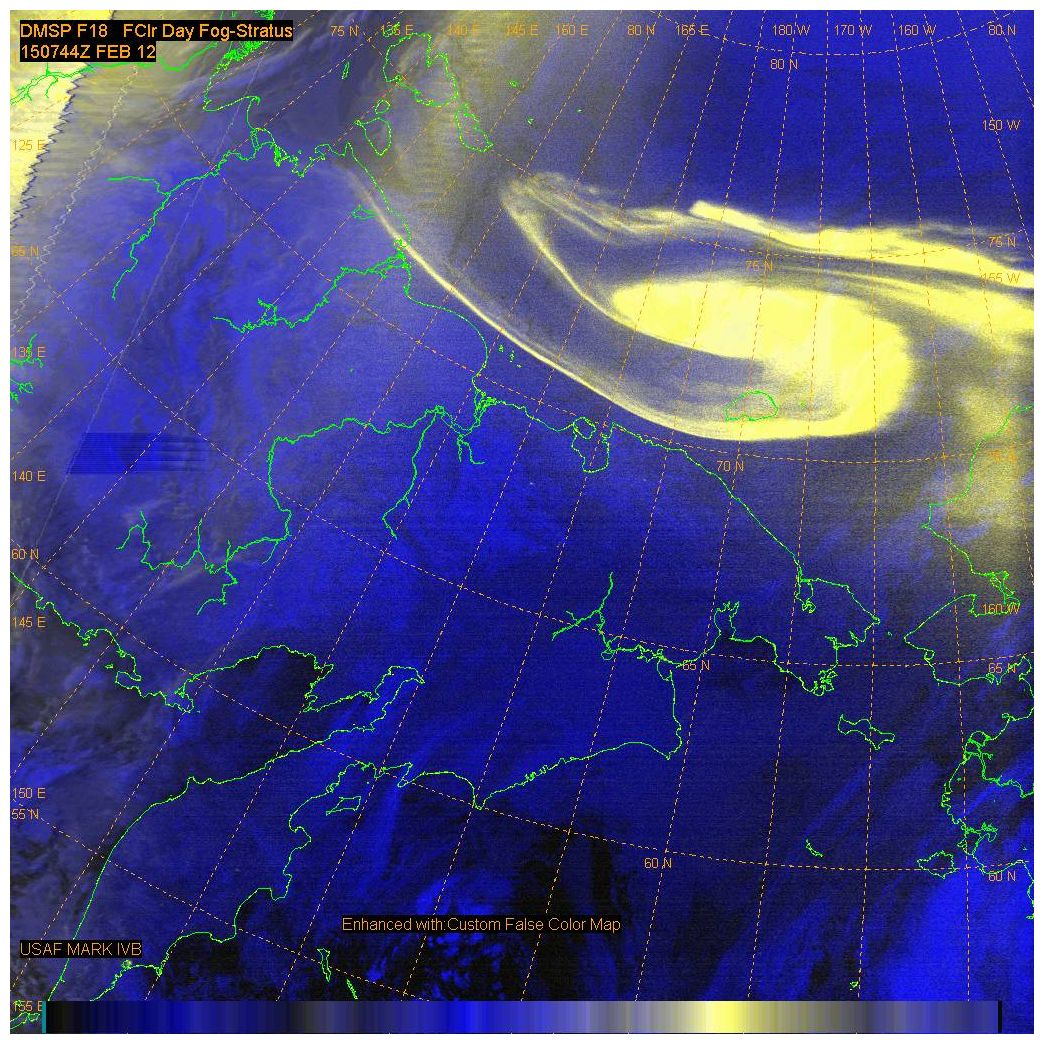
Sometimes the sky surprises us. On Feb. 14-15, with little warning, geomagnetic activity rippled around the Arctic Circle, producing an outbreak of auroras that veteran observers said was among the best in months. At the height of the display, a US Defense Meteorological Program satellite photographed a whirlpool of Northern Lights just north of the Bering Sea:

Aurora's
© US DMSP
"A number of images from the DMSP F18 satellite captured the dramatic auroral event of the last couple nights," says analyst Paul McCrone, who processed processed the data at the US Navy's Fleet Numerical Meteorology and Oceanography Center in Monterey, CA.

The reason for the outburst is still not completely clear. It got started on Feb. 14th when a magnetic disturbance rippled around the Arctic Circle. No CME was obvious in local solar wind data at the time; the disturbance just ... happened. Once begun, the disturbance was amplified by the actions of the interplanetary magnetic field (IMF) near Earth. The IMF tipped south, opening a crack in our planet's magnetic defenses. Solar wind poured in and fueled the auroras.

Meteor

US: Exploding UFO Wakes Thousands in South Carolina

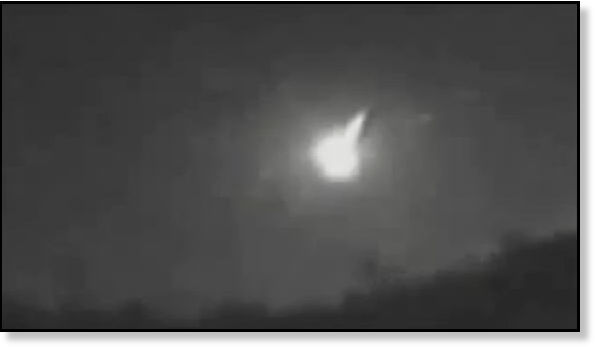
A streaking flash of blue light, what many witnesses are calling a UFO, burst over the midnight skies of South Carolina early on Monday morning. What was it? No one really knows, but the object, caught on tape, has astronomers trying to allay fears in a nervous public.

The unidentified flying object was caught on a home security cam, reflected in the window of a parked car, and a nighttime sky camera which showed the UFO blasting through the sky trailed by a flashing tail.

Local astronomers were immediately consulted and tried to allay public fears by saying the UFO was probably a comet or meteorite, even though such celestial phenomenon are usually well-known and expected by the time an object of this size burns up in the atmosphere.

Image
© Unknown
Still, one local resident, interviewed by the local FOX affiliate in the video below, admits she was scared and wondered for just a moment if it was "aliens" attacking.

Meteor

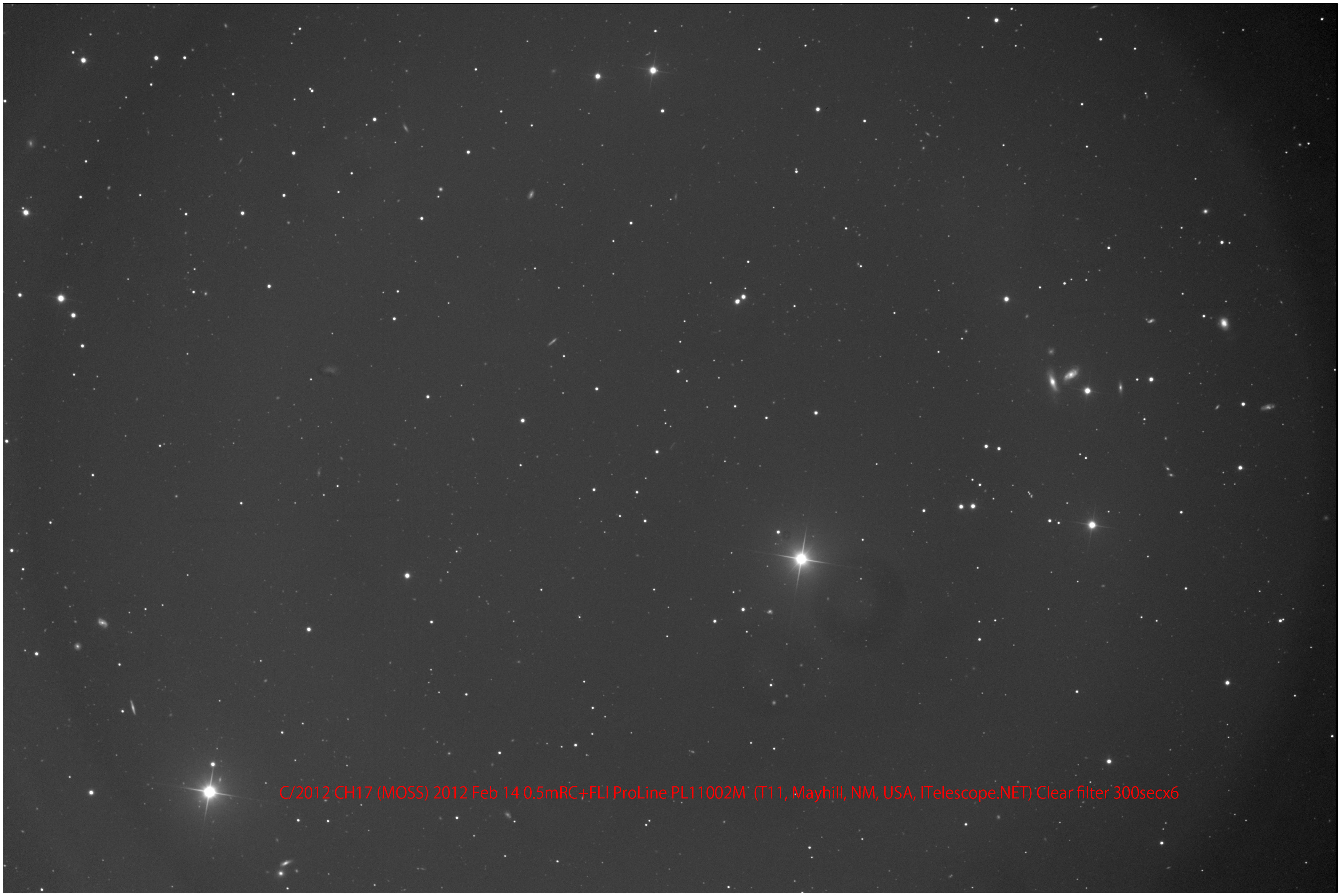
New Comet: C/2012 CH17 (MOSS)

Discovery Date February 7, 2012
Magnitude 17.9 mag
Discoverer Morocco Oukaimeden Sky Survey (MOSS)

Comet Moss
© meineko.sakura.ne
Orbital Elements

T 2012 Sept. 28.07814 TT MPC
q 1.2957137 (2000.0) P Q
Peri. 138.01949 -0.04302480 +0.92540652
Node 125.94444 -0.99480698 -0.00488755
e 1.0 Incl. 27.71566 -0.09223850 -0.37894443
From 29 observations 2012 Feb. 2-13.

Meteor

South Carolina, US: New Video Shows Upstate Meteor


Spartanburg - Officials in Spartanburg County said a large boom heard by many people in the Upstate Monday morning may be a meteor.

Law enforcement officials saw a large ball of fire that popped in the air around 1:45 a.m. Monday. Viewers from Greenville to Cherokee Counties called 7 On Your Side saying they heard the noise and their homes shook. No one was hurt.

Calls poured in to dispatchers across the Upstate soon after. Some said it sounded like a crash. Others said they thought someone was kicking in their door.

The National Weather Service tells 7 On Your Side it was most likely something speeding toward Earth from outer space. It could have been moving as fast as 10 times the speed of sound.

"Thank God for the atmosphere," says Doug Gegen.

Meteor

US: Possible Meteorite Wakes Many in South Carolina

Possible Meteor
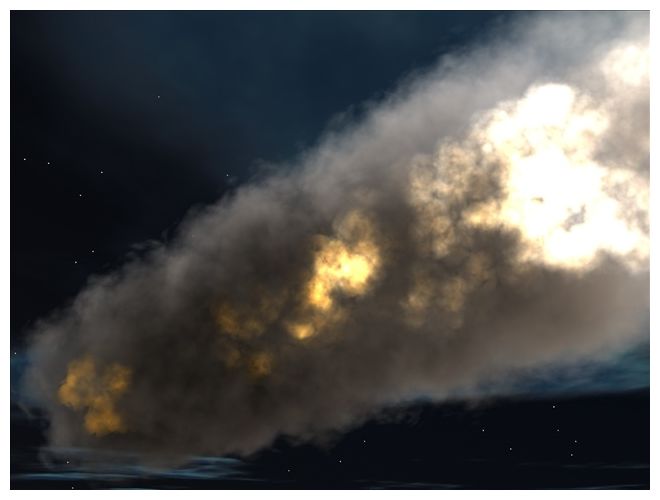
© WISTVSimulated image of a meteorite.
Greenville - Emergency dispatchers from across the Upstate and The National Weather Service office say they got numerous calls overnight from people who heard a loud explosion followed by lights streaking across the sky.

The National Weather Service said it got a call from Greenville police around 2 a.m. Police said they had been getting calls about lights in the sky and a loud boom.

They said after they started getting calls they checked the security camera at the National Weather Service and saw a flash of light at 1:42 a.m. A National Weather Service representative said it could have been a meteorite.

The National Weather Service say they also got calls from Cherokee County. One of these callers said they saw an object breaking apart in the sky.

Telescope

US: What was that light in the sky?

NC fireball
© Stuart McDanielLawndale, NC Sandia Sentinel Allsky
Date: February 13 2012. Time: 01:42 am EST
So, just what was that in the sky this morning?

Some upstate South Carolina residents reported seeing a fireball and hearing a large boom around 1:45 a.m. today. But so far, the National Weather Service hasn't been able to confirm that it was a meteor.

"There's no evidence of anything actually striking the ground," said meterologist Harry Gerapetritis, of the National Weather Service office in Greer, S.C. "So it must have burned up in the sky, as best anybody can tell."

Telescope

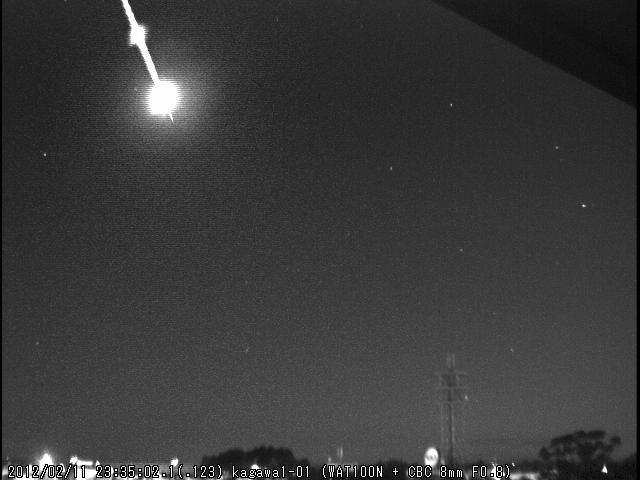
Exploding Fireball recorded over Okayama, Japan

Video of a fireball entering Earth's atmosphere and exploding over Okayama, Japan, 12th February 2012.


Thanks to the fine folks at Sonotaco.jp for their videos/images.

Japan fireball
© SonotaCo Network

Meteor

Laughable! Scientists Say Nuclear Bomb CAN Save Earth from Asteroid

Image
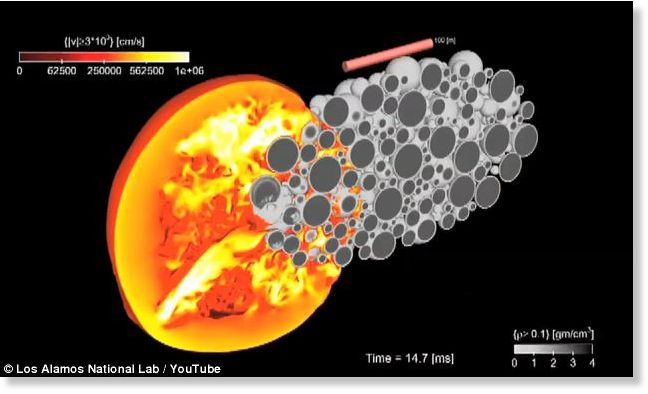
© Los Alamos National Lab/YouTubeBoom: This picture shows the effect that a one megaton nuclear blast would have on an incoming asteroid that threatened Earth
It sounds like a plot fit for a disaster movie - but this is real life.

Scientists say they have worked out a way to blast an asteroid into space dust using an atomic bomb.

The plan has potentially world-saving consequences should an asteroid emerge on a collision course with Earth.

And unlike the film Armageddon - where Bruce Willis and his crew of stars fly a space shuttle to an oncoming Asteroid to drill a warhead into its core - the nuclear payload could be delivered by rocket.

Using one of the world's most powerful supercomputers at Los Alamos National Laboratory, physicists have calculated the effect of a nuclear blast on an incoming space rock.

Although Nasa and other space agencies have mapped most nearby asteroids, the effect of one catching us by surprise would be catastrophic and, they believe, is worth preparing for.

Meteor

New Comet: C/2012 C2 (BRUENJES)

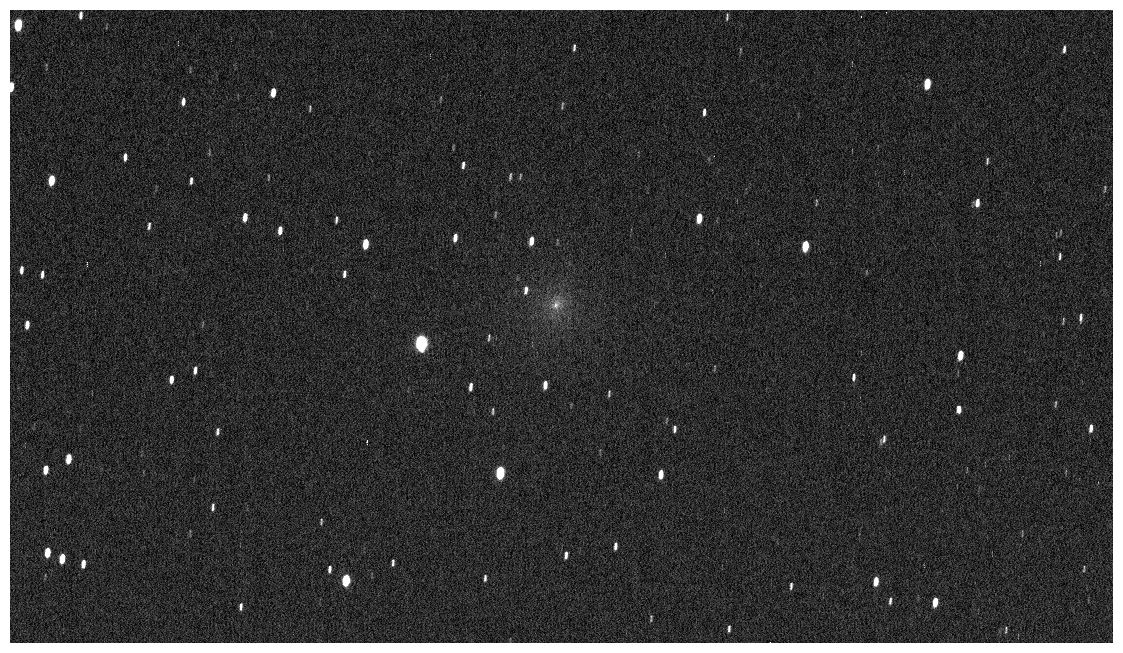
Cbet nr. 3019, issued on 2012, February 12, announces the discovery of a new comet (discovery magnitude 15.3) by Manfred Bruenjes on 30-s CCD exposures taken on two nights with a 0.36-m f/2.0 Schmidt-Cassegrain reflector on February 11.1 & 12.08. The new comet has been designated C/2012 C2 (BRUENJES).

We performed some follow-up measurements of this object, while it was still on the neocp. Co-adding of 5 unfiltered exposures, 30 seconds each, obtained remotely on 2012 Feb 12.8 through a 0.15-m f/7.3 refractor + CCD (Nerpio MPC Code - I89) confirms that this object is a comet: diffuse coma 1 arcminute and 30 arcseconds in diameter, with a sharp central condensation

Our confirmation image:

Comet Bruenjes
© Remanzacco Observatory

Meteor

New Comet: C/2012 C1 (McNAUGHT)

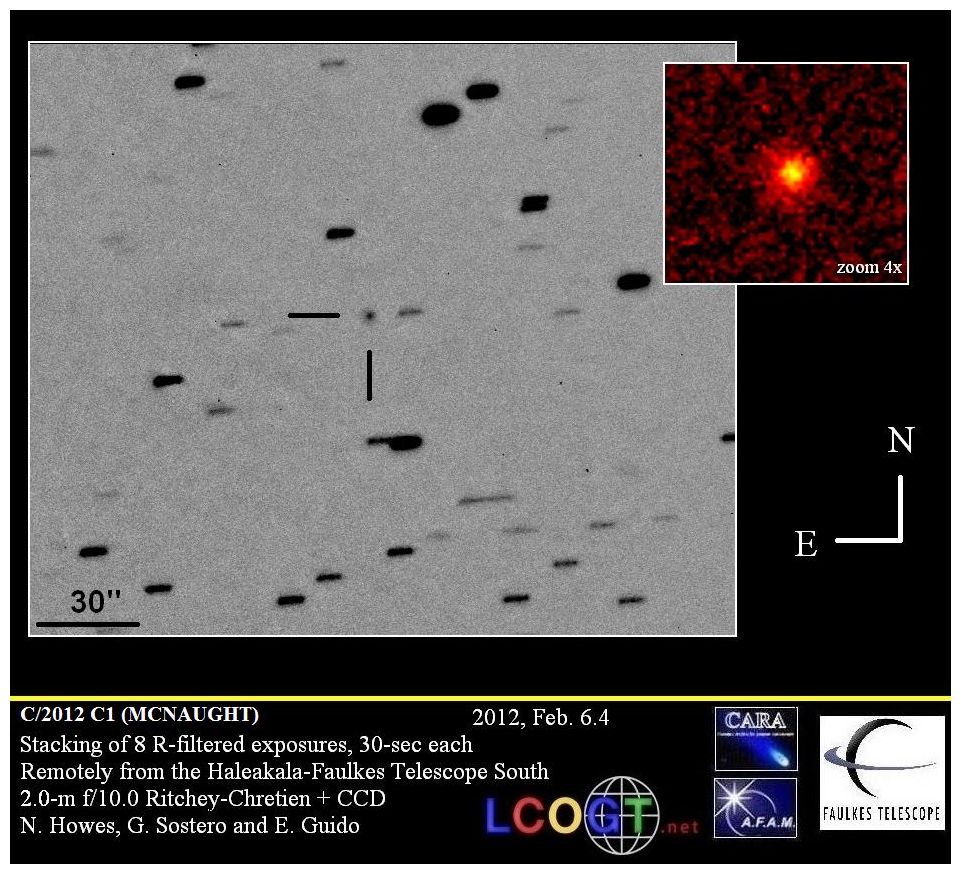
Cbet nr.3016, issued on 2012, February 11, announces the discovery of a new comet (discovery magnitude 18.8) by R. H. McNaught on CCD images obtained on February 5.5, 2012 taken with the 0.5-m Uppsala Schmidt telescope at Siding Spring. The new comet has been designated C/2012 C1 (McNAUGHT).

We performed some follow-up measurements of this object, while it was still on the neocp. Stacking of eight R-filtered exposures, 30-sec each, obtained remotely, from the Siding Spring-Faulkes Telescope South on 2012, Feb. 6.4, through a 2.0-m f/10.0 Ritchey-Chretien + CCD, shows that this object is a comet: coma about 5" in diameter, with a weak central condensation. The coma is slightly elongated toward the southwest.

Our confirmation image

C/2012 C1 (McNaught)
© Remanzacco Observatory