Puppet MastersS


Arrow Down

For anyone that ever wondered if our news is scripted...

Watch this, and ask yourself, who might be writing that script?


Top Secret

The spies who fooled the world

As we approach the 10th anniversary of possibly the most contentious and divisive war in living memory, Peter Taylor forensically investigates how key intelligence used by Downing Street and the White House to justify invading Iraq was based on fabrication, wishful thinking and lies.

Using never before first hand testimony, this Panorama special tells the story of how two high placed sources, who were very close to Saddam Hussein, talked to the CIA secretly via an intermediary and directly to M16 in the build-up to the war and stated that Iraq did not have a Weapons of Mass Destruction programme, but they were both ignored.

In a story of spies and intrigue, lies and deception, key people reveal how little intelligence Britain and America actually had and how none of the human sources at hand had any direct knowledge of WMD's. Former CIA Paris Station Chief Bill Murray tells of how he used an intermediary to recruit Iraq's Foreign Minister and of his frustration when his crucial information he gathered from his source was rejected because it did not fit the White House's agenda. The intelligence received from the Iraqi Foreign Minister was confirmed just a few months later when Iraq's Head of Intelligence passed on the same message, that Iraq did not have any WMD's, to an MI6 officer.

USA

No more asking for permission to speak

Image
In 1798, when John Adams was president of the United States, the feds enacted four pieces of legislation called the Alien and Sedition Acts. One of these laws made it a federal crime to publish any false, scandalous or malicious writing - even if true - about the president or the federal government, notwithstanding the guarantee of free speech in the First Amendment.

The feds used these laws to torment their adversaries in the press and even successfully prosecuted a congressman who heavily criticized the president. Then-Vice President Thomas Jefferson vowed that if he became president, these abominable laws would expire. He did, and they did, but this became a lesson for future generations: The guarantees of personal freedom in the Constitution are only as valuable and reliable as is the fidelity to the Constitution of those to whom we have entrusted it for safekeeping.

We have entrusted the Constitution to all three branches of the federal government for safekeeping. But typically, they fail to do so. Presidents have repeatedly assaulted the freedom of speech many times throughout our history, and Congresses have looked the other way. Abraham Lincoln arrested Northerners who challenged the Civil War. Woodrow Wilson arrested Americans who challenged World War I. FDR arrested Americans he thought might not support World War II. LBJ and Richard Nixon used the FBI to harass hundreds whose anti-Vietnam protests frustrated them.

In our own post 9/11 era, the chief instrument of repression of personal freedom has been the government's signature anti-terror legislation: the Patriot Act. It was born in secrecy, as members of the House of Representatives were given 15 minutes to read its 300 pages before voting on it in October 2001, and it operates in silence, as those who suffer under it cannot speak about it.

Bad Guys

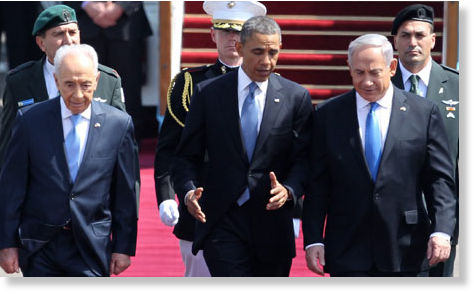
Barack Obama hails 'eternal' U.S.-Israel alliance at start of Middle East visit

Image
© Oliver Weiken/EPABarack Obama with Shimon Peres and Binyamin Netanyahu at Ben Gurion airport, Tel Aviv.
Obama says his first visit to Israel as US president is chance to 'reaffirm the unbreakable bond between our nations'

The alliance between Israel and the United States is eternal, Barack Obama has said after landing in the Jewish state for his first visit since becoming US president more than four years ago.

"I see this visit as an opportunity to reaffirm the unbreakable bond between our nations, to restate America's unwavering commitment to Israel's security and to speak directly to the people of Israel and to your neighbours," Obama said at a welcoming ceremony at Tel Aviv's Ben Gurion airport. "I am confident in declaring that our alliance is eternal, is forever," he added.

In a short speech before Israeli parliamentarians, religious leaders, military figures and other dignitaries, Obama said: "We will never lose sight of the vision of an Israel at peace with its neighbours." The Palestinians were not mentioned by name.

Air Force One touched down at about 12.30pm local time in glorious spring sunshine that prompted the president to discard his jacket shortly after the end of the ceremonials. His visit to Israel and the Palestinian territories is scheduled to last 50 hours before the 600-strong entourage departs for Jordan on Friday.

Eye 1

New South Wales laws passed to end right to silence

Image
People in NSW will no longer have the "right to silence" when being questioned by police after the Shooters and Fishers Party voted with the government on its bid to combat gang violence.

Critics of the laws - which the government will now push through the lower house - say it's a fundamental attack on people's rights.

Greens MP David Shoebridge wants the government to come clean on the deal it struck with MPs from the minor party to get the laws through the upper house, where they have the balance of power.

"The question is, what have they been offered in return?" he told AAP.

The legislative changes allow judges and juries to take a negative view of people who exercise their right to remain silent.

The government flagged the move last August following a spate of drive-by shootings in Sydney's west.

Eye 1

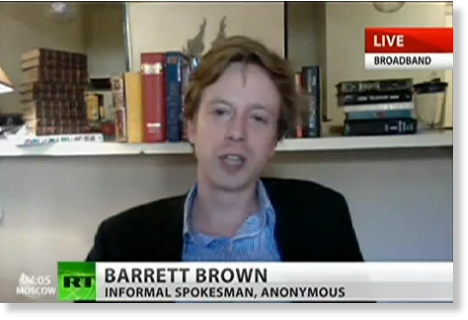
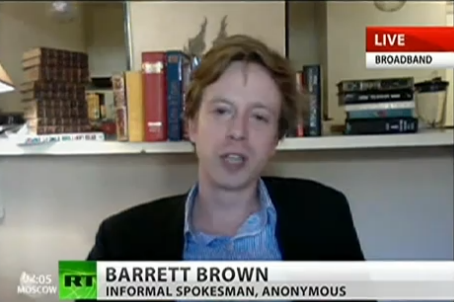
The persecution of Barrett Brown - and how to fight it

Image
Journalist and activist Barrett Brown in a 2012 interview with RT
The journalist and Anonymous activist is targeted as part of a broad effort to deter and punish internet freedom activism

Aaron's Swartz's suicide in January triggered waves of indignation, and rightly so. He faced multiple felony counts and years in prison for what were, at worst, trivial transgressions of law. But his prosecution revealed the excess of both anti-hacking criminal statutes, particularly the Computer Fraud and Abuse Act (CFAA), and the fixation of federal prosecutors on severely punishing all forms of activism that challenge the power of the government and related entities to control the flow of information on the internet. Part of what drove the intense reaction to Swartz's death was how sympathetic of a figure he was, but as noted by Orin Kerr, a former federal prosecutor in the DOJ's computer crimes unit and now a law professor at GWU, what was done to Swartz is anything but unusual, and the reaction to his death will be meaningful only if channeled to protest other similar cases of prosecutorial abuse:
"I think it's important to realize that what happened in the Swartz case happens in lots and lots of federal criminal cases. . . . What's unusual about the Swartz case is that it involved a highly charismatic defendant with very powerful friends in a position to object to these common practices. That's not to excuse what happened, but rather to direct the energy that is angry about what happened. If you want to end these tactics, don't just complain about the Swartz case. Don't just complain when the defendant happens to be a brilliant guy who went to Stanford and hangs out with Larry Lessig. Instead, complain that this is business as usual in federal criminal cases around the country - mostly with defendants who no one has ever heard of and who get locked up for years without anyone else much caring."
Prosecutorial abuse is a drastically under-discussed problem in general, but it poses unique political dangers when used to punish and deter online activism. But it's becoming the preeminent weapon used by the US government to destroy such activism.

Just this week alone, a US federal judge sentenced hactivist Andrew "Weev" Auernheimer to 3 1/2 years in prison for exploiting a flaw in AT&T's security system that allowed him entrance without any hacking, an act about which Slate's Justin Peters wrote: "it's not clear that Auernheimer committed any actual crime", while Jeff Blagdon at the Verge added: "he cracked no codes, stole no passwords, or in any way 'broke into' AT&T's customer database - something company representatives confirmed during testimony." But he had a long record of disruptive and sometimes even quite ugly (though legal) online antagonism, so he had to be severely punished with years in prison.

Also this week, the DOJ indicted the deputy social media editor at Reuters, Matthew Keys, on three felony counts which carry a maximum penalty of 25 years in prison for allegedly providing some user names and passwords that allowed Anonymous unauthorized access into the computer system of the Los Angeles Times, where they altered a few stories and caused very minimal damage. As Peters wrote about that case, "the charges under the CFAA seem outrageously severe" and, about Keys' federal prosecutors, observed: "apparently, they didn't take away any lessons from the Aaron Swartz case."

Bad Guys

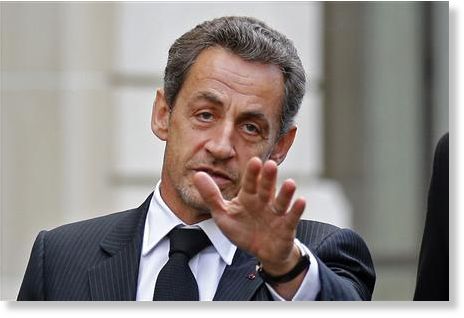
France's Sarkozy investigated in party-funding affair

Image
© Reuters/Benoit TessierFormer French President Nicolas Sarkozy reacts as he leaves his car in Paris November 26, 2012 after a lunch meeting with his former Prime Minister Francois Fillon to discuss the UMP political party's crisis.
Ex-French president Nicolas Sarkozy was placed under formal investigation on Thursday for "abuse of weakness" in a 2007 party funding case involving elderly L'Oreal heiress Liliane Bettencourt, the public prosecutor said.

The risk for Sarkozy, unseated May last year but considered a potential conservative candidate in the 2017 presidential race, is that he may end up plagued by suspicion for months or years, even if his lawyer says there is no case against him.

Under French law, a formal investigation is the final step before a suspect is accused of a crime. Sarkozy, who only this month hinted he could make a political comeback, repeatedly has denied taking campaign funds from Bettencourt.

"Nicolas Sarkozy, who benefits from the presumption of innocence, had been notified that he has been placed under formal investigation for taking advantage of a vulnerable person in February 2007 and during 2007 to the detriment of Liliane Bettencourt," the prosecutor in the southwestern city of Bordeaux said in a statement after a hearing.

Pistol

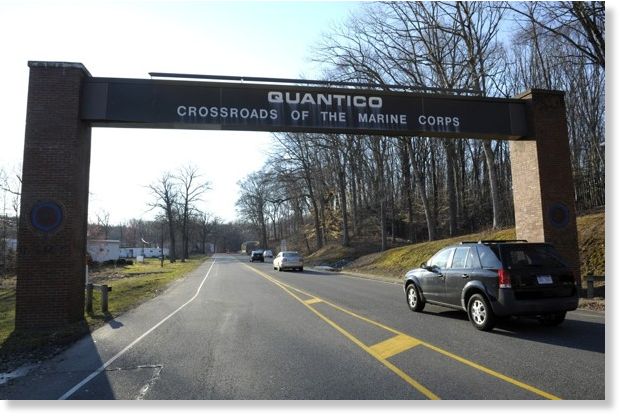
Three Marines die in shootings at Quantico

Image
A suspected gunman and two others are dead after a shooting on a Marine Base in Quantico, Virginia, near Washington, D.C. The base went into lockdown for several hours when the suspect barricaded himself in a barracks.
Two Marines were shot and killed Thursday at the Officer Candidate School at the Marine Corps Base Quantico, and the suspected shooter, also a Marine, fatally shot himself at the base, Marine Corps officials said.

The shooter gunned down a male Marine before seizing a female Marine and killing her, then himself, officials said.

Marine Corps officials said the shooting was not a terrorist attack nor an attempt to cause mass casualties, adding that the gunman and two victims were members of the same unit and knew each other.

"This was an isolated incident," said Capt. Eric D. Flanagan, a Marine spokesman at the Pentagon. "At no point was this suspected to be a mass shooting."

Vader

Obama compares Israel/Palestinian relations to U.S. and Canada

Image
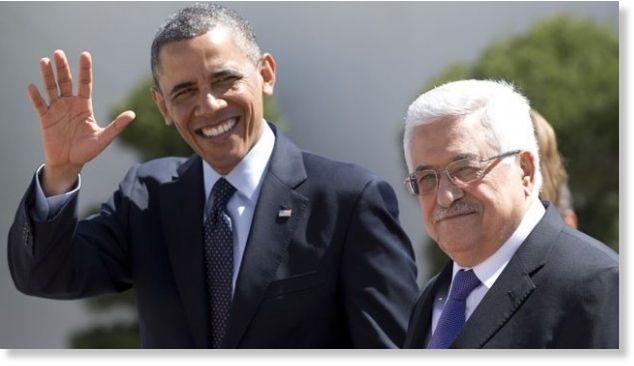
© AP Photo/Carolyn KasterPresident Barack Obama waves to media as he walks with Palestinian President Mahmoud Abbas, right, as he arrives at the Muqata Presidential Compound Thursday, March 21, 2013, in the West Bank town of Ramallah.
At his press conference Thursday with Palestinian Authority President Mahmoud Abbas, President Barack Obama chose an unusual example to drive home his belief that peace between Israelis and Palestinians is possible.

In his effort to convince the local populations, who have been in a decades-old (and some might even say millennia-old) conflict, Obama invoked perhaps the most peaceful neighbors on the planet, that is the U.S. and Canada.

"We can't afford to have our kids in bed sleeping and suddenly a rocket comes through the roof, but my argument is even though both sides may have areas of strong disagreement, may be engaging in activities the other side considers to be a breach of good faith, we have to push through those things to try to get to an agreement," Obama said.

Star of David

Obama heckled in Jerusalem: 'Actually made me feel at home'

Image
© AP
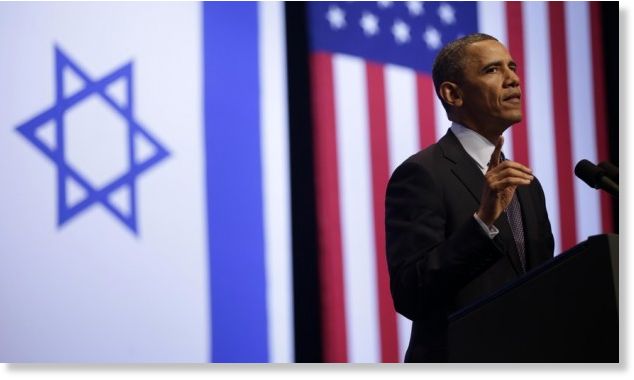
President Barack Obama was briefly interrupted by a heckler during a speech to students in Jerusalem on Thursday.

The heckler was booed loudly by the surrounding audience. As the protester continued to shout, Obama said, "This is part of the lively debate that we talked about, this is good!"

At that, the audience burst into applause and gave him a standing ovation.