
© Unknown
Russia's vision of the Eurasian Union is one in which it sits at the center of an interconnected supercontinent, with Moscow taking the initiative in bringing all sides closer together for their joint and multivectoral benefit.
The West's confrontation with Russia and the New Cold War may actually have been a blessing in disguise, as ever since then, Moscow has been propelled with a renewed sense of urgency to probe and clinch major deals all across Eurasia. Stretching from the coasts of Vietnam to the world's most populous Arab country, Egypt, it feels as though Russian diplomacy is omnipresent nowadays.
The purpose behind Russia's pan-Eurasian foreign policy push is to cement an alternative political and economic arrangement to challenge Western dominance and facilitate the birth of a truly multipolar world.From Network Diplomacy...The underlying basis of Russia's foreign policy successes has been that all of its strategic partners, in one way or another, understand the necessity of a multipolar world in order to safeguard their full sovereignty (cultural, political, historic, etc.). Incidentally, it was the US and its own foreign policy fumblings (especially in the post-9/11 era) that convinced most of the world that multipolarity was their only practical option for survival in the 21
st century. Working with the West carries with it certain privileged benefits (as Saudi Arabia and its Gulf clients know firsthand), but a non-Western state's existence within this system is tenuous, and once its leader's utility inevitably expires (as Mubarak's did) or the state refuses to follow essential unipolar dictates (like Gaddafi's Libya did), then the country is done away with, destroyed, and redefined as a dystopia.
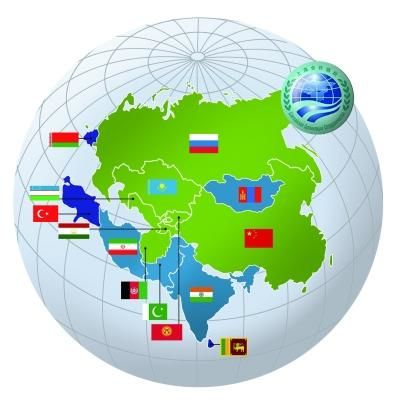
© UnknownMap of SCO: Green: members; Light blue: observers; Dark blue: dialogue partners
Even before the
'Arab Spring' theater-wide Color Revolutions, this nefarious objective was apparent to Russia and China, which entered into a
strategic partnership in 1997 in order to help one another build the multipolar world. Shortly thereafter, they transformed the Shanghai Five into the Shanghai Cooperation Organization (SCO) in order to safeguard themselves and their allies against the asymmetrical Western weapons of terrorism, separatism, and extremism (political, religious, economic [sanctions], etc.).
A few years later, the emerging economic reality in the non-Western world led to the bestowing of the BRICS moniker, which quickly evolved into an dynamic political and economic grouping dedicated to multipolarity.In order to bridge any potential rivalry and divergence between its two largest members, Russia solidified its strategic partnerships with China and India, forming the geopolitical glue of trust that has kept either of them from completely falling for the tempting and Brzezinski-esque Western trap of intra-BRICS conflict. It's not to say that this doesn't exist to some level, but by Russia positioning itself as the mediator via its bilateral partnerships with both, it joins them closer together than if it hadn't, and it also provides a trustful go-between intermediary in case tensions risk boiling over some time in the future.
Seen from another angle, the SCO and BRICS form the institutional cores of multipolarity in the Eurasian supercontinent, while the Russian-Chinese and Russian-Indian Strategic Partnerships provide the bilateral boosts to this process. Supplementary to these Eurasian anchors' agreement on the world's destiny, each of their own lesser (but no less important) strategic partnerships, such as the Russian-Iranian and Chinese-Pakistani ones, add a deeper network vector to this global vision and work to erode unipolar hegemony.



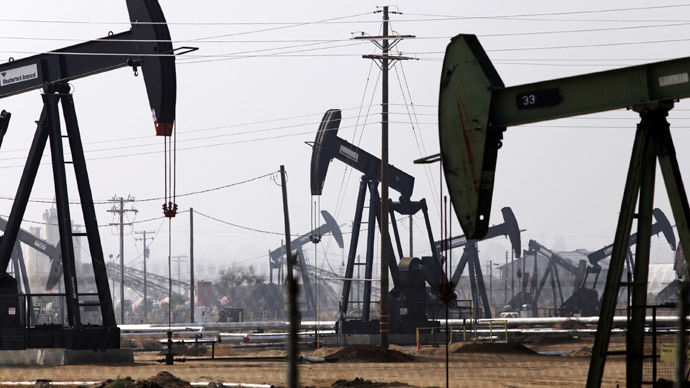















Comment: It seems the scheme intended to sink Russia is coming home to roost. Millions of people reliant on the oil industry for jobs will suffer needlessly because the psychopaths running the US cannot see, nor do they care about, the consequences of their ill-conceived policies. Worse, it appears that the US 'ally' Saudi Arabia may be putting additional pressure on prices to eliminate competition.