Puppet Masters
In sync with media outlets across the country, the New York Times put a chilling headline on Wednesday's front page: "Boston Bombs Were Loaded to Maim, Officials Say." The story reported that nails and ball bearings were stuffed into pressure cookers, "rigged to shoot sharp bits of shrapnel into anyone within reach of their blast."
Much less crude and weighing in at 1,000 pounds, CBU-87/B warheads were in the category of "combined effects munitions" when put to use 14 years ago by a bomber named Uncle Sam. The U.S. media coverage was brief and fleeting.
One Friday, at noontime, U.S.-led NATO forces dropped cluster bombs on the city of Nis, in the vicinity of a vegetable market. "The bombs struck next to the hospital complex and near the market, bringing death and destruction, peppering the streets of Serbia's third-largest city with shrapnel," a dispatch in the San Francisco Chronicle reported on May 8, 1999.
And: "In a street leading from the market, dismembered bodies were strewn among carrots and other vegetables in pools of blood. A dead woman, her body covered with a sheet, was still clutching a shopping bag filled with carrots."
Pointing out that cluster bombs "explode in the air and hurl shards of shrapnel over a wide radius," BBC correspondent John Simpson wrote in the Sunday Telegraph: "Used against human beings, cluster bombs are some of the most savage weapons of modern warfare."
But there is another point that Americans need to ponder. That point is that the U.S. government's assassination program in Pakistan, Yemen, and elsewhere and its sanctions program against Iran might well lead to "blowback" in the form of another major terrorist attack on American soil.
While it's still undetermined as to who committed the Boston Marathon bombings and why, at the top of the list of suspects has got to be people who are retaliating for what the U.S. national-security state has been doing and continues to do to people in foreign countries, including the drone assassinations, the 12-year occupation of Afghanistan, the sanctions against Iran, and the support of brutal Middle East dictatorships.
Is it all worth it? That's what Americans need to be asking themselves.
In the process of reflecting on that question, Americans need to rid themselves of the propagandistic nonsense that the U.S. national-security state has been spouting ever since 9/11 - like "The terrorists just hate us for our freedom and values" or "We're killing people over there to keep Americans safe.
Everyone has seen a False Flag Operation, but few have recognized one. The classic example is 9/11, seen by millions on TV but not recognized for what it really was - a treasonous inside job.
Unlike 9/11 and the 1964 Gulf of Tonkin "attack" (that never took place) and the 1933 torching of the Reichstag, the German parliament building, by Hitler (but which he blamed on "the communists") not all False Flags are both large and brazen. In this series I will try to give some idea of the dizzying array of forms that False Flags take: false flag events, false flag pseudo-events, false flag front organizations and false flag operators. You can barely open a newspaper without seeing the telltale markings of a False Flag - if you know what these markings are.
What all False Flags have in common is that they are deceptions, a category of phenomena too ambitious for this series. But I will argue that historically, materially and politically the False Flag is the most important and damaging type of deception.
The word deception and the concept it describes are familiar because of the fact, again known by everybody, that deceptions abound.
Equally important, if you stop to think about it, is that there's this well-established word, deception, that names the phenomenon. It has a well-grooved place in our neural pathways. The concept and its emotive and other nuances can be instantly retrieved when we encounter an obvious deception.
In contrast, the term False Flag is not yet widely known. No well-grooved neural pathway leads to a mental storage area.
Additionally, those familiar with the term offer similar but varying definitions of what it means. (The sizable definitional issues will be addressed later in this series.).

The Richards family home in the Dorchester neighborhood of Boston where 8-year-old Martin Richards (inset) lived.
Call it "terrorism" if a label helps you make sense of this madness. Find who did it and squash him - or them - with what President Obama called "the full weight of justice." But in the broad scheme of things, such loose ends matter less than this: Life in America changed with the Boston Marathon bombings - again, and as with past attacks, for the much worse.
The Oklahoma City bombing in April 1995 and the Sept. 11, 2001, attacks were knee-buckling blows that led to an obsession over domestic security and foreign wars that will mark - and mar - our generation. The last mass terrorist assault on U.S. soil was carried out by Maj. Nidal M. Hassan, an Army psychiatrist with loose connections to al-Qaida in the Arabian Peninsula, who fatally shot 13 people and wounded 30 more at Fort Hood, Texas, in November 2009.
There were attacks thwarted by the swelling ranks of federal police: The so-called shoe bomber, Richard Reid; an attempt to bomb the New York City subway system in 2009; and an unexploded car bomb in Times Square in 2010.
Boston is another bridge too far. The Boston Marathon and its competitors reflect the best of America - always striving, forever resilient, and, as measured by population and cultural significance, enormous.
You might say it's unfair to compare Boston's relatively low death toll to 9/11 and Oklahoma City, much less to the thousands of casualties in Iraq and Afghanistan, as well as the daily total of gun deaths on U.S. streets.
But the Boston attack is notable not for the number of deaths, but for its social significance. It's one thing - a dastardly, evil thing - to strike symbols of economic and military power. It's another to hit the heart of America. Death at the finish line in Boston makes every place (and everybody) less secure.

A woman holds up images of President-elect Nicolas Maduro and the late Hugo Chavez as supporters gather outside the Parliament building where Maduro's inaugural ceremony takes places, in Caracas, Venezuela, Friday, April 19, 2013. The opposition boycotted the ceremony, hoping that the ruling party's last-minute decision to allow an audit of nearly half the vote could change the result in a the bitterly disputed presidential election
The red-jacketed man appeared to be trying to address the crowd instead of attacking President Nicolas Maduro, but the interruption raised instant fears of assassination.
"He could have shot me here," Maduro said, dressing down his security detail before continuing with his address.
Barely five minutes into the speech, the man in a red, long-sleeved jacket ran on stage and said "Nicolas, my name is Jenry" before security converged from all sides.
The broadcast on state television cut away, then returned to the lectern and Maduro, who continued his speech.
The incident marred the ceremony in which Venezuela's ruling party to cement its grip on power. The socialist government packed thousands of red-clad supporters into the streets outside the inauguration of late leader Hugo Chavez's hand-picked successor, who is battling to establish his own authority.

In a Russian-language statement on Instagram, the Russian-backed president of Chechnya, Ramzan Kadyrov, criticized American authorities for killing one of the two Chechen-born men suspected in the Boston bombing, and blamed the United States — not Chechnya — for shaping the bombers.
"Tragic events have taken place in Boston. A terrorist attack killed people. We have already expressed our condolences to the people of the city and to the American people. Today, the media reports, one Tsarnaev was killed as [police] tried to arrest him. It would be appropriate if he was detained and investigated, and the circumstances and the extent of his guilt determined. Apparently, the security services needed to calm down the society by any means necessary," says Chechen president Ramzan Kadyrov, according to BuzzFeed.
"Any attempt to draw a connection between Chechnya and Tsarnaevs - if they are guilty - is futile. They were raised in the United States, and their attitudes and beliefs were formed there. It is necessary to seek the roots of this evil in America. The whole world must struggle against terrorism - that we know better than anyone else. We hope for the recovery of all the victims, and we mourn with the Americans."

The V-22 Osprey arrives for the Marines from the 1st Battalion 9th Marines Charlie Company 2nd Platoon during a tactical demonstration as a part of Fleet Week in New York, May 26, 2012.
The deal, more than a year in the making through a series of coordinated bilateral negotiations, would result in the sale of V-22 Osprey aircraft, advanced refueling tankers and anti-air defense missiles to Israel and 25 F-16 Desert Falcon jets worth nearly $5 billion to the United Arab Emirates.
The UAE and Saudi Arabia also would be allowed to purchase weapons with "stand-off" capabilities - those that can be used to engage the enemy with precision at a greater distance, defense officials said.
The deal marks the first time the United States has offered to sell tilt-rotor Ospreys to another country, and the "stand-off" weapons would give Saudi Arabia and the UAE a more advanced capability than they have had in the past, said the defense officials, who spoke on condition of anonymity.

This combination of undated photos shows Tamerlan Tsarnaev, 26, left, and Dzhokhar Tsarnaev, 19.
The FBI removed a computer and other evidence Friday from the home in West New York, N.J., of Ailina Tsarnaeva.
Police identified the woman Friday evening. They say she told agents she hadn't been in contact with her brothers for a long time.
The suspects were identified by law enforcement officials and family members as Dzhokhar and Tamerlan Tsarnaev, brothers from a Russian region near Chechnya.
West New York Police Director Michael Indri says the focus of the investigation was to confirm there was no contact. He says he's confident the FBI confirmed that.
Alina Tsarnaeva, sister of the alleged Boston Marathon bombers, brothers Tamerlan Tsarnaev and Dzhokhar A. Tsarnaev, speaks to media from behind a man who identified himself as her husband at their West New York, New Jersey, apartment on Friday, April 19, 2013. (Video by Frances Micklow/The Star-Ledger)
Comment: Actually what Alina says in the video is that she doesn't know whether her brothers were involved in the bombings, and adds, "In the news, you guys say whatever you want. No one knows the truth."


Comment: This may be the intent of the PTB - to ratchet up the fear factor to be able to impose more controls.
Question everything you hear about the Boston Marathon bombing
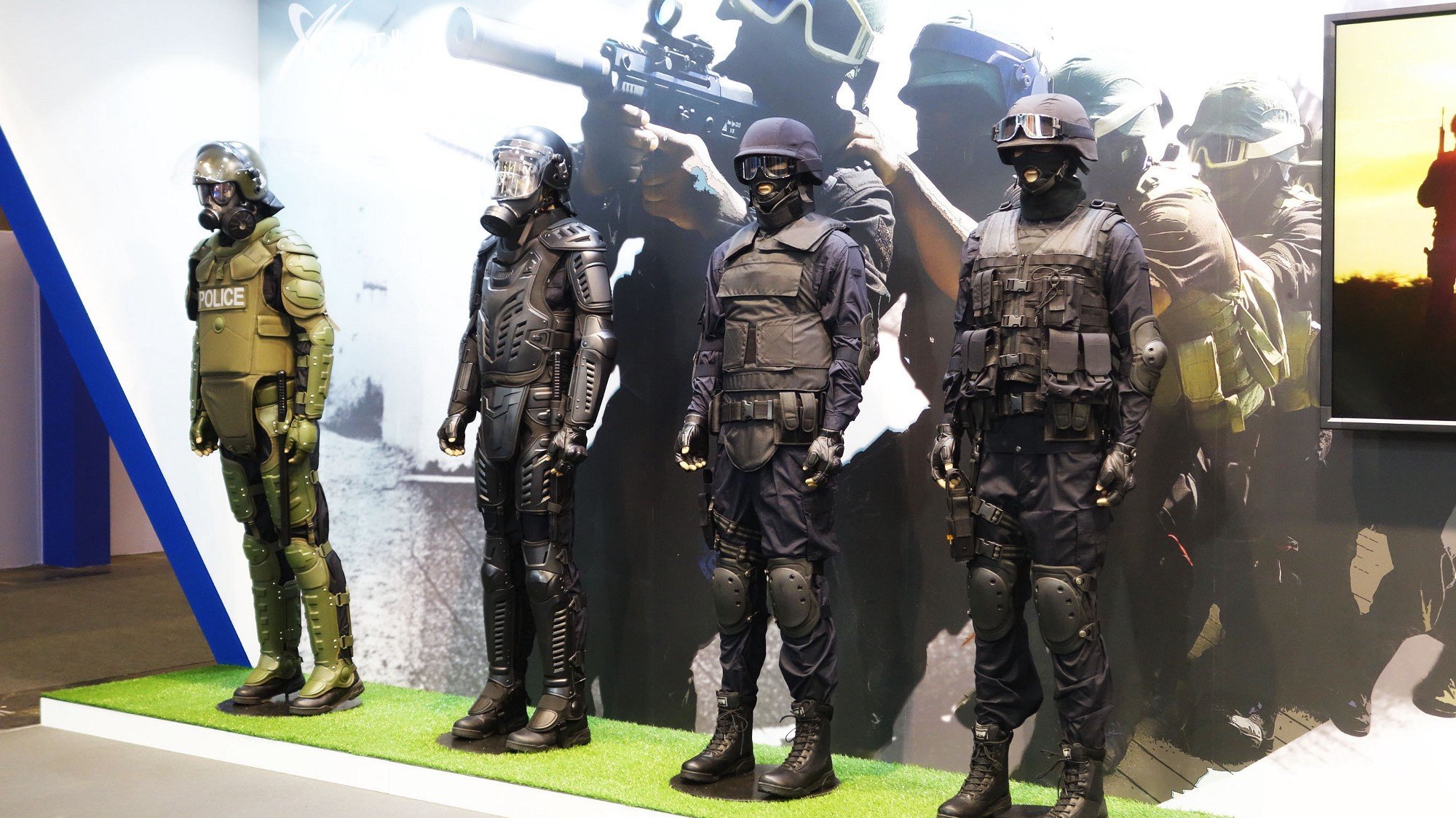
Pictures From Boston Show Militarization Of US Police Forces
Boston Marathon bombing: More justification for repression and endless global war of terror