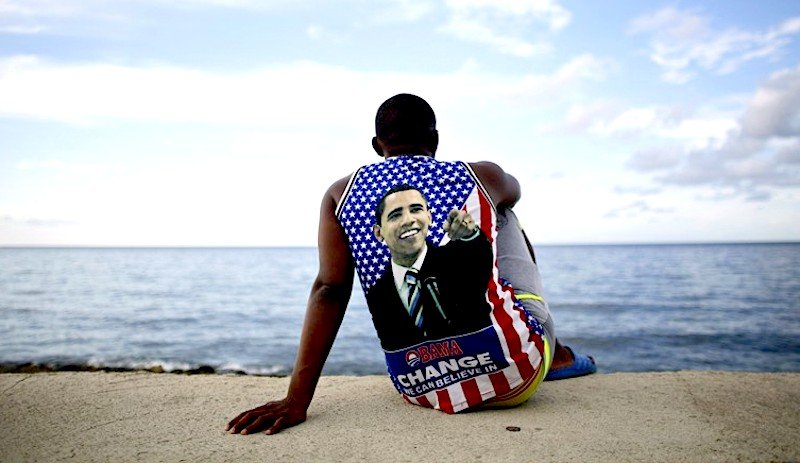
© www.theatlantic.com"I can see Cuba from my beach."
These days, US foreign policy is often contradictory, as we can see in Syria, where troops trained by the Pentagon are fighting troops trained by the CIA. And yet it remains perfectly
coherent on two points - to divide Europe between the European Union on one side and Russia on the other - and to divide the Far East between the Association of Southeast Asian Nations on one side and China on the other. Why? And can this be predicted?
For more than a century, in an attempt to explain and therefore anticipate US foreign policy, we have been visualising a
struggle between the isolationists and the interventionists. The former adopted the line of the
Pilgrim Fathers, who fled old Europe to build a new world based on their religious beliefs, and therefore distant from European cynicism. The latter, in the tradition of certain of the
Founding Fathers, intended not only to seize their independence, but also to pursue the project of the British Empire for their own benefit.
Today, this distinction has lost almost all validity, since it has become
impossible to live in autarchy, even for a country as vast as the United States. Although it has become commonplace to accuse one's political adversaries of isolationism, no US politician - with the
exception of Ron Paul - now defends such an idea.
The debate has shifted to a confrontation between the partisans of perpetual war and the adepts of a more measured use of force. If we are to believe the work of professors Martin Gilens and Benjamin I. Page, the
present policy of the United States is decided by a collection of interest groups, independent of the desires of its citizens. In this debate, therefore, it is legitimate to note the influence, on the one hand, of the
military-industrial complex, which dominates the US economy and whose interest is to pursue a state of "endless war" - and, on the other, the
toll companies (software, high-tech, entertainment) who, although their production is more virtual than real, make their money wherever the world is at peace.









Comment: See also: