Puppet MastersS


Vader

US trying to downplay Chinese anger over spy planes flying over South China Sea

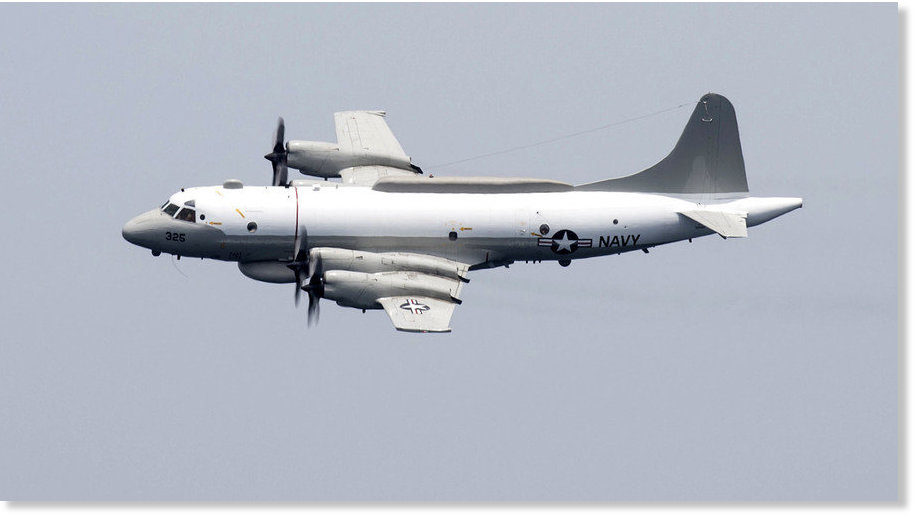
navy spy plane
© The United States Navy / Wikipedia
The White House is trying to defuse a row with Beijing since claiming its jets intercepted a US surveillance plane over the South China Sea at an "unsafe" distance. China has rejected the accusations and called on the US to stop spying near its territory.

"Over the course of the last year, the Department of Defense has seen improvements in the way that Chinese military pilots fly, consistent with the international guidelines and consistent with the way that aircraft can be operated in a safe and professional manner," said White House press secretary Josh Earnest, when questioned about the incident on Tuesday.

The Pentagon claimed earlier that China's J-11 Shenyang fighter planes had flown within 50 feet of a Navy EP-3 Orion surveillance plane on a routine mission over international waters on Tuesday.

Earnest refrained from finger-pointing, however.

"So there is a well-established diplomatic and military channel to work through these kinds of concerns. Presumably, in those channels, the Chinese officials can explain their perspective and what exactly occurred," he told the press corps in Washington.


Comment: The White House press secretary must not read well, as the Chinese issued a rather clear statement explaining their perspective on this issue.

Bomb

Former NATO commander declares nuclear war 'entirely possible' with Russia

Nuclear Blast
© Crisis HQ
It is not only American generals who are irresponsible and declare on the basis of no evidence whatsoever that "Russia is an existential threat to the United States" and also to the Baltic states, Poland, Georgia, Ukraine, and all of Europe. British generals also participate in the warmongering. UK retired general and former NATO commander Sir Richard Shirreff, Deputy Supreme Allied Commander in Europe until 2014, has just declared that nuclear war with Russia is "entirely possible" within the year.

My loyal readers know that I, myself, have been warning for some time about the likelihood of nuclear war. However, there is a vast difference between me and the Western generals. I see the war as the consequence of the neoconservative drive for US world hegemony. The neoconservative drive for world hegemony is acknowledged by the neoconservatives themselves in their public position papers, and it has a 15 year record of being implemented in America's many and ongoing wars in the Middle East and Africa. Although the Presstitute media does its best to keep our focus away from the known facts, the facts remain known.

The position of the Western generals is that "Russian aggression" is driving an innocent America/NATO to nuclear war.

Here is General Shirreff's list of "Russian aggressions": "He [Putin] has invaded Georgia, he has invaded the Crimea, he has invaded Ukraine. He has used force and got away with it. In a period of tension, an attack on the Baltic states... is entirely plausible." Shirreff is talking about make-believe happenings that even if real would be taking place inside what were until recently Russia's long-standing national boundaries.

General Shirreff strikes me as either uninformed or a dissembler. It is the United States and Israel who use force and get away with it. The Russian invasion of the former Russian province, Georgia, was a response to the American puppet government's invasion of South Ossetia in which the American and Israeli trained and equipped Georgian troops killed Russian peace-keeping troops and a large number of South Ossetian civilians while the Russian government was at the Beijing Olympics.

Bad Guys

Ruling South African ANC party accuses UK of plotting regime change

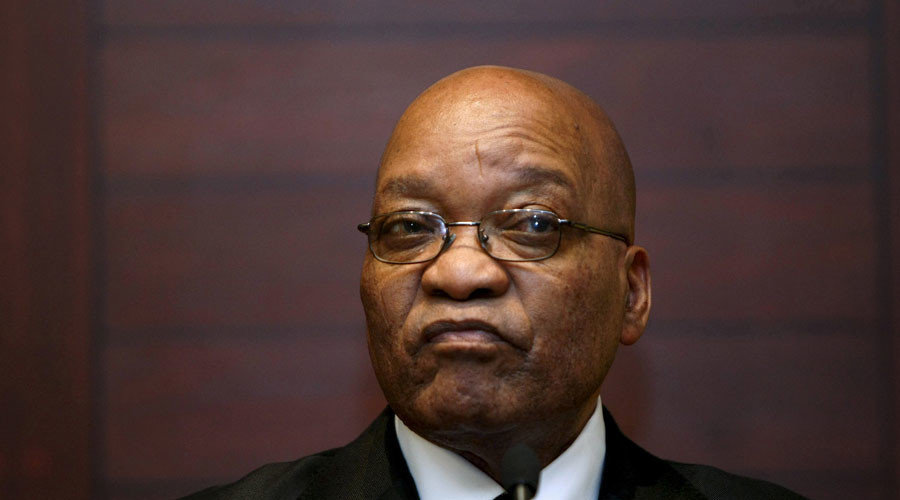
Zuma
© Mike Hutchings / ReutersSouth African President Jacob Zuma
Britain has denied it wants to overthrow South African President Jacob Zuma, following claims by an African National Congress (ANC) spokesperson. Reports suggest the UK military is seeking to prop up the country's ruling party.

The denial came after Vice News reported the UK has drawn up a secret report on how to keep the ANC in power in the August local elections.

Responding to the report, ANC spokesperson Zizi Kodwa claimed the UK is trying to distract South Africans from the "real story" - that Britain is working with the US to overthrow the president.

A spokesperson for the UK Foreign Office said: "The British government does not interfere in democratic electoral processes in other countries."


Comment: LOL.


Vice News revealed what it said were the Ministry of Defence (MoD) plans on May 16.

Comment: More background on why the conniving Brits are so interested in South Africa: Brazil, Venezuela, South Africa threatened by CIA soft coups


Che Guevara

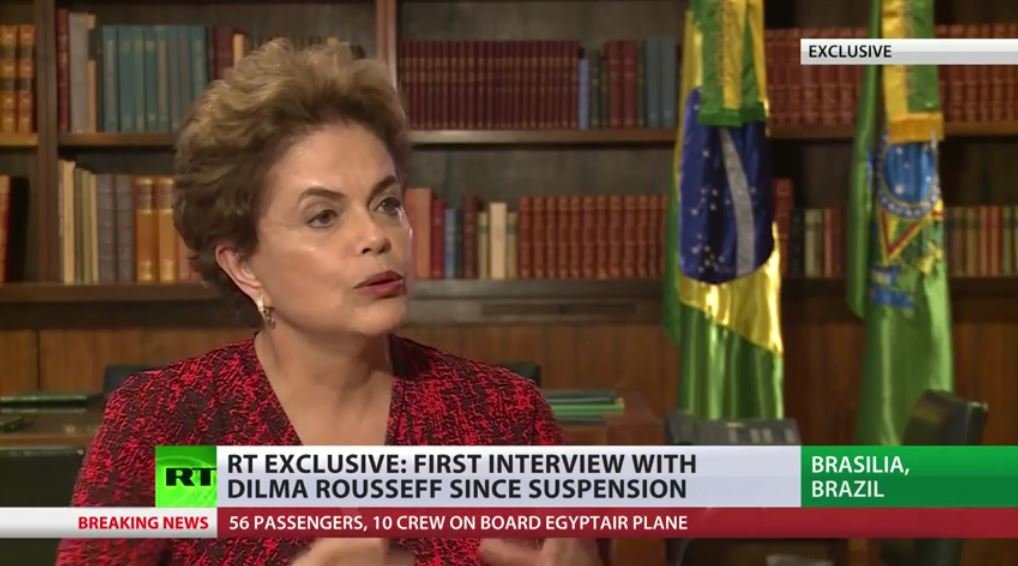
Best of the Web: Rousseff on RT, first interview since impeachment: 'Brazilian oligarchy is behind coup'

Rousseff
© RT
Brazilian President Dilma Rousseff talked with RT Spanish in her first exclusive interview since being suspended due to impeachment, which she calls a coup. Rousseff shared her surprise at the media bias in favor of those trying to remove her, who include her former political allies.

"The media here in Brazil have been highly critical when it comes to me, my government and our allies... But they suddenly tend to favor the interim government, and avoid criticizing it - despite the peculiar situation that has arisen," Rousseff told RT.

The liberalization of the media has been a hot topic of debate in Brazil, Rousseff said.

"We don't want to control anyone or influence anyone's position. We are against media oligopoly, which would keep all the power in the hands of the few families."

This kind of media rule would destabilize Brazil's democracy and "we are actually seeing that happen now," she said.

Rousseff compared the proceedings against her and her government to "blackmail," saying that the acting government is dominated by neoliberal policies and has ties with Brazilian oligarchs.

She also vowed to fight impeachment by all means available.

Stock Down

World central banks selling off U.S. debt at highest levels since 1978

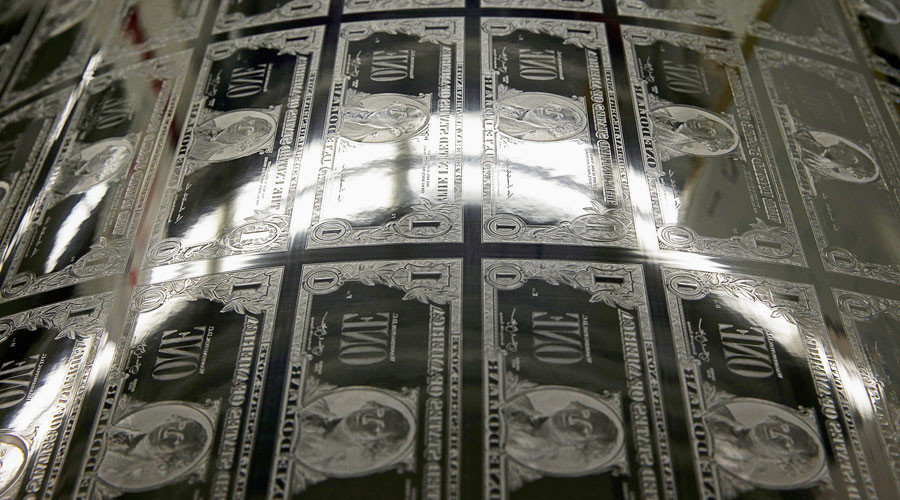
money plate
© Gary Cameron / Reuters
In March, central banks from around the world dumped $17 billion in American Treasuries. Since the beginning of the year the sell-off has reached $123 billion, which is the quickest pace since 1978.

China sold $7.7 billion in US debt in March, lowering its holding by $26.4 billion since last June. Russia dumped $1.6 billion, while Brazil sold almost $1 billion.

"It's more of a global fear than anything. There's still this fear of everything is going to fall apart," Ihab Salib, head of international fixed income at Federated Investors told CNN.

However, overall investment in US government bonds increased by almost $51 billion, reaching $6,287 trillion.

Comment: Further reading:
The numbers don't add up: Treasury Dept claims Ireland is America's fourth-largest creditor, while Saudi Arabia holds relatively small amount of US debt


Bad Guys

SOTT Exclusive: Ex-NATO general writes fiction about Russian nuclear threat, tries to pretend he's serious

shireff
General Sir Richard Shirreff, NATO's Deputy Supreme Allied Commander in Europe between 2011 and 2014, has a new piece of fiction out: 2017 War with Russia. I know what you must be thinking, "What, another bogus think-tank report pulling a menacing Russian threat out of thin air?" No, this is actually a real, old fashioned novel. But that hasn't stopped Shirreff from claiming that the events he fantasizes about - namely, an Russian attack on the Baltic nations followed by all-out nuclear war when 'murica comes to the rescue - are "entirely plausible".

The brave general sir should be commended for stepping up to the time-honored tradition and thankless task of warning the world of entirely fictional dangers. Without people like him, where would we be? (Actually, don't think about that. It might hurt his book sales.) But don't worry, free world, for the great Sir Shirreff has the solution: in order to avert the "potential catastrophe" of nuclear war, NATO must only increase its defensive capabilities in the Baltics. Wow, it's so simple! Someone give this man a Nobel Peace Prize.

Blue Planet

What is multipolarity? The indicators for which nations are trying to build a better world

multipolarity

Comment: In Part 1 of a new series, Katehon's Andrew Korybko breaks down what exactly it means to be a multipolar state, and the key factors that can be looked at to determine which nations align with which end of the unipolar-multipolar spectrum.


Contemporary global politics is marked by the struggle of multipolar forces to balance International Relations at the same time as the existing unipolar ones are aggressively resisting and fighting to retain their hegemony. The consequence of these dueling world views and their fierce multi-spectral competition is the global instability that's come to characterize the modern day and usher in the start of the New Cold War. Whether it's the War on Syria, the War on Currency, or the War on BRICS, the US is pulling out all the stops in offsetting the rise of multipolarity and safeguarding the unipolar world order that it's constructed since the end of the Old Cold War. Hybrid Wars, both their regular economic & informational iterations and their irregular regime change one, are becoming the modus operandi in waging a series of incessant asymmetrical battles across all fronts.

The scope of what's happening is unprecedented in history and can be overwhelming for even the most zealous analysts to follow, let alone the passive observer, so what's needed in order to make sense of this all and simplify the various processes that are underway is a solid definition of what exactly constitutes multipolarity. The topic of study is rich with detail and impossible to comprehensively cover even in the scope of this book-length series, but the purpose is to instill the reader with a broad understanding of the differences between unipolarity and multipolarity. From this foundational cornerstone of meaning, individuals can then categorize countries into one or the other camp, which in turn more easily allows them to identify whether an examined event is more favorable to the world's unipolar or multipolar forces. Sometimes it's very difficult to classify a country or event into either of these binary groups, but in that case it just confirms that the said subject of study is the source of fierce competition between the two sides and a focal point of the New Cold War.

Vader

The Imperial Empire: The sun never sets but the Empire is still blind

US empire American imperialism
© The Hawaii Independent
Post-colonial empires are complex organizations. They are organized on a multi-tiered basis, ranging from relative autonomous national and regional allies to subservient vassal states, with variations in between.

In the contemporary period, the idea of empire does not operate as a stable global structure, though it may aspire and strive for such. While the US is the major imperial power, it does not dominate some leading global political-economic and military powers, like Russia and China.

Imperial powers, like the US, have well-established regional satellites but have also suffered setbacks and retreats from independent local economic and political challengers.

Empire is not a fixed structure rigidly embedded in military or economic institutions. It contains sets of competing forces and relations, which can change over time and circumstances. Moreover, imperial allies and clients do not operate through fixed patterns of submission. While there is submission to general agreements on ideology, military doctrine and economic policy identified with imperial rulers, there are cases of vassal states pursuing their own links with non-imperial markets, investors and exporters.

If the global world of imperial power is complex and indeterminate to some degree, so is the internal political, economic, administrative and military structure of the imperial state. The imperial political apparatus has become more heavily weighted on the side of security institutions, than diplomatic and representative bodies. Economic institutions are organized for overseas markets dominated by multi-national corporations against local markets and producers. 'Market economy' is a misnomer.

Red Flag

The collapse of mainstream media as source of reliable information creates a danger for the entire world

Krauthammer
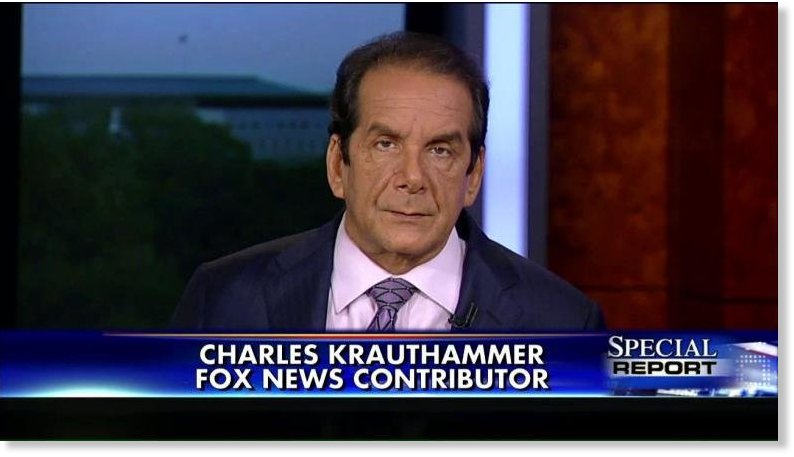
Neocon cranks like Krauthammer have made mainstream media a joke when it comes to foreign policy
Does any intelligent person look at a New York Times article about Russia or Vladimir Putin these days and expect to read an objective, balanced account? Or will it be laced with a predictable blend of contempt and ridicule? And is it any different at The Washington Post, NPR, MSNBC, CNN or almost any mainstream U.S. news outlet?

And it's not just Russia. The same trend holds true for Iran, Syria, Venezuela, Nicaragua and other countries and movements that have fallen onto the U.S. government's "enemies list." We saw the same pattern with Saddam Hussein and Iraq before the 2003 U.S. invasion; with Muammar Gaddafi and Libya before the U.S.-orchestrated bombing campaign in 2011; and with President Viktor Yanukovych and Ukraine before the U.S.-backed coup in 2014.

That is not to say that these countries and leaders don't deserve criticism; they do. But the proper role of the press corps - at least as I was taught during my early years at The Associated Press - was to treat all evidence objectively and all sides fairly. Just because you might not like someone doesn't mean your feelings should show through or the facts should be forced through a prism of bias.

In those "old days," that sort of behavior was deemed unprofessional and you would expect a senior editor to come down hard on you. Now, however, it seems that you'd only get punished if you quoted some dissident or allowed such a person onto an op-ed page or a talk show, someone who didn't share Official Washington's "group think" about the "enemy." Deviation from "group think" has become the real disqualifier.

Light Sabers

Russia calls out US over regime change tactics in Latin America

brazil protest
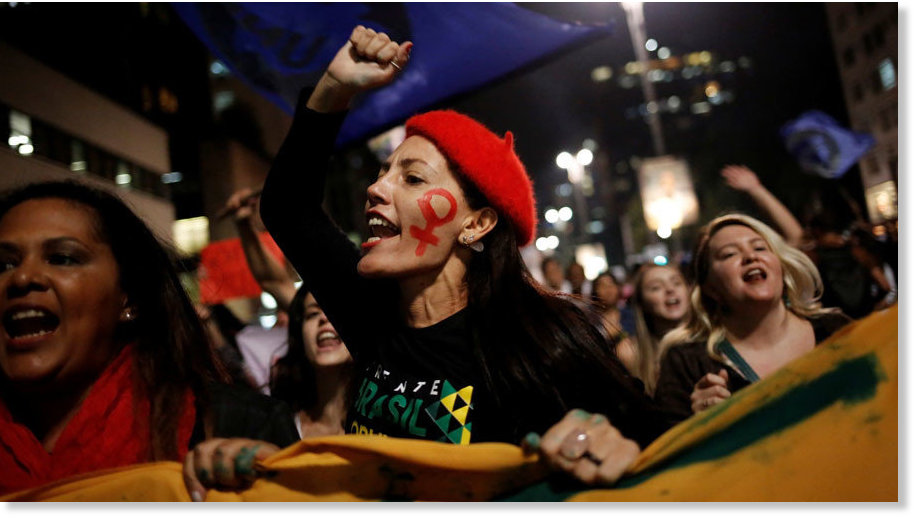
© Nacho Doce / ReutersWomen shout slogans during a protest against Brazil's interim President Michel Temer and in support of suspended President Dilma Rousseff at Paulista Avenue in Sao Paulo, Brazil, May 17, 2016
A Russian diplomatic call to outlaw the US-sponsored policy of "regime change" is timelier than ever following recent events in Latin America.

The developments there are now routinely described as 'institutional' coups d'état, with popular presidents removed from power and replaced by neoliberal functionaries, enjoying almost unhidden support of the US government and American financial capital.

"What we see in the world now is an attempt by the so-called historic West to preserve its dominance in international affairs," Russian Deputy Foreign Minister Sergey Ryabkov said at a conference on Latin American development, held in Moscow. "Latin America is not an exception to this global trend. We see attempts by the United States to interfere directly into the internal affairs of some countries in the region... Argentina, Brazil, Venezuela are just the most recent examples."

Last week, Brazil's leftist President Dilma Rousseff was removed from power by a very unpopular group of senators, despite having the votes of 54 million citizens, who expressed their will a year and a half ago. Rousseff was removed because of accusations of corruption. However, even the mainstream media in the United States did not consider these accusations to be well founded.