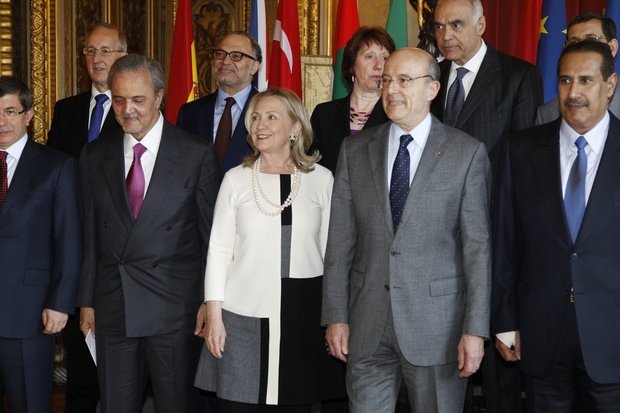
© Agence France-PresseThen US Secretary of State Hillary Clinton (2ndR) talks to Saudi Arabia's Foreign Minister Prince Saud al-Faisal, next to France's Foreign Affairs minister Alain Juppe (R) and Qatar's Prime Minister and Minister of Foreign Affairs Sheikh Hamad bin Jassim al-Thani (L) during a meeting with Western and Arab foreign ministers at the ministry of Foreign Affairs in Paris, on 19 April 2012, focused on the Syria crisis
The main criticism of US policy in Syria has long been that President Barack Obama should have used US military force or more aggressive arms aid to strengthen the armed opposition to Assad.
The easy answer is that the whole idea that there was a viable non-extremist force to be strengthened is a myth - albeit one that certain political figures in London and Washington refuse to give up.
But
the question that should have been debated is why the Obama administration acquiesced to its allies funding and supplying a group of unsavoury sectarian armed groups to overthrow the Assad regime.That US acquiescence is largely responsible for a horrible bloodletting that has now killed as many as 400,000 Syrians. Worse yet, there is still no way to end the war without the serious threat of sectarian retribution against the losers.
"The Obama administration bears responsibility for this atrocity, because
it could have prevented Turkey, Qatar and Saudi Arabia from launching their foolishly adventurous war in Syria. None of them did so out of desperate need;
it was a war of choice in every case. And each of the three states is part of the US security system in the Middle East, providing military bases to NATO or to the United States and depending on US support for its security.
But instead of insisting that those three Sunni allies reconsider their options, the Obama administration gave the green light at a conference in Riyadh at the end of March 2012 for proceeding with arming those who wanted to replace the regime, leaving the United States ostensibly free to be a peacemaker. As Hillary Clinton put it at the Riyadh conference: "Some will be able to do certain things, and others will do other things."











Comment: The Empire has tried to harness the forces of chaos to do its bidding. That tactic is now blowing up in its face.
General Wesley Clark reveals 2001 U.S. plan to conduct 'regime change' in Iraq, Syria, Lebanon, Libya, Somalia, Sudan and Iran