Puppet MastersS


Bomb

'It's different': US justifies Saudi 'self-defense' in Yemen, slams Russia's actions in Syria

Naif Rahma/Reuters
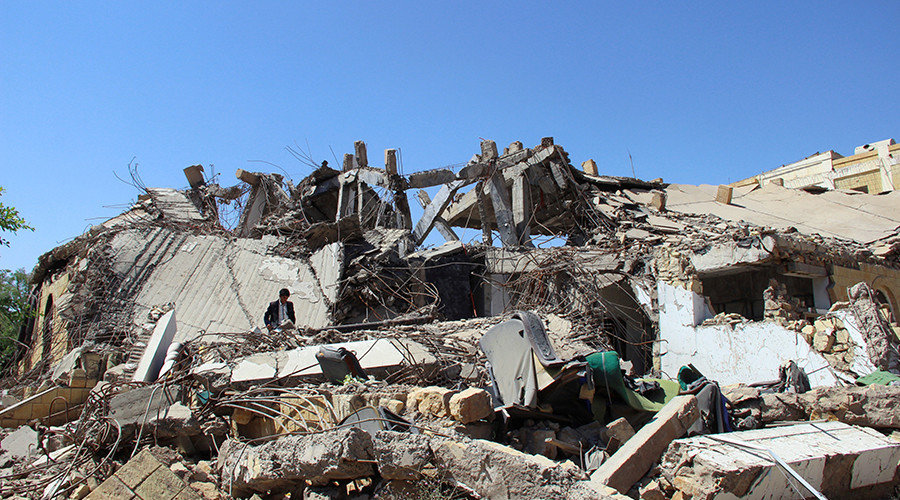
© Naif Rahma/ReutersA man walks on the rubble of a municipal board building after it was destroyed by Saudi-led air strikes in the northwestern city of Saada, Yemen
The US says Saudi Arabia's bombing of Yemen was an act of "self-defense" against Iranian missiles on its border. While there are similarities with the Syrian conflict, Washington sees "differences" between the deaths of over 150 civilians, blamed on Riyadh, and the situation in Aleppo.

"It is different," the State Department's John Kirby has told AP's Matt Lee, when asked whether Capitol Hill sees a difference between the recent attack in Yemen and "what you accuse the Russians and the Syrians and the Iranians of doing in Syria, particularly Aleppo?"

The question specifically referred to an airstrike that targeted a funeral service in the Yemeni capital, Sana'a, killing more than 150 civilians and injuring over 525.

Located on opposite sides of Saudi Arabia, Yemen and Syria bear few similarities, but have one thing in common: a civil conflict between their governments and rebels, which later evolved into larger-scale wars, with the intervention of foreign forces. However, the rules of the game appear to be different for each case.

Comment: See: SOTT Exclusive: Funeral massacre in Yemen: Houthis blame U.S., mobilize to original Islamic State Saudi Arabia's border - UPDATE


Binoculars

Sarkozy blasts 'irresponsible' Hollande after Putin cancels visit

French President Francois Hollande and Former French President Nicolas Sarkozy
© ReutersFrench President Francois Hollande and Former French President Nicolas Sarkozy
Former French President Nicolas Sarkozy has joined a chorus of French politicians sharply criticizing the incumbent Francois Hollande for escalating tensions with Russia, following Vladimir Putin's decision to cancel a diplomatic visit.

Laptop

Leaked email reveals evidence that State Dept. probably never intended to charge Clinton

podesta
One of Hillary Clinton's top aides, attorney Heather Samuelson — one of the lawyers who scanned the notorious emails to ostensibly separate the personal from those considered work-related — appears, a newly disclosed email shows, to have been acting in concert with the State Department during that investigation, showing further evidence of possible collusion.

Wikileaks' release of documents from Clinton campaign chair John Podesta thus continues to deliver damning evidence calling into question the former secretary of state's integrity — as well as her suitability for the White House.

Dated March 17, 2015, originating from Samuelson, with the subject marked "JW FOIA | WJC Speeches," referencing the Freedom of Information Act request by Judicial Watch and William (Bill) Jefferson Clinton, a newly revealed email shows near certain evidence the aide was in close contact with people inside the Department of State (DOS) — during the investigation of the private email server.

To Maura Pally, senior vice president of programs with the Clinton Foundation; Craig Minassian, Clinton Foundation Chief Communications Officer; Philippe Reines, one of Clinton's press secretaries who worked under her at the State Department; Nick Merrill, another Clinton press secretary who worked at State; and Jennifer Palmieri, White House communications director at the time, Samuelson wrote:

Comment: See: The Podesta Emails: New Wikileaks documents reveal media collusion with the Clinton campaign


Bullseye

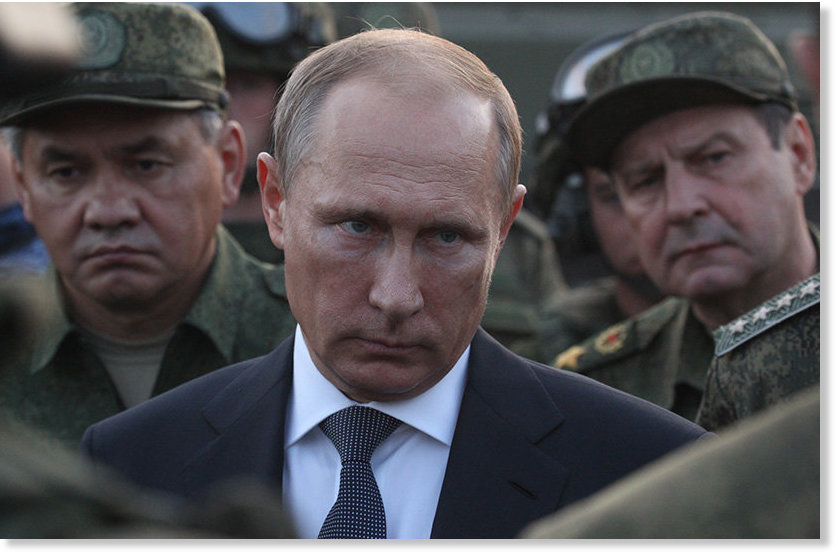
Russia weighs its options against a US attack on Syria, sets bold new conditions for dealings with Empire

putinpissed
The tensions between Russia and the USA have reached an unprecedented level. I fully agree with the participants of this CrossTalk show - the situation is even worse and more dangerous than during the Cuban Missile Crisis. Both sides are now going to the so-called "Plan B" which, simply put, stand for, at best, no negotiations and, at worst, a war between Russia and the USA.

The key thing to understand in the Russian stance in this, an other, recent conflicts with the USA is that Russia is still much weaker than the USA and that she therefore does not want war. That does not, however, mean that she is not actively preparing for war. In fact, she very much and actively does. All this means is that should a conflict occur, Russia you try, as best can be, to keep it as limited as possible.

In theory, these are, very roughly, the possible levels of confrontation:
  1. A military standoff à la Berlin in 1961. One could argue that this is what is already taking place right now, albeit in a more long-distance and less visible way.
  2. A single military incident, such as what happened recently when Turkey shot down a Russian SU-24 and Russia chose not to retaliate.
  3. A series of localized clashes similar to what is currently happening between India and Pakistan.
  4. A conflict limited to the Syrian theater of war (say like the war between the UK and Argentina over the Malvinas Islands).
  5. A regional or global military confrontation between the USA and Russia.
  6. A full scale thermonuclear war between the USA and Russia

Comment: Read why the latter is unlikely to happen: Russia Checkmates US in Syria: Expect More Terrorism, Not Nuclear War


Comment: See also: The U.S. hits back after Putin's stunning, heroic humiliation


2 + 2 = 4

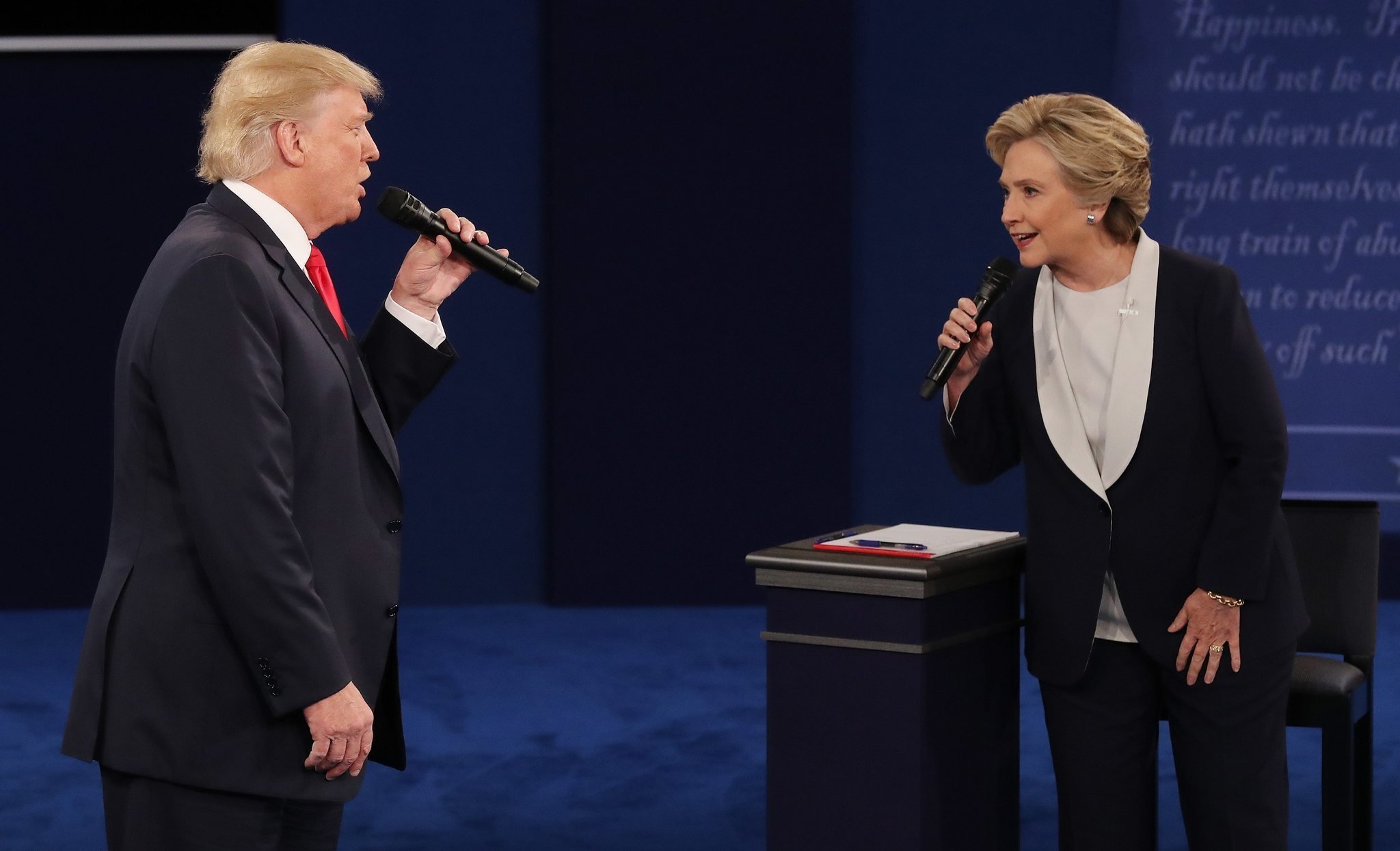
Break-down of the second 'presidential' debate. Trump takes off shackles, delivers well deserved blows to Killary

trump clinton debate
As senior members of his own party were deserting him, Donald Trump found his footing in his rematch debate with Hillary Clinton on Sunday night, blasting her for "always" blaming Russia even without evidence and for backing rebels who turn out "worse" than the leaders the U.S. overthrows. He even disavowed his own running mate' for supporting war with Syria.

Just before the debate 16 Republican senators withdrew their support for Trump because of the emergence of a tape on Friday in which Trump is heard making obscene remarks about unnamed women. It was all the U.S. corporate media could talk about and Trump was facing calls from with his party to step down.

Instead he stepped up. The town hall style debate at a Missouri university allowed Trump to move aggressively around the stage as he hurled invectives at his opponent. Clinton, who was on the defensive most of the night, tried to counter-attack on taxes, Russia, Syria and the scandal of the day, his treatment of women. But she seemed unnerved by Trump, expecting instead a defeated man who had performed so badly in the first debate after taking her bait, and who should now have been on the ropes.

Being against the whole word—the Democrats, the media and even his own party—seems to invigorate the totally unorthodox Trump. He felt confident enough to blithely disagree with his running mate, Gov. Mike Pence of Indiana. In the vice presidential debate last week, Pence backed U.S. military attacks on the Syrian government and launched the most virulent criticism of Russia by any candidate in this campaign. Trump said he simply didn't agree with his running mate, something probably never said before publicly by a modern presidential candidate.

Comment: Maybe Jerry Springer can host the next debate. He'd probably do a better job than the deplorables who aggressively showed their hand during the debate:


MIB

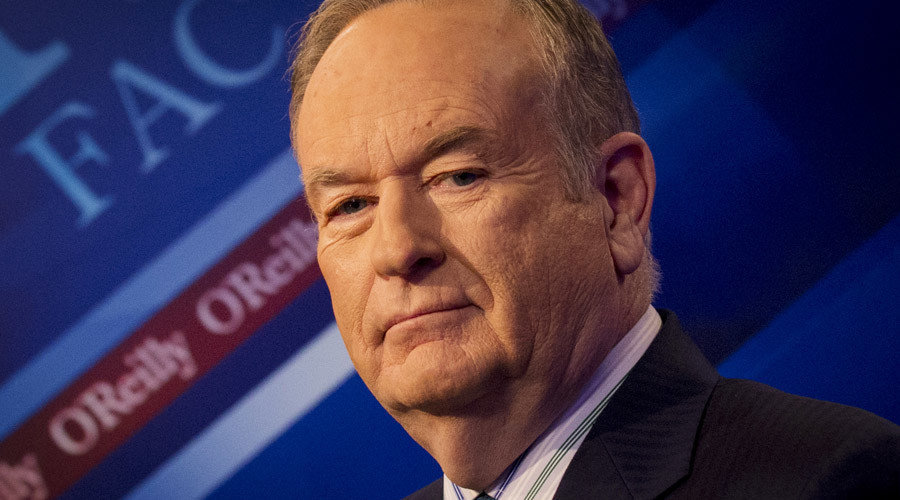
Bill O'Reilly: Media conglomerates have "ordered employees to destroy Trump"

Bill O'Reilly
© Brendan McDermid / Reuters
At least three media organizations have "ordered their employees to destroy Donald Trump," Bill O'Reilly said this morning.

Sitting down with Bill Hemmer to analyze last night's second debate between Trump and Hillary Clinton, O'Reilly said he's "100 percent convinced" of the media plot against Trump.

"I'm talking about big conglomerates. ... News organizations have sent, not officially but through the corporate grapevine, [word] that we don't want anybody supporting Trump. If you study it, you can see which ones they are," he said.

O'Reilly said the first 30 minutes were crucial for Trump after the 2005 hot mic comments about groping women's genitals surfaced on Friday.

"That was the key to Donald Trump's life. Not just the presidential race, his life. If he had faltered in those first 30 minutes, his brand was done, he was done and the election was over and everything. But he didn't falter. He took what came at him and he turned it into at least a stalemate," said O'Reilly, calling that portion a "huge win" for Trump.

He said Trump was then able to go on offense for much of the final hour, "sometimes effectively, sometimes not."

Watch the clip above and more from Bill and Charles Krauthammer, here.

Comment: You know things are getting out of control when Bill O'Reilly says something that resembles the truth.


Snakes in Suits

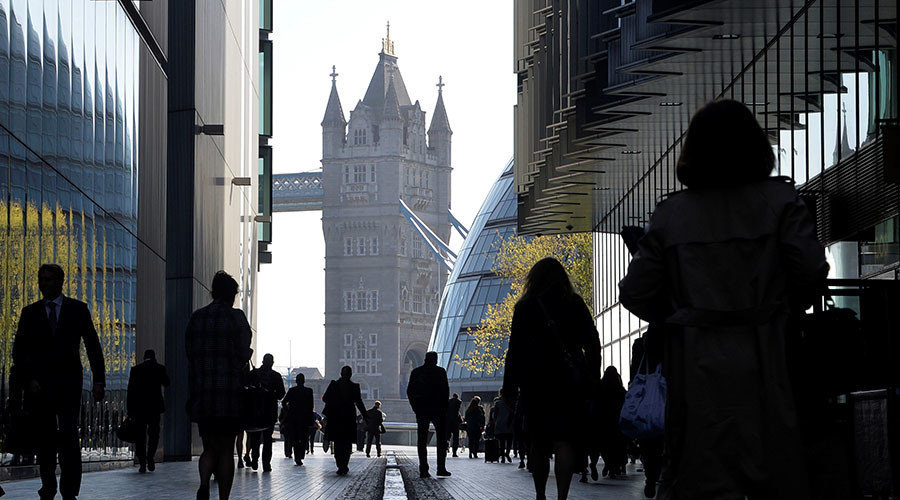
More doom and chaos: Leaked govt. papers claims 'hard Brexit' could lead Britain to lose up to 9.5% of GDP

London street
© Toby Melville / Reuters
A 'hard Brexit' could cost the UK Treasury up to £66 billion in tax revenues each year, according to leaked government papers seen by The Times. The documents also estimate a drop in GDP of up to 9.5 percent, compared with staying in the EU.

The draft cabinet committee paper is based on a Treasury study into the predicted impact of leaving the EU, which was commissioned by Conservative MP George Osborne during the referendum campaign in April.

A 'hard Brexit' would see the UK leave the single market and switch to World Trade Organization (WTO) rules - a move which would cause gross domestic product (GDP) to decline by up to 9.5 percent, according to the document.

"The Treasury estimates that UK GDP would be between 5.4% and 9.5% of GDP lower after 15 years if we left the EU with no successor arrangement, with a central estimate of 7.5%," the paper reads.

Clipboard

Petition calling for the halt to THAAD deployment in S. Korea rejected by WH

THAAD anti-missile
© Handout / Reuters
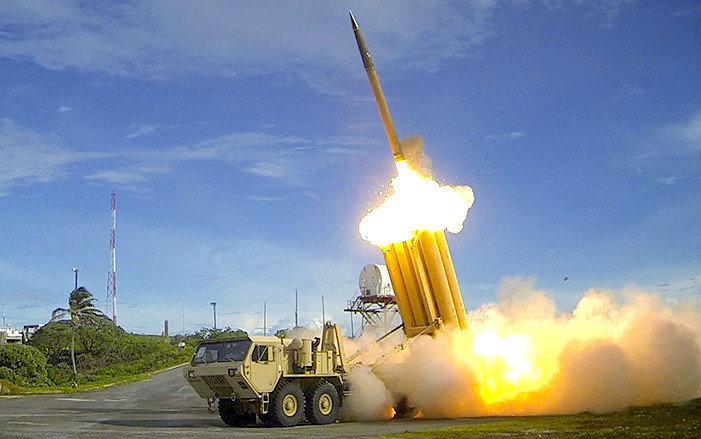
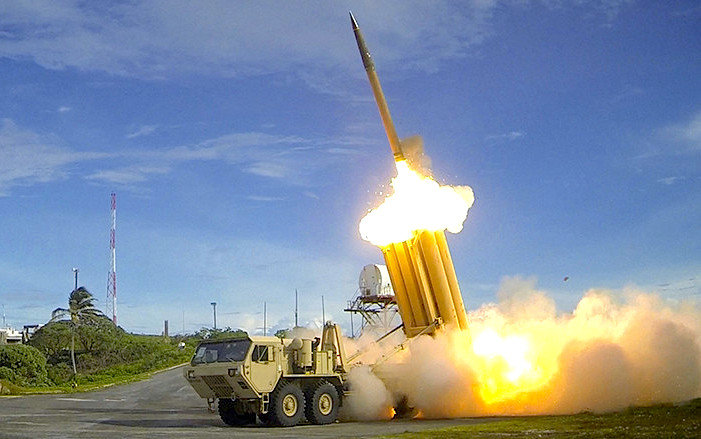
The White House has rejected a public petition demanding the US reverse its decision to deploy the THAAD anti-missile system on the Korean Peninsula. The move will "not undermine China's or Russia's strategic deterrent," the administration emphasized.

When Washington and Seoul formalized plans to deploy US' THAAD (Terminal High Altitude Air Defense) system in South Korea back in July, a group of activists started an online 'We the People' petition asking the Obama administration to reconsider its policy. Deployment of the system, activists argued, would "escalate tension in the region, by provoking North Korea, China, and Russia into a spiraling arms race in the region that is already heavily militarized with weapons of mass destruction." In its response to the appeal, signed by more than 100,000 petitioners, the White House rejected the plea citing security concerns surrounding the North Korean nuclear program.

In September, North Korea confirmed it had conducted its fifth nuclear test, announcing it was capable of mounting nuclear warheads on ballistic rockets, after conducting multiple missile tests that directly violate UN Security Council resolutions. In light of Pyongyang's actions, the White House defended THAAD's deployment as a means by which to "improve the missile defense posture of the U.S.-[South Korea] alliance" against "North Korea's continued provocations and refusal to engage in serious negotiations on denuclearization."

Brushing aside criticism by China and Russia, Washington said that its hardware in Korea will be "solely" focused on countering the North Korean nuclear and ballistic missile threat. "It will not undermine China's or Russia's strategic deterrent," the statement read. Furthermore, the reply reads, the United States is working to deploy THAAD system "as soon as feasible" to defend US military personnel in South Korea. Late last month Seoul chose a golf course in Seongju as the final resting place for US weapons. South Korea wants to complete the installation by 2017.

Comment: See also:


Snakes in Suits

FBI study states the obvious: US military operations abroad the reason for homegrown terrorism

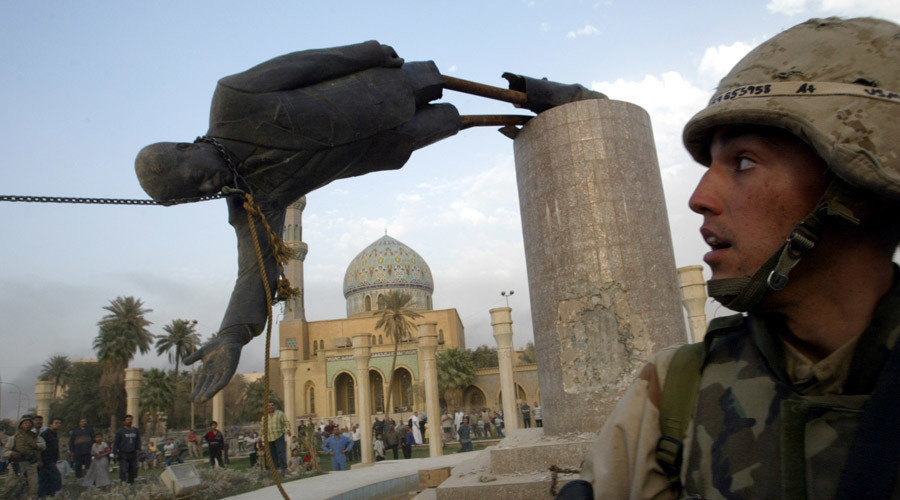
A U.S. soldier watches as a statue of Iraq's President Saddam Hussein falls in central Baghdad, Iraq April 9, 2003
© Goran Tomasevic / Reuters A U.S. soldier watches as a statue of Iraq's President Saddam Hussein falls in central Baghdad, Iraq April 9, 2003.
A secret FBI study found that anger over U.S. military operations abroad was the most commonly cited motivation for individuals involved in cases of "homegrown" terrorism. The report also identified no coherent pattern to "radicalization," concluding that it remained near impossible to predict future violent acts.

The study, reviewed by The Intercept, was conducted in 2012 by a unit in the FBI's counterterrorism division and surveyed intelligence analysts and FBI special agents across the United States who were responsible for nearly 200 cases, both open and closed, involving "homegrown violent extremists." The survey responses reinforced the FBI's conclusion that such individuals "frequently believe the U.S. military is committing atrocities in Muslim countries, thereby justifying their violent aspirations."

Jet5

US war-talk about attacks on Syrian government and military could lead to irreparable, global consequences

manpads
© Reuters
The US media is currently widely reporting that US authorities are seriously considering the possibility of direct intervention in the armed conflict in Syria - on the side of Bashar al-Assad's opponents.

The Washington Post, citing unnamed government officials, reported that one of the measures under consideration is airstrikes on the Syrian Air Force's runways - something that would be conducted 'covertly', thereby (they believe) enabling the US to avoid criticism at the United Nations.

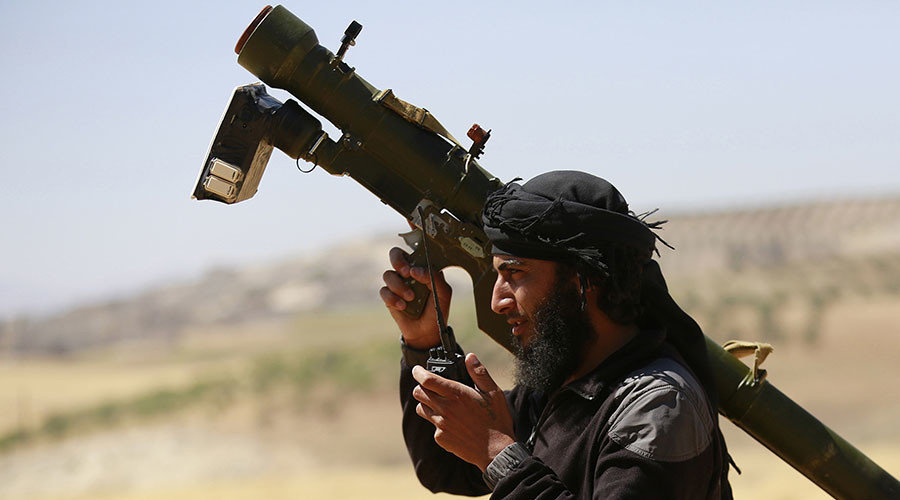
Meanwhile, unnamed Pentagon 'experts' are considering a 'phased plan of action'. The first phase would see the delivery of several dozen modern MANPADS - Made in the USA, of course - to 'moderate' Syrian opposition, beginning with the Free Syrian Army and its affiliate, Free Idlib Army.

As reported by the French portal 'Intelligence Online', a recent closed meeting between the leadership of the General Staff of the Saudi armed forces Turkish, Qatari, UAE and US intelligence in Riyadh resulted in an agreement on the delivery of MANPADS to militants in Syria.

According to Reuters, Free Idlib Army commanders confirmed receiving these heavy arms from Saudi Arabia. In addition, a variety of videos boasting this fact have been published on the Free Syrian Army YouTube channel.