Puppet MastersS


Arrow Up

Iraqi Kurdistan: Parliament to approve independence referendum on September 25

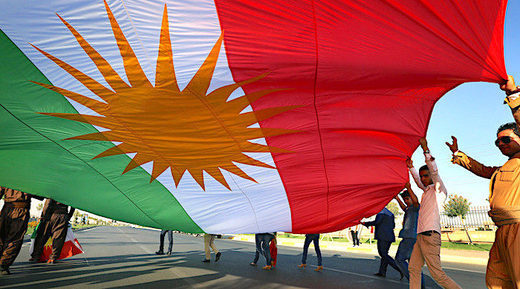
Kurd flag
© Salin Hamed/AFP
Iraqi Kurdistan parliament on Friday passed a law assigning the Kurdistan election body to hold an independence referendum on September 25 in the Kurdistan Region and disputed areas, the Rudaw news agency reported.

The Kurdish parliament holds today an "extraordinary" session, the first in two years.

The legislative body has not convened since October 2015 because of political rivalry between the Kurdish parties.

In June, Masoud Barzani, the president of the Iraqi Kurdistan, set September 25 as the date for an independence referendum. The announced referendum has been widely criticized by a number of countries, including Russia, Turkey, Iran and the United States. While Moscow voiced support for Iraq's unity and territorial integrity, Washington reportedly asked Iraqi Kurdistan's President Masoud Barzani to postpone holding the region's independence referendum. Earlier this week, the Iraqi parliament voted against the Iraqi Kurdistan independence referendum.

The leader of Iraqi Kurdistan Masoud Barzani said Thursday that he might consider the proposal of several Western countries to postpone the planned referendum if a suitable alternative is found.


Comment: Baghdad claims unilateral steps taken by Iraqi Kurdistan for independence violates the country's constitution and the referendum threatens Iraqi and international security. Iraq's constitution recognizes Kurdistan as an autonomous region and is run by the Kurdistan Regional Government.

Comment: Controversy on all sides surrounds this decision to hold the Kurdish referendum. On the one hand, Kurds claim the right to self-determination as, historically, have other 'nations'. However, the Kurds have populations concentrated in several countries and multiple bids for independence will assuredly spur regional chaos that could end badly. The Iraq solution to this problem will set the tone and way forward for all other Kurdish independence bids.

See also: Tillerson allegedly urged Iraqi Kurdistan president to delay independence vote


Network

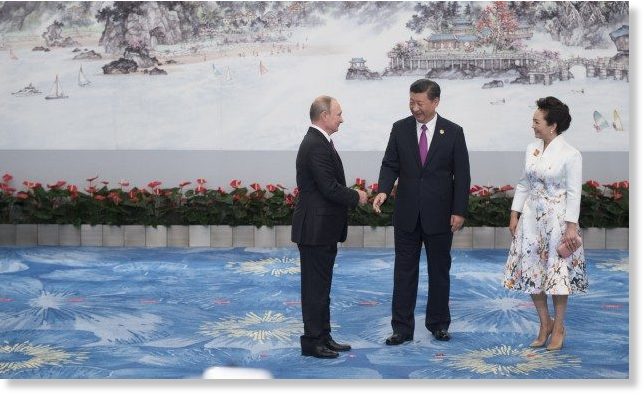
Pepe Escobar: Russia and China's plan for North Korea revolves around stability and connectivity

putin xi
© AFP / Fred DufourChinese President Xi Jinping (centre) and his wife Peng Liyuan welcome Russian President Vladimir Putin ahead of a banquet dinner during the BRICS Summit in Xiamen, Fujian province, on September 4, 2017
The United Nations Security Council's 15-0 vote to impose a new set of sanctions on North Korea somewhat disguises the critical role played by the Russia-China strategic partnership, the "RC" at the core of the BRICS group.

The new sanctions are pretty harsh. They include a 30% reduction on crude and refined oil exports to the DPRK; a ban on exports of natural gas; a ban on all North Korean textile exports (which have brought in US$760 million on average over the past three years); and a worldwide ban on new work permits for DPRK citizens (there are over 90,000 currently working abroad.)

But this is far from what US President Donald Trump's administration was aiming at, according to the draft Security Council resolution leaked last week. That included an asset freeze and travel ban on Kim Jong-un and other designated DPRK officials, and covered additional "WMD-related items," Iraqi sanctions-style. It also authorized UN member states to interdict and inspect North Korean vessels in international waters (which amounts to a declaration of war); and, last but not least, a total oil embargo.

Stormtrooper

Surge redux in Afghanistan - U.S. resolves to repeat failures

US soldiers Afghanistan
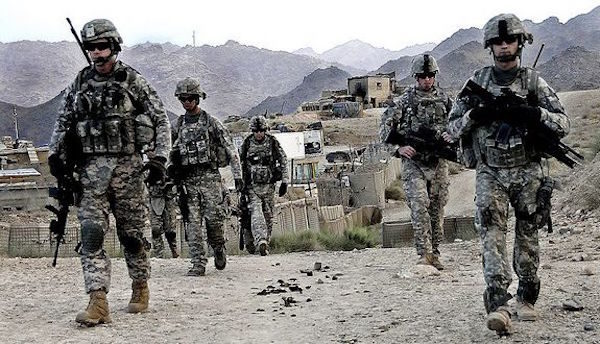
The U.S. military and political leadership is so devoid of learning capability that it does not fight multiyear long wars. Instead it fights one disconnected campaign after the other on the very same battlefield. Each of these campaigns will repeat the mistakes that previous ones made and will have the same outcome.

Thus we have seen several increases in troop numbers in Afghanistan. Each time such a surge happened under Bush, under Obama and now under Trump, the result was an increase in Taliban activity and success.

We have seen the use of local militia forces fail under Obama when these were called Afghan Local Police. The 20,000 men strong ALP was supposedly "trained" to hold land against the Taliban. But the local police groups turned out to be local gangs who, thanks to their "official" status, could rob, rape and kill people without fear of retaliation. The suppressed population then turned to the Taliban for relief.

The idea to create such a local force was so bad that it is time to repeat it:

Pirates

Bipartisan Congress opposes Jeff Sessions, shuts down expansion of Civil Asset Forfeiture

sessions civil forfiture
© The Free Thought Project
Congress actually voted in favor of the American people by approving an amendment to shut down Jeff Sessions's proposed expansion of civil asset forfeiture.

While it is a rare occasion when the group claiming to represent the will of the American people actually votes accordingly, the House of Representatives voted in opposition of Attorney General Jeff Sessions' plan to expand civil asset forfeiture on Tuesday.

The Make America Secure and Prosperous Appropriations Act will now include Amendment 126, which "restricts the use of the federal government's use of adoptive forfeiture." It is co-sponsored by a group of nine bipartisan representatives, including Justin Amash, a Republican from Michigan, and Tulsi Gabbard, a Democrat from Hawaii.

"About to speak on the House floor in support of my amendment to rein in unconstitutional civil asset forfeiture," Amash wrote on Twitter. "We must defend our rights."

Gabbard noted that she co-sponsored the bill because it was "yet another area where AG Sessions must be stopped in his unconstitutional attempts to expand civil asset forfeiture."

Comment: Good news. Civil asset forfeiture has ruined many lives.


Vader

German company HeidelbergCement whitewashes its plunder of Palestinian resources

HeidelbergCement’s Nahal Raba quarry
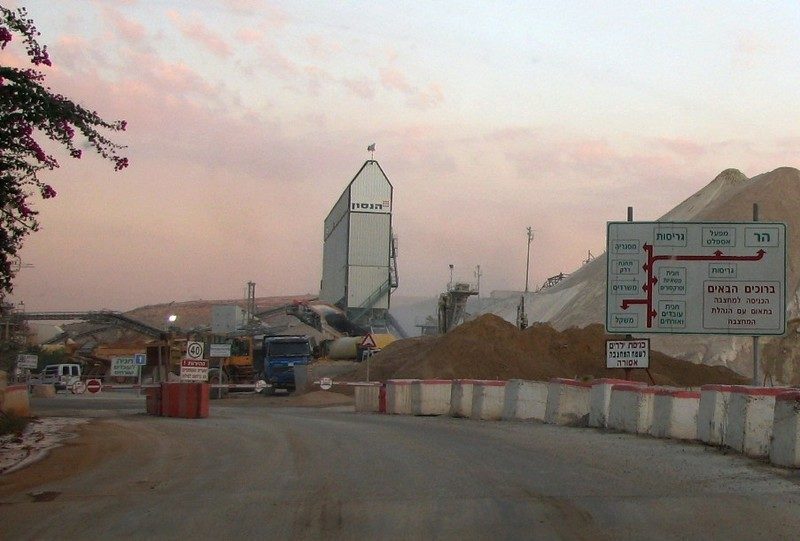
HeidelbergCement’s Nahal Raba quarry in the occupied West Bank plunders Palestinian resources in violation of international law
HeidelbergCement is trying to present its theft of Palestinian natural resources under the cover of Israeli military occupation as a force for good.

For a decade, the German company has operated without permission of the Palestinians a quarry on land stolen from the village of al-Zawiya, in the occupied West Bank.

Israeli authorities gave HeidelbergCement's subsidiary Hanson Israel permission to exploit Nahal Raba, one of a number of Israeli and internationally run quarries in Area C.

Area C is the roughly 60 percent of the West Bank that remains under complete Israeli military control under the terms of the Oslo accords of the early 1990s.

Light Sabers

President Assad sends letter to Iranian leader Ayatollah Khamenei, thanking his country for their assistance and fighting ISIS

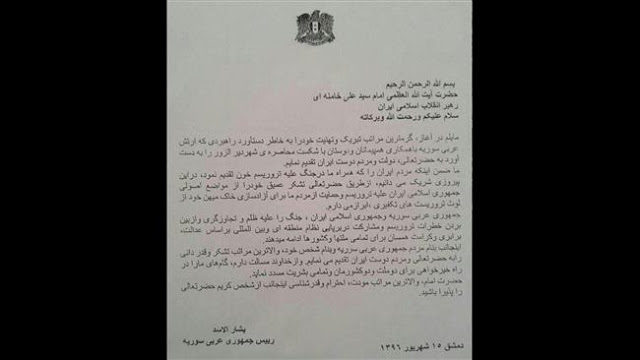
Assad's letter to Iranian leader Khamenei
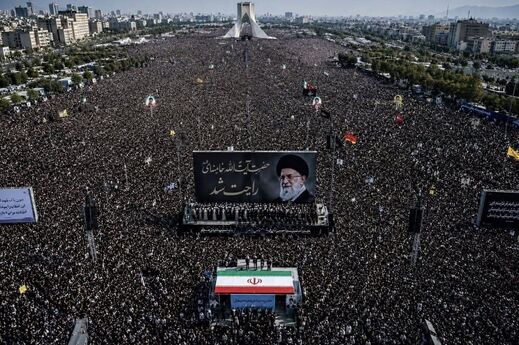
Syrian President Bashar Assad has sent a letter to Leader of the Islamic Revolution, Ayatollah Seyyed Ali Khamenei, thanking him and Iran for their assistance in the war in Syria for helping lift the ISIS-imposed siege on Deir Ezzor.

"In the beginning, I would like to congratulate in the warmest terms Your Excellency and the friendly government and people of Iran on the strategic achievements that the Syrian Arab Army has made with the cooperation of our allies and friends, in breaking the siege on Deir Ezzor city," Assad said in a part of the message.

This comes as only last week pro-Syrian government forces broke the three-year long siege on Deir Ezzor city.

Eye 2

Best of the Web: Who really rules America? The power elite in the time of Trump

deep state
In the last few months, several competing political, economic and military sectors - linked to distinct ideological and ethnic groups - have clearly emerged at the centers of power.

We can identify some of the key competing and interlocking directorates of the power elite:
1. Free marketers, with the ubiquitous presence of the 'Israel First' crowd.

2. National capitalists, linked to rightwing ideologues.

3. Generals, linked to the national security and the Pentagon apparatus, as well as defense industry.

4. Business elites, linked to global capital.
This essay attempts to define the power wielders and evaluate their range of power and its impact.

Bad Guys

'Sense of Congress': Senate Intel slips sentence into bill that could lead to spying on US citizens

Julian Assange
© Frank Augstein APJulian Assange greets supporters outside the Ecuadorian embassy in London, Friday May 19, 2017. Assange fears that if he leaves the embassy, British authorities will extradite him to stand trial in the United States
A Senate panel may be stealthily trying to give federal law enforcement a new tool to go after the anti-secrecy group WikiLeaks and its U.S. collaborators.

A one-sentence "Sense of Congress" clause was tacked onto the end of a massive 11,700-word bill that was approved by the Senate Intelligence Committee and is likely to come before the full Senate later this month.

The clause says that WikiLeaks "resembles a non-state hostile intelligence service" and that the U.S. government "should treat it as such."

The intended target might not be Julian Assange, the Australian-born founder of WikiLeaks who has been holed up at the Ecuadorean Embassy in London since 2012. Federal law enforcement, experts say, is likely targeting anyone collaborating with his organization.

Laptop

Worse than we thought: New emails show Clinton aide Abedin mishandled classified info on host of sensitive issues

Clinton Abedin
© redstatewatcher.com
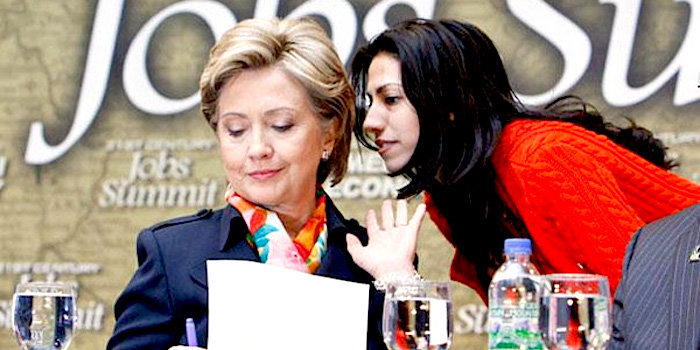
Government watchdog Judicial Watch has just released a new batch of emails, more than 1600 pages worth, belonging to former Secretary of State Hillary Clinton and longtime aide Huma Abedin. The emails, released by the State Department as part of a lawsuit, show further mishandling of classified information.

The list of egregious incidents is long, including exposure of a classified conversation about U.S.-Israeli relations, the war against drug cartels in Mexico, details about Clinton's arrival in war torn Afghanistan, Afghanistan elections and much more. Here are a few, bolding is mine:

Comment:


Attention

Stop pretending that fundamentalist Islam and violence aren't linked, says top Muslim scholar

soldier training
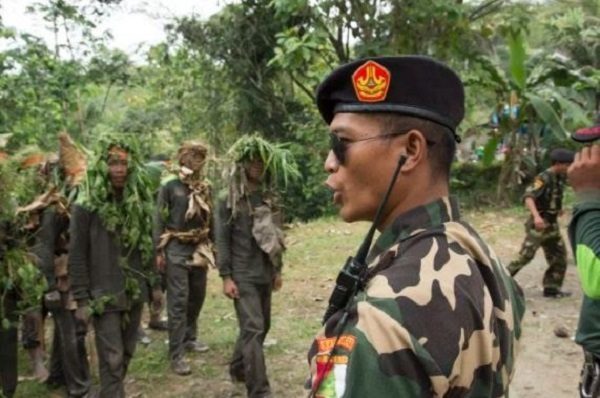
© Ed Wray/Getty ImagesA Banser instructor announces an afternoon schedule during a rigorous three day induction course for Nahdatul Ulama, Indonesia's largest Muslim organization, on July 23, 2017 in Kebumen, Indonesia.
Indonesia, the world's biggest Muslim-majority country, has a constitution that recognizes other major religions, and practices a syncretic form of Islam that draws on not just the faith's tenets but local spiritual and cultural traditions. As a result, the nation has long been a voice of, and for, moderation in the Islamic world.

Yet Indonesia is not without its radical elements. Though most are on the fringe, they can add up to a significant number given Indonesia's 260-million population. In the early 2000s, the country was terrorized by Jemaah Islamiyah (JI), a homegrown extremist organization allied with al-Qaeda. JI's deadliest attack was the 2002 Bali bombing that killed 202 people. While JI has been neutralized, ISIS has claimed responsibility for recent, smaller terrorist incidents in the country and has inspired some Indonesians to fight in Syria - Indonesians who could pose a threat when they return home. The country has also seen the rise of hate groups that preach intolerance and violence against local religious and ethnic minorities, which include Shia and Ahmadiya Muslims.

Among Indonesia's most influential Islamic leaders is Yahya Cholil Staquf, 51,advocates a modern, moderate Islam. He is general secretary of the Nahdlatul Ulama, which, with about 50 million members, is the country's biggest Muslim organization. Yahya. This interview, notable for Yahya's candor, was first published on Aug. 19 in German in Frankfurter Allgemeine Zeitung. Here are excerpts translated from the original Bahasa Indonesia into English.