Puppet MastersS


Top Secret

Netanyahu's 'evidence' of Iranian 'crimes' wasn't just old, some parts were fabricated

Netanyahu
© Abel Danger/KJN
Israeli Prime Minister Benjamin Netanyahu's claim in his theatrical 20-minute presentation of an Israeli physical seizure of Iran's "atomic archive" in Tehran would certainly have been the "great intelligence achievement" he boasted if it had actually happened. But the claim does not hold up under careful scrutiny, and his assertion that Israel now possesses a vast documentary record of a covert Iranian nuclear weapons program is certainly fraudulent.

Netanyahu's tale of an Israeli intelligence raid right in Tehran that carted off 55,000 paper files and another 55,000 CDs from a "highly secret location" requires that we accept a proposition that is absurd on its face: that Iranian policymakers decided to store their most sensitive military secrets in a small tin-roofed hut with nothing to protect it from heat (thus almost certainly ensuring loss of data on CDs within a few years) and no sign of any security, based on the satellite image shown in the slide show. (As Steve Simon observed in The New York Times the door did not even appear to have a lock on it.)

Comment: See also:


Sheriff

Time Magazine: 'Yes, something is seriously wrong at the FBI'

SecretsFBI
© Bill of Rights Defense Committee/KJN
Both Democrats and Republicans have taken turns criticizing the FBI over the past two years, but of late the former have been criticizing the latter for attacking the law-enforcement agency's leadership and performance. Democrats complain that the GOP wants to weaken the FBI as part of their efforts to defend Donald Trump and are sacrificing the credibility of the organization. Rep. Jim Himes preached to a CNN congregation last month that those "besmirching" the integrity of James Comey would "rot in Hell."

Don't repent too quickly, Time Magazine's Eric Lichtblau reports today. Politics aside, the FBI finds itself in a serious crisis of credibility, and not just on the news shows. Juries have begun discounting testimony from FBI agents, and James Comey may be one of the problems, Hell notwithstanding:
Many view Trump's attacks as self-serving: he has called the renowned agency an "embarrassment to our country" and its investigations of his business and political dealings a "witch hunt." But as much as the bureau's roughly 14,000 special agents might like to tune out the news, internal and external reports have found lapses throughout the agency, and longtime observers, looking past the partisan haze, see a troubling picture: something really is wrong at the FBI.

The Justice Department's Inspector General, Michael Horowitz, will soon release a much-anticipated assessment of Democratic and Republican charges that officials at the FBI interfered in the 2016 presidential campaign. That year-long probe, sources familiar with it tell TIME, is expected to come down particularly hard on former FBI director James Comey, who is currently on a high-profile book tour. It will likely find that Comey breached Justice Department protocols in a July 5, 2016, press conference when he criticized Hillary Clinton for using a private email server as Secretary of State even as he cleared her of any crimes, the sources say. The report is expected to also hit Comey for the way he reopened the Clinton email probe less than two weeks before the election, the sources say.

Comment: Whatever the outcome of investigating the wrongs and woes of the FBI, there is no easy fix and credibility will continue to be questioned if the public manages to pay attention and Congress sets aside bias for justice with lessons learned. (Not taking bets.)


Dollars

Mueller's investigation financed by Soros, says Trump campaign official

Dan Jones
© Blunt Force TruthDaniel J. Jones
The Robert Mueller investigation is using research financed by a top George Soros official, according to top strategists from the Donald J. Trump presidential campaign.

Thursday, Big League Politics revealed the role of deep state operative Daniel J. Jones, who is working behind the scenes to fund the Special Counsel Robert S. Mueller's bogus investigation into Trump campaign "collusion" with Russia.

As we reported:
"'Dan Jones, the former Senate Intelligence staffer, has raised millions of dollars to fund continued exploration of the bogus [Steele] dossier,' said Michael Caputo, Trump campaign advisor.

Daniel J. Jones is a deep state operative and President of The Penn Quarter Group, a Washington D.C. based investigative research firm. He spent four years in the FBI before joining the United State Select Committee on Intelligence under then-Senator Jay Rockefeller, and subsequently under Sen. Dianne Feinstein.

'If you see the stories out there with unnamed sources, it's become very clear that Dan Jones is one source, and he goes and gets another - no doubt from among his colleagues on the partisan hit-squad at the Intelligence Committee,' Caputo continued."
We have learned that Jones' deep state ties are much more in-depth than previously understood.

Comment: More from The Federalist:
Jones previously worked as a senior intelligence staffer for Feinstein, who currently serves as the ranking member on the Senate Judiciary Committee, which is currently investigating Fusion GPS. In that capacity, she violated committee precedent by unilaterally releasing a transcript of the testimony of Fusion GPS founder Glenn Simpson without disclosing that a top former staffer of hers was directing the firm's efforts during the Judiciary committee's investigation.
See also:
Sen. Dianne Feinstein's former staffer raised $50M, hired Fusion GPS and Christopher Steele after 2016 election


Whistle

Kallstrom labels FBI a criminal 'Fifth Column' conspiracy to topple Trump's presidency

FBI seal
© Foreign Policy Journal
Former FBI Assistant Director James Kallstrom took the gloves off on Thursday, accusing the FBI of taking part in an organized conspiracy to topple President Trump's presidency.

Kallstrom is a respected FBI alumnus. When he speaks many other FBI officials and former officials listen. As do lawmakers. He shapes opinions.

Kallstrom called the leadership of the FBI a disgrace. He alluded Special Counsel Robert Mueller was a would-be thug fabricating concocted evidence. The FBI was part of a fifth column running a clear conspiracy to topple Trump, he said.

Kallstrom's comments should raise a number of eyebrows in Congress too.

Even FOX News host Tucker Carlson was taken aback by Kallstrom's hammering of his former employer.


Comment: Kallstrom slams the FBI and Mueller with conspiracy charges and disregard of protocol.


Question

For Mueller it's a question of three conflicts

MuellerKremlin
© El Molino
As the special counsel investigation surrounding President Trump goes on, we still don't know what evidence Robert Mueller and his team have amassed behind closed doors. It's entirely possible they have built a strong case that Trump illegally conspired with Russian President Putin, which Trump's critics have long claimed but which Trump denies.

If the New York Times' list of questions that Mueller wants to ask Trump is accurate, however, it's hard not to notice that Mueller is treading in waters in which he - the special counsel - may have at least three serious conflicts of interest.

The first area has to do with Mueller's reported inquires into Trump's alleged desire to terminate Mueller himself as special counsel, as well as Trump's firing of Mueller's longtime friend and colleague, former FBI director James Comey.

Think of it this way: You're the boss at a company and decide to fire an important manager. Maybe you believe he acted improperly, conspired against you, or is simply not the right man for the job. He's unhappy you fired him. Now imagine the fired employee - or his good friend and colleague - is awarded the power to judge and assess your motives regarding that firing and other matters. Would it be fair to have the very people who feel wronged be put in charge of determining your fate?

Comment: Mueller has a shady history at best. It was surprising that he was appointed to special counsel in the first place. Is he stalling the 'nothing' investigation to bide time for his cohorts, or is he grasping at straws to lag folding the investigation for personal reasons?


Colosseum

Pyrrhic victories and anti-Russian sanctions: 'Russia must be destroyed' is US policy

carthage
The ruins of Carthage. The US is increasingly following a policy of “Carthago delenda est” – Carthage must be destroyed
When King Pyrrhus of Epirus stood on the Italian coast surveying the battlefield of Asculum where he had just defeated the Roman army in 279BC, he famously said: "If I have another victory like that I will return to Epirus alone."

Epirus is in the modern-day Balkans and Pyrrhus was the first serious challenger faced by the growing Roman Empire, which very nearly lost to the Illyrian fighting forces.

The Romans won in the end thanks to their ability to out-resource all their opponents: if an army lost they simply drew on their massive and growing hinterland to raise another one. They wore their opponents down into eventual defeat - even if that took years to accomplish. The Romans were later challenged by Hannibal in the second Punic war and unable to defeat the wily general, but again they out-resourced him and Carthage was eventually razed to the ground.

The US is in a similar position today and that is what worries the emerging markets that are rapidly catching up with the western world.

Comment:
Russia doesn't have the US resources and will sink into stagnation unless deep structural reforms are put in place
The author overlooks a major ace in the deck: China.

Chinese economic development will swamp the US long before it gets its 'Carthage moment'.


Info

French President Macron: If US scraps Iranian nuclear deal, it 'could mean war'

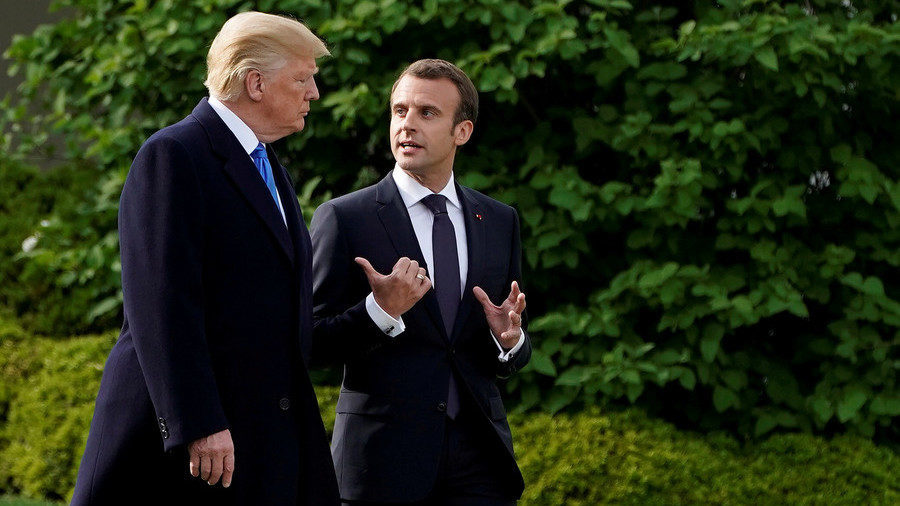
US President Donald Trump and French President Emmanuel Macron
© Joshua Roberts / Reuters
French President Emmanuel Macron has warned that the US pulling out of the nuclear deal with Iran "could mean war." Trump has until May 12 to either re-certify the deal or dump it, as he has repeatedly threatened.

Scrapping the landmark 2015 nuclear deal with Iran "would mean opening Pandora's box, it could mean war," according to an undated quote from Macron provided in the latest Der Spiegel magazine edition.

However, the worst-case scenario may not in fact materialize, as the French leader said he does not believe that US President Donald Trump is really seeking a military conflict.

Comment: The US will be faced with regret if it decides to pull out of the nuclear deal agreed with Tehran, Iranian President Hassan Rouhani has warned, adding that his government has "plans to resist" the move.
"If the United States leaves the nuclear agreement, you will soon see that they will regret it like never before in history,"Rouhani said in a televised speech on Sunday, as quoted by Reuters.

Rouhani went on to state that Tehran has "plans to resist any decision by Trump on the nuclear accord," and that "orders have been issued to our atomic energy organization... and to the economic sector to confront America's plots against our country.

"America is making a mistake if it leaves the nuclear accord."
...
That notion was slammed by Rouhani on Sunday. "We will not negotiate with anyone about our weapons and defenses, and we will make and store as many weapons, facilities and missiles as we need," he said, stressing the rejection by Iranian leaders to hold talks on Iran's missile program, which it claims is purely for defensive purposes.


Beaker

OPCW 'corrects' director's claim that 50-100g of novichock were used in Skripal poisoning

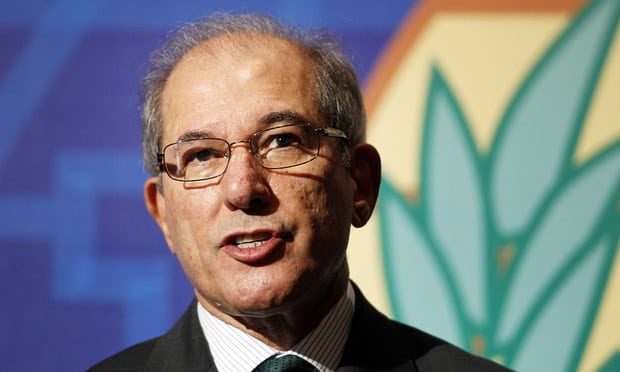
Ahmet Üzümcü
© Bas Czerwinski/EPAAhmet Üzümcü, the head of the Organisation for the Prohibition of Chemical Weapons.
The international chemical weapons watchdog has amended a claim made by its director general that as much as 50-100 grams of liquid nerve agent was used in the attack on the former Russian double agent Sergei Skripal in Salisbury.

On Thursday the head of the Organisation for the Prohibition of Chemical Weapons, Ahmet Üzümcü, said the amount of novichok - a military-grade nerve agent developed by the Soviet Union - used in the attack on 4 March was significantly more than needed for research purposes and indicated it was likely to have been created for use as a weapon.

He told the New York Times: "That quantity - a range from slightly less than a quarter-cup to a half-cup of liquid - is significantly larger than the amount that would be created in a laboratory for research purposes, meaning that it was almost certainly created for use as a weapon."

Within hours of the report, however, startled chemical weapons experts were challenging the figure, insisting a miscommunication had occurred. A statement from the OPCW on Friday said the organisation "would not be able to estimate or determine the amount of the nerve agent that was used".

It added: "The quantity should nonetheless probably be characterised in milligrams."

It is not clear how Üzümcü made his error.

Comment: Unless Uzumcu is an idiot (which he does not appear to be), it might be worth taking a closer look at his statement. As Rob Slane points out, here's what he actually said:
"For research activities or protection you would need, for instance, five to 10 grams or so, but even in Salisbury it looks like they may have used more than that, without knowing the exact quantity, I am told it may be 50, 100 grams or so, which goes beyond research activities for protection".
It doesn't make sense for Uzumcu to say on the one hand that the OPCW cannot make an estimate, and then proceed to do exactly that. Slane wonders if perhaps Uzumcu was simply relating what he has "been told":
I can't be sure, but my hunch is that he does know his grams from his milligrams; that he is well aware that 50-100 grams of the stuff would be enough to have killed the Skripals outright, along with hundreds or possibly thousands of others in the surrounding area; and also that he understands full well that the current multi-million pound clean up operation in Salisbury, which is precisely intended to give the impression that there was so much of the stuff that it might make up half a cupful, or perhaps even a whole bucketful, is something of a farce.

And so even though his original statement at first seems absurd, I'm fairly convinced that it was not a display of incompetence on his part. Rather, together with the subsequent clarification, it was very likely a signal that he believes his source for the claim to be either incompetent or - shall we say - economical with the actualité. And it may be that his real aim was - as diplomatically as possible - to let certain folks in Britain know that he's not as convinced by some of their claims as they might like him to be.


Headphones

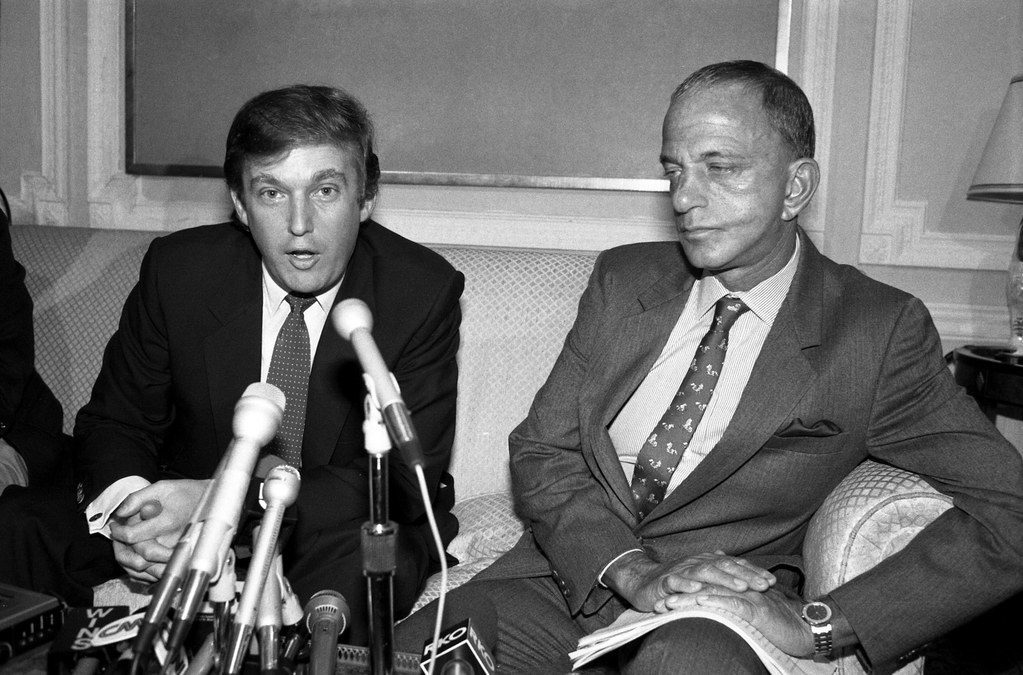
Notes emerge from eavesdropping of Roy Cohn and Donald Trump

Trump and Cohn
© BETTMANN / GETTYDonald Trump and Roy Cohn in October, 1984. Many of Trump’s private conversations with his late mentor were eavesdropped on by Cohn’s longtime switchboard operator and courier.
In early March, President Trump sent four tweets accusing his predecessor of wiretapping the phones in Trump Tower in the months before the 2016 election. The tweets were just the latest manifestation of Trump's preoccupation with eavesdropping and surveillance - one that can be traced back decades. As BuzzFeed's Aram Roston reported last summer, during the mid-two-thousands, Trump kept a telephone console in his bedroom at his Mar-a-Lago resort, in Palm Beach, that allowed him to listen in on phone calls between his employees and, sometimes, staff and guests. (Trump denied this.) In the mid-nineteen-eighties, Trump allowed Tony Schwartz, his ghostwriter, to listen in on his private phone calls with bankers, lawyers, and developers, as Schwartz wrote "The Art of the Deal." And, in the nineteen-seventies and eighties, many of Trump's private conversations with his late mentor, the lawyer Roy Cohn, were eavesdropped on by Cohn's longtime switchboard operator and courier, whose activities were later exposed.

Cohn, who had been an aide to Senator Joe McCarthy, in the nineteen-fifties, was a political fixer and lawyer who represented New York power brokers, from the Yankees owner George Steinbrenner to the mob boss Carlo Gambino. Trump was one of his favorite clients; before Cohn's death, of AIDS-related complications, in 1986, the two men talked up to five times a day and partied together at Studio 54 and other night clubs. "Roy was brutal, but he was a very loyal guy," Trump told the writer Tim O'Brien, in 2005. "He brutalized for you."

Christine Seymour had recently graduated from Sarah Lawrence College when she started working at the back of Cohn's office as a switchboard operator, connecting calls with clients including Nancy Reagan, Gloria Vanderbilt, and the mobsters Gambino and Anthony (Fat Tony) Salerno. "She listened in to all of them," Susan Bell, Cohn's longtime secretary, recalled recently. "Not at his direction, but he knew." A pretty brunette, Seymour was, according to her brothers, brash and funny, with a gossipy sense of humor. Cohn had his reasons for tolerating her behavior. "She was very efficient, and he liked that about her," Bell said. "She would work anytime, day or night. She was always at his beck and call."

Quenelle

Russiagate the new litmus test for GOP hopefuls as candidates denounce Mueller's witch-hunt

MuellerKremlin
© El Molino
Special counsel Robert Mueller's investigation is emerging as a new litmus test in key Republican Senate primaries.

GOP hopefuls locked in nasty primary fights are increasingly denouncing the Russia probe as they try to position themselves as the candidate aligned closest with President Trump.

The volleys against the special counsel - who has been investigating potential collusion between Moscow and the Trump campaign for nearly a year - come at a time when elections in several battleground states have entered a crucial stretch.

Rep. Todd Rokita, who is in a heated three-way primary in Indiana, appears to be the first Republican Senate candidate to include Mueller in a TV spot, telling GOP voters he will "fight the Mueller witch hunt" if he wins.

The ad unfavorably compares the former FBI director, who is widely respected in the Beltway, to House Minority Leader Nancy Pelosi (D-Calif.) and Democratic Sen. Joe Donnelly (Ind.), saying they are using "fake news to try to destroy our president."

Rokita's ad is just one example of Republicans trying to outdo each other to be the most pro-Trump candidate in a Republican primary.