Puppet MastersS


Star of David

Congress members pushing to extend US armed forces benefits to IDF military

israel america us military exercise
© DVIDS.The “Juniper” series of events are designed to test collective US-Israeli readiness and improve the interoperability of defense systems.
A real policy push emerged in 2024 to extend certain legal protections to Americans who serve in the Israel Defense Forces (IDF). In 2024, members of Congress introduced H.R. 8445, a bill that would have amended federal law "to provide for the eligibility of United States citizens who serve in the Israeli Defense Forces for certain protections relating to such service."

Under current law, US veterans' benefits are tied to service in the US armed forces. The statutory definition of "veteran" appears at 38 USC § 101(2) and limits eligibility to those who served in US military forces or narrow statutory exceptions. The proposal in H.R. 8445 would move away from that framework.

Who Was Pushing for It and What They Were Saying

The legislation was introduced in 2024 by Representatives Guy Reschenthaler (R-PA) and Max Miller (R-OH). In their official statement, they said the bill was intended to support Americans serving in Israel and noted that "over 20,000 American citizens are currently defending Israel." They added that the legislation would "ensure we do everything possible to support these heroes."

Comment: It's never enough for the parasite Israel.


Arrow Up

Iran offers deal to break deadlock with US - Axios

Arabian Sea vessel
© Getty ImagesArabian Sea • April 20, 2026, Iranian-flagged vessel • Strait of Hormuz
Tehran has proposed reopening the Strait of Hormuz first, and then focus on nuclear talks, according to the report.

Iran has made the US a new proposal to reopen the Strait of Hormuz and end the war - postponing nuclear negotiations to a later stage to break the deadlock in the high-stakes talks, Axios reports, citing sources.

An unnamed US official and two other sources familiar with the matter told the outlet that Iranian Foreign Minister Abbas Araghchi mentioned the plan during back-to-back visits to Islamabad, informing the Pakistani, Egyptian, Turkish, and Qatari mediators that Iran's leadership has no internal consensus on how to address Washington's nuclear demands. The US has insisted that Iran dismantle its nuclear program and hand over all of its enriched uranium.

The proposal, which was delivered to the White House via Pakistani intermediaries, reportedly focuses on extending the ceasefire or even ending the war, as well as lifting the US blockade of the Strait of Hormuz, a critical chokepoint accounting for 20% of the world's seaborne oil trade. Nuclear talks would not start until the blockade is lifted, according to the reported plan.

Attention

Mr. Araghchi goes to Russia

Araghchi and Putin
© Public Domain
Talk about an entrance pregnant with meaning.

Iranian Foreign Minister Abbas Araghchi engaged on a high-stakes diplomacy tour to Islamabad, Muscat and St. Petersburg aboard flight "Minab 168" on Meraj Airlines.

In memory, of course, of the 168 schoolgirls from Minab killed by the Empire of Chaos, Lies, Plunder and Piracy.

Before he set out on his voyage, Araghchi went straight to the point:

"It had been some time since meetings with Russia had taken place. We use the current opportunity to hold consultations with our Russian friends regarding developments related to the war. This coordination will be important."

Araghchi explained the importance of reviewing negotiations in Pakistan, and "under what conditions negotiations could continue." Conversations in Oman "will lead to greater expansion in relations with neighbors, especially in the southern regions of the Persian Gulf."

On the Strait of Hormuz, "consultations with Oman were also necessary...We share many common views with Oman, and it was agreed that discussions would continue at the expert level."

Araghchi in St. Petersburg did not only meet his counterpart, Grandmaster Sergey Lavrov, as protocol would have it. Himself and his mini-delegation were personally received by President Putin.

With a supremely elegant, sharp as a dagger delivery, Putin summarized the whole New Game generated by the war on Iran.

Three absolutely key points:

1.Respect for the Supreme Leader Ayatollah Mojtaba Khamenei: "I would like to note at the beginning of the conversation that last week I received a message from the Supreme Leader of Iran. I would like to ask you to convey my most sincere words of gratitude for this and to confirm that Russia, just like Iran, intends to continue our strategic relations. Please convey to the Supreme Leader words of gratitude for this message and wishes of the best, health, and well-being.

2.Iran's fight is all about independence and sovereignty: "We see how courageously and heroically the people of Iran are fighting for their independence and sovereignty. Of course, we very much hope that, relying on this courage and striving for independence, the Iranian people, under the leadership of their new Leader, will overcome this difficult period of trials and see peace prevail."

3.Russia is all in: "For our part, we will do everything that serves your interests and the interests of all peoples of the region to ensure that this peace is achieved as soon as possible. You know our position well.".

Araghchi for his part confirmed Iran and Russia are engaged on a "strategic partnership at the highest level." Moreover, "it has also been proven to everyone that Iran has friends and allies like the Russian Federation, who in difficult moments stand by Iran. We are grateful to you for your strong and firm positions in support of the Islamic Republic of Iran."

To say that the Empire of Piracy will have a lot to mull over is of course the understatement of the century.

Star of David

Wired for War: Why is the EU ignoring the Israeli cyber threat?

Von der Leyen Black cube  collage
From Black Cube stings to Pegasus spyware, Israeli intelligence firms have repeatedly targeted European politics.

Two proven cases of political interference by a Mossad-linked private intelligence firm should have set alarm bells ringing in Brussels. The EU's silence reveals just how deeply the Israeli spy-tech nexus has penetrated the bloc.

The European Commission has claimed that Russia interfered in almost every major European election of the last half decade. Despite being proven wrong in France, Germany, Romania, Hungary, Bulgaria, and counting, the allegations alone have been enough to justify the commission's activation of its 'Rapid Response System', a powerful suite of censorship tools that give Brussels the power to decide what voters see - and don't see - on social media in the run-up to elections.

This year alone, two cases of meddling by Black Cube, a private intelligence company staffed by former Mossad and Israel Defense Forces (IDF) agents, have taken place in the EU without so much as an acknowledgment from Brussels. RT covered these cases earlier in our 'Wired for War' series, but if you're not familiar with the story, here's a quick recap:

Comment: Europe criticism of Israel is non existent. It is a taboo and power, money and blackmail are likely a big part of the equation.


Bad Guys

The WHO is quietly building a supranational vaccine authorization mechanism

graphic world stethescope Who medicine
"I need to ask someone else to take responsibility for the second part of the approvals process, so that I won't have a conflict of interest. I'm also working with Bill Gates and the World Health Organization on the vaccine itself." — Prof. Lester Schulman
This admission of a conflict of interest was made by Prof. Lester Schulman, secretary of the Ministry of Health's polio committee, in March 2023, during an internal discussion about approving the importation into Israel of a new polio vaccine. The vaccine was developed and promoted by the World Health Organization in collaboration with the Bill & Melinda Gates Foundation, and its approval pathway relied on a new emergency authorization mechanism the WHO has developed in recent years: the EUL (Emergency Use Listing).

Although the remark was framed as a technical aside, it was an unusual confession of a conflict of interest by the committee's secretary. Its seriousness is compounded by the fact that it was made only after the committee had already voted by an overwhelming majority to initiate the process of bringing the vaccine to Israel, and after it had already worked vigorously to persuade the Pharmaceutical Division to cooperate.

Comment: It appears Israel was also used as a test lab for Covid:


Arrow Up

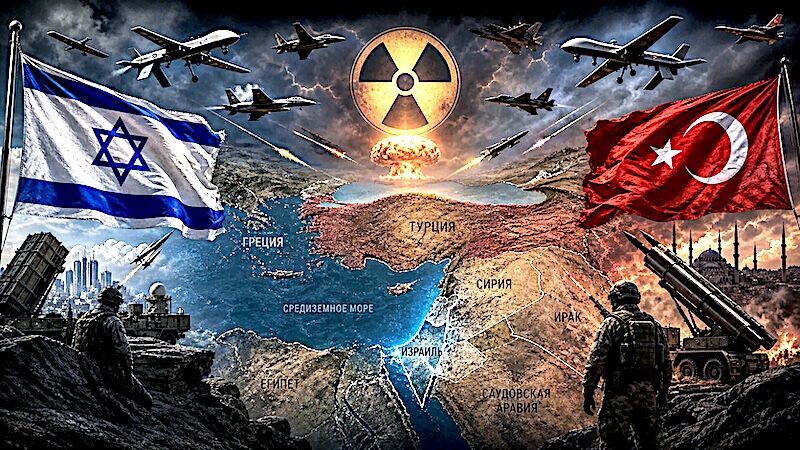
Rising tensions between Israel and Türkiye: From strategic partnership to manufactured rivalry

Erdoğan Netanyahu
© Unknown/KJNTurkish President Recep Tayyip Erdoğan • Israeli PM Benjamin Netanyahu
The ongoing conflict in Gaza is reshaping the moral and geopolitical landscape of the Middle East. Israel's rhetoric toward Türkiye now signals more than a diplomatic rupture; it reveals a pattern of strategic antagonism in which war has become the primary mode of diplomacy.

From Uneasy Partnership to Open Antagonism

The rupture between Israel and Türkiye is not the result of a single disagreement or incident. Rather, it is the culmination of a prolonged political collapse that has accelerated since the onset of the Gaza war. Two states that once engaged in trade, coordination, and occasional mutual trust have now become rivals engaged in a public war of words.

In May 2024, Türkiye halted all trade with Israel, stating that the decision would remain in effect until a permanent ceasefire and humanitarian access in Gaza were achieved. In response, Israel abolished its free trade agreement with Türkiye and imposed a 100% tariff on Turkish imports. Trade, which previously served as a diplomatic buffer, has now become a tool of confrontation.

Additionally, Turkish prosecutors have indicted 35 senior Israeli officials in connection with the interception of the humanitarian Sumud flotilla.

According to Ankara, Israel is "burning all bridges" in the region. Turkish Foreign Minister Hakan Fidan has publicly stated that Israel "cannot live without an enemy" and may be attempting to position Türkiye as its next adversary after Iran. Thus, the diplomatic dispute has evolved into a narrative contest over perceived threats.

Sherlock

'Spies inside the Holy See': Report reveals US espionage campaign targeting Pope Leo XIV

Pope Leo
© Guglielmo Mangiapane/ReutersPope Leo XIV
Independent US journalist Ken Klippenstein says Washington stepped up intelligence activities against the Vatican following Trump's spat with the Pope.

The administration of US President Donald Trump has been "spying" on Pope Leo XIV as part of a years-long intelligence campaign by Washington against the Vatican, US investigative journalist Ken Klippenstein said in a report released on 24 April.

Klippenstein - an independent, Washington-based investigative journalist who formerly wrote for The Intercept - cited sources as saying that Trump's recent comments on the new Pope were taken by the intelligence community as "a directive to prioritize spying on the Vatican." Trump had said earlier this month that Pope Leo was "terrible on foreign policy" and "weak on crime."

X

"We have all the cards": Trump cancels Witkoff-Kushner trip to Pakistan for Iran talks

witkoff kushner
© Lesley Stahl/www.rev.comSteven Witkoff • Jared Kushner
Summary
  • Araghchi has responded - saying that he has conveyed Iran's position, waiting to see if the US "is truly serious about diplomacy"
  • In a sharp reversal, Trump has personally canceled the Witkoff-Kushner trip to Pakistan
  • Iran denies that FM Abbas Araghchi's trip to Pakistan will include new talks with US, rejecting reports that Trump is sending his negotiating team to restart negotiations.
  • 24/7 shuttle diplomacy (via Al Jazeera): There's been shuttle diplomacy, and as one diplomat said, it's been relentless diplomacy that has been put forward by Pakistan from all sides.
  • Iran's military says finger on the trigger: "greater power & readiness than before."
  • Pakistani mediators are "cautiously optimistic" despite it being clear negotiations have been at a stalemate.
Trump Cancels Witkoff-Kushner Trip to Pakistan for Iran Talks

In a sharp reversal first reported by Fox News, President Trump has personally canceled the planned trip of Steve Witkoff and Jared Kushner to Pakistan.

Trump told the outlet that he halted the delegation just as they were preparing to leave:
"I've told my people a little while ago they were getting ready to leave, and I said, 'Nope, you're not making an 18 hour flight to go there. We have all the cards. They can call us anytime they want, but you're not going to be making any more 18 hour flights to sit around talking about nothing.'"

Comment: Iran explains the "cards":


Star of David

Former Israeli PMs join forces to dethrone Netanyahu in upcoming elections

Lapid/ Bennett
© UnknownFormer Israeli prime ministers Yair Lapid (R) and Naftali Bennett
Two former Israeli prime ministers have said they would join forces in upcoming elections expected later this year in a bid to dethrone longtime prime minister Benjamin Netanyahu.

On Sunday, Naftali Bennett and Yair Lapid, who previously shared power under a rotation agreement, announced plans to merge their parties into a single political faction led by Bennett.

The move is intended to bring together opposition forces that have remained divided in recent years.

"The move is intended to unite the bloc, put an end to internal divisions and focus all efforts on winning the critical upcoming elections," Lapid's Yesh Atid party said in a statement.

Attention

A new middle eastern power paradigm

Iran won the war. There are consequences for being on the wrong side of the power equation, a reality that the US and its Gulf Arab allies are learning the hard way.
The Iranian Navy patrols the Strait of Hormuz
© Real Scott RitterThe Iranian Navy patrols the Strait of Hormuz.
It is a bad time to be a Gulf Arab State.

The United States and Israel took a gamble when launching their surprise attack on Iran on February 28 of this year. To the extent that they were consulted beforehand, America's Gulf Arab allies did so as well.

They lost.

No discernible political or military objectives were attained by the practitioners of perfidy — neither regime change, missile suppression, nor control of the Strait of Hormuz.

Instead, the anti-Iranian cabal was compelled to seek a ceasefire that left Iran in total control of the strategic Strait of Hormuz, throttling both regional and global economies by blocking the transit of the very energy that they rely upon for their functioning, and its military intact, capable and defiant, able to deliver devastatingly damaging blows to their enemies lairs.

The 40-day war between the US/Israeli/Gulf Arab States cabal and Iran has underscored a reality that is difficult for many to accept — that military capability of the United States to project force into the Middle East has eroded to the point of near impotence, and that the original US-centered security architecture that has been in place for decades has failed to prevent Iran from acquiring de facto control over the very energy chokepoints the US was supposed to secure. This new reality will compel the region and the world to move away from concepts centered on US-based military-centric deterrence to a multipolar security framework derived from economic reality which will involve Russia, China, and BRICS-like relationships. The legacy military doctrine upon which the old security relationships were founded is no longer viable, and any effort to revive legacy military doctrine would be prohibitively expensive, and ultimately unachievable.

In short, the US lost because its foundational military-centric approach toward regional problem solving was no longer effective, and no amount of defense spending can reverse this reality.