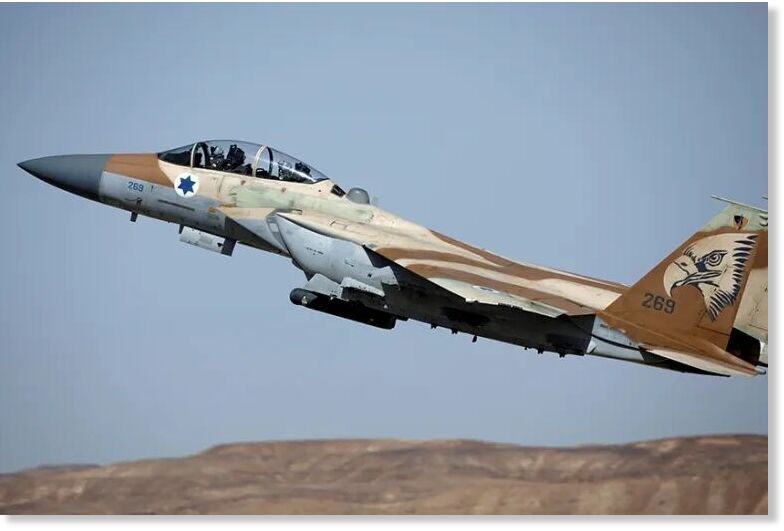
© Amir Cohen/Reuters
Six Israeli warplanes flew over the border village of Kfar Kila, located 96 kilometers (59 miles) south of the capital Beirut, at 9:50 a.m. (0650 GMT) on Sunday and conducted several unwarranted flights above areas in southern Lebanon, a statement released by the Lebanese military read.
The Israeli warplanes left the Lebanese airspace at 11:00 a.m. local time (0800 GMT) while flying over the southern border town of Alma al-Shaab.
Meanwhile, two Israeli fighters violated Lebanese airspace at 10:05 a.m. local time (0705 GMT), and flew over southern part of the country. The jets left at 11:45 a.m. local time (0845 GMT).
Two remote-controlled Israeli drones also entered the Lebanese airspace and carried out covert surveillance fights over the village of al-Naqoura, located 91 kilometers (57 miles) south of Beirut, and the southern village of Rmeish.
The aircraft flew over the southern areas of Lebanon at 2:10 p.m. local time (1110 GMT) and 4:00 p.m. local time (1300 GMT) on Sunday and left.