
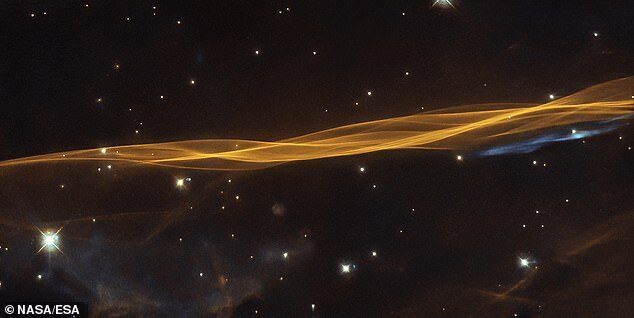
© NASA/ESAAppearing like a light veil across the sky, it is actually the outer edge of a supernova remnant from an explosion that blasted apart a dying star up to 20,000 years ago
An image of a 'delicate supernova blast wave' seen draped across the sky 2,400 light years from Earth, has been captured by the NASA Hubble Space Telescope.
Appearing like a light veil across the sky, it is actually the outer edge of a supernova remnant from an explosion that blasted apart a dying star up to 20,000 years ago.
The European Space Agency (ESA), a partner in the Hubble telescope, said the exploding star would have been about 20 times more massive than our Sun.
















Comment: See also: