Science & TechnologyS


Music

Bug-infected music: Androids can be hacked through opening song or video

MP3
© www.findmemes.comCybersecurity warning: Listen at your own risk!
A billion Android devices across the world are vulnerable to a bug that may be exploited to infect your smartphone or tablet when you try to preview a song or video on the internet, cybersecurity experts warn.

"Meet Stagefright 2.0, a set of two vulnerabilities that manifest when processing specially crafted MP3 audio or MP4 video files," says a report from Zimperium, a cybersecurity company specializing in mobile devices.

The first Stagefright exploit was found by Zimperium in April and was publicly announced in July this year. It involved an Android multimedia engine library known as libstagefright, which could be made to execute malicious code via an MMS message. A bug fix was rolled out two days ago after it was reported to Google by the cybersecurity company.

The new exploit affects the same library, but does so via a malicious MP3 or MP4 file played on a webpage. According to Zimperium, the bug is capable of affecting "almost every Android device since version 1.0 released in 2008."

The risk lies "in the processing of metadata within the files," say the experts so you can 'catch the bug' when you are playing a song or a video.

"Since the primary attack vector of MMS has been removed in newer versions of Google's Hangouts and Messenger apps, the likely attack vector would be via the Web browser. An attacker would try to convince an unsuspecting user to visit a URL pointing at an attacker controlled Web site."

Comment: The first vulnerability (in libutils) impacts almost every Android device since version 1.0 released in 2008. Methods were found to trigger that vulnerability in devices running version 5.0 and up using the second vulnerability (in libstagefright). Do you Android?


Info

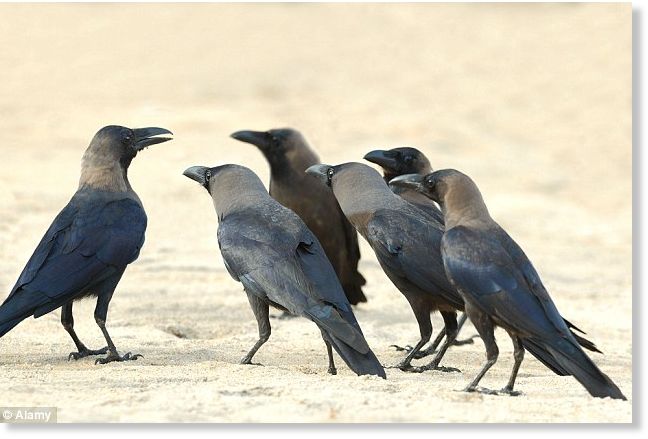
The mystery of 'crow funerals' solved: Scientists say birds are trying to learn about potential dangers to their own lives

Image
Previous research has found crows have an excellent memory for human faces.
Crows mourn their dead to try and learn about potential dangers to their own lives, researchers have found.

They found the birds can even remember an animal or person seen with a dead crow.

The birds were also able to easily distinguish between people or hawks carrying dead crows and other birds.

'The funeral behaviour of crows is so widely observed, and people often asked about it - but we haven't known what was happening,' Kaeli Swift at the University of Washington, who led the research, told Dailymail.com.

The study recorded the crow's behaviour when stuffed crows which appeared dead were introduced to areas where they are feeding.


Bulb

Study shows that common mealworms can safely biodegrade various types of plastic

mealworms eat styrofoam
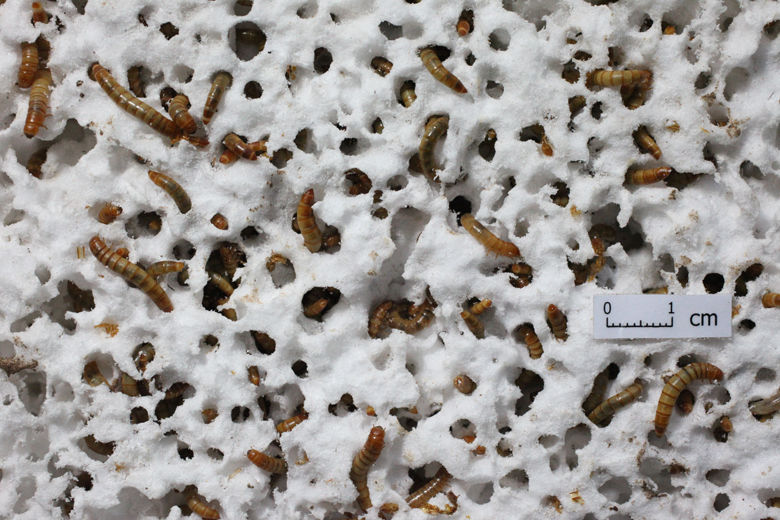
Mealworms munch on Styrofoam, a hopeful sign that solutions to plastics pollution exist. Wei-Min Wu, a senior research engineer in the Department of Civil and Environmental Engineering, discovered the larvae can live on polystyrene.
Consider the plastic foam cup. Every year, Americans throw away 2.5 billion of them. And yet, that waste is just a fraction of the 33 million tons of plastic Americans discard every year. Less than 10 percent of that total gets recycled, and the remainder presents challenges ranging from water contamination to animal poisoning.

Enter the mighty mealworm. The tiny worm, which is the larvae form of the darkling beetle, can subsist on a diet of Styrofoam and other forms of polystyrene, according to two companion studies co-authored by Wei-Min Wu, a senior research engineer in the Department of Civil and Environmental Engineering at Stanford. Microorganisms in the worms' guts biodegrade the plastic in the process - a surprising and hopeful finding.

"Our findings have opened a new door to solve the global plastic pollution problem," Wu said.

Comment: There is a Plague of Plastic killing the world's oceans, its marine life and is slowly moving up the food chain:


Attention

Scientists find evidence that sudden rapid collapse of Fogo volcano 73K years ago triggered massive tsunami

boulder Fogo volcano
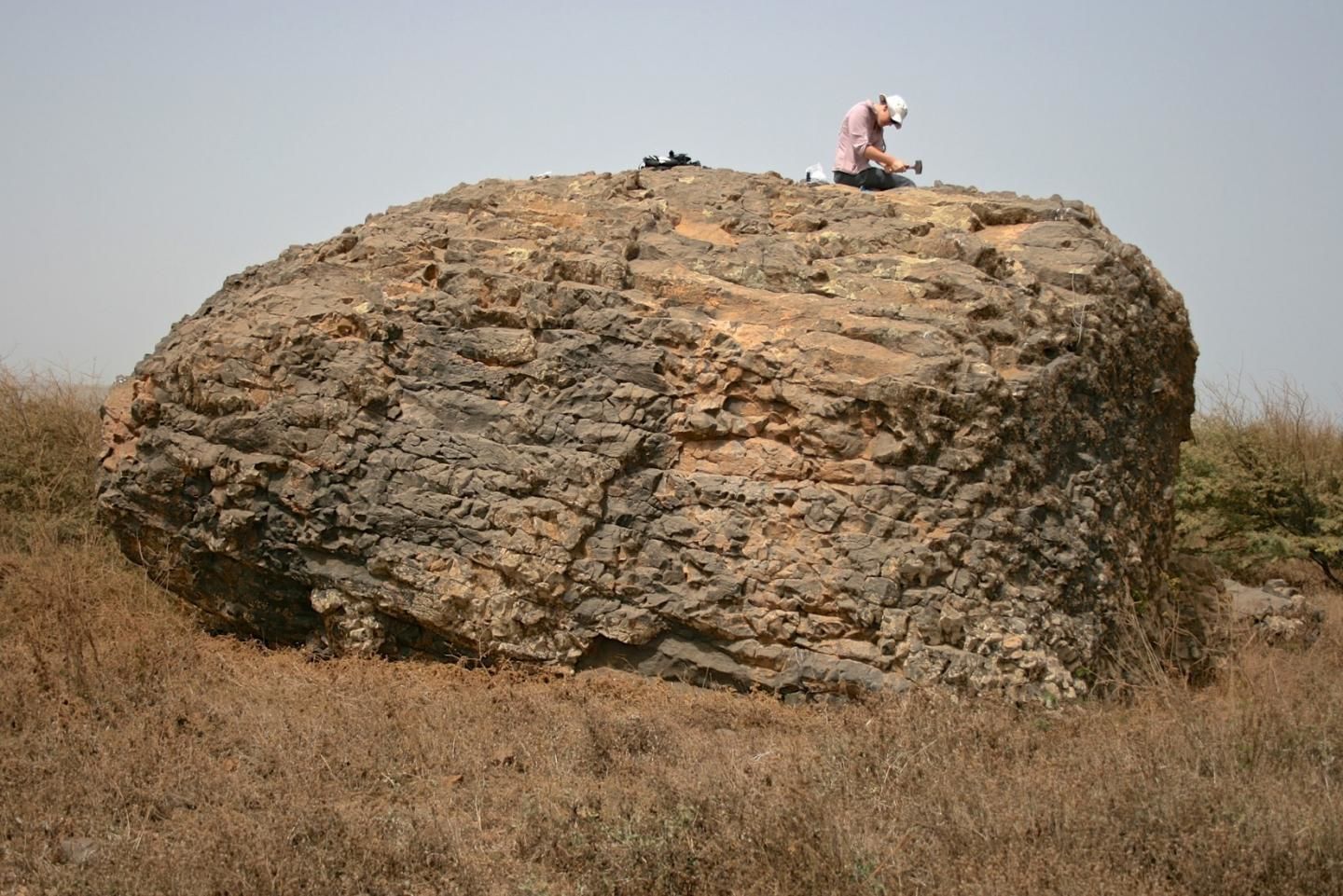
© Ricardo RamalhoThe tsunami generated by Fogo's collapse apparently swept boulders like this one from the shoreline up into the highlands of Santiago island. Here, a researcher chisels out a sample.
Scientists working off west Africa in the Cape Verde Islands have found evidence that the sudden collapse of a volcano there tens of thousands of years ago generated an ocean tsunami that dwarfed anything ever seen by humans. The researchers say an 800-foot wave engulfed an island more than 30 miles away. The study could revive a simmering controversy over whether sudden giant collapses present a realistic hazard today around volcanic islands, or even along more distant continental coasts. The study appears today in the journal Science Advances.

"Our point is that flank collapses can happen extremely fast and catastrophically, and therefore are capable of triggering giant tsunamis," said lead author Ricardo Ramalho, who did the research as a postdoctoral associate at Columbia University's Lamont-Doherty Earth Observatory, where he is now an adjunct scientist. "They probably don't happen very often. But we need to take this into account when we think about the hazard potential of these kinds of volcanic features."

The apparent collapse occurred some 73,000 years ago at the Fogo volcano, one of the world's largest and most active island volcanoes. Nowadays, it towers 2,829 meters (9,300 feet) above sea level, and erupts about every 20 years, most recently last fall. Santiago Island, where the wave apparently hit, is now home to some 250,000 people.

Meteor

Craters reveal two asteroids crashed into Earth's ocean simultaneously

double hit
© www.natureworldnews.comDouble trouble.
Geologists have discovered the craters of two large asteroids they believed crashed into earth simultaneously. Scientists from the University of Gothenburg in Sweden found the impact craters just ten miles apart in Jämtland, Sweden. It is believed they are the world's first confirmed simultaneous significant craters. One of them is a huge 4.7 miles wide, while the other spans 1.3 miles across.

The space rocks, which struck in the sea, would have caused devastating tsunamis, and could have even wiped out some species, scientists believe.

Erik Sturkell, professor of geophysics at the university, said: "Around 470 million years ago, two large asteroids collided in the asteroid belt between Mars and Jupiter, and many fragments were thrown off in new orbits. Many of these crashed on Earth, such as these two in Jämtland. Information from drilling operations demonstrates that identical sequences are present in the two craters, and the sediment above the impact sequences is of the same age. In other words, these are simultaneous impacts."

Comment: There is a distinct possibility that the double hit was a fragmentation of one asteroid body. This article doesn't address this more likely option.

NASA says "nothing is scheduled to hit earth for several hundred years"...because NASA currently has no satellite telescope capable of this sort of monitoring. It has reportedly cancelled recent cooperative projects that would offer this service, at least that is what is being told to the public. Near-zero capability, with all the recent influx of fireballs and such? Hard to imagine that it isn't otherwise!


Meteor

NASA terminates contract with asteroid-hunting company

Image
© nasa.gov / NASAAsteroid 243 Ida
NASA has terminated its 10-year contract with a company hoping to build a spacecraft that would hunt for Earth-threatening asteroids. NASA cited "limited resources" and an inability to further "reserve funds" for the $450 million mission.

The B612 Foundation - the company whose "interplanetary mission" is to build a spacecraft that would track asteroids - signed what is called a Space Act Agreement (SAA) back in 2012.

Under the agreement with NASA, B612 would have been able to obtain NASA's technical consultation and tracking facilities for Sentinel, if it had been launched. For its part, B612 would inform NASA on the spacecraft's findings and deliver data from the spacecraft to the Minor Planet Center.

Expected to last 10 years, the contract laid out a number of milestones that the foundation needed to meet.

Blue Planet

Floating landscape on Gowanus Canal, NY purifies one of the most polluted waterways

gowanus canal
© Balmori Associates
An oasis of greenery is floating on the Gowanus Canal in New York City, purifying the water and brightening the murky waterway.

The Gowanus Canal in New York City is known to be one of the most polluted waterways in the United States. You can imagine everyone's surprise, then, when an oasis of greenery was spotted sprouting on the surface of the river three weeks ago.

Not only is the brackish water's appeal improved with the improbable garden, the stream is being cleansed at the same time.

Attention

'Alien Threat': Microbes in Mars water may pose danger to Earth

Image
© Flickr/Cyril Rana
Now that liquid water has officially been found on Mars, scientists are warning of the risk of interstellar contamination that may put our planet's ecosystem in danger.

After decades of research and exploration of the Red Planet, NASA announced Monday the definitive existence of surface water on Mars. And where there is water, there's likely life.

Germs resistant to highly inhospitable environments — hot, salty, devoid of light — have been found and studied here on Earth. Astrobiologists have long suggested this same kind of highly resilient, primitive life could be possible on other planets, too. The announcement of water on Mars this week suggests they may be right.

Comment: It seems like "lifeless" planets aren't the only places that hold microbial life.

See also: Meteorites: Tool kits for creating life on Earth


Chalkboard

Beam me up Scotty: Why 'teleportation' is no longer science fiction

Image
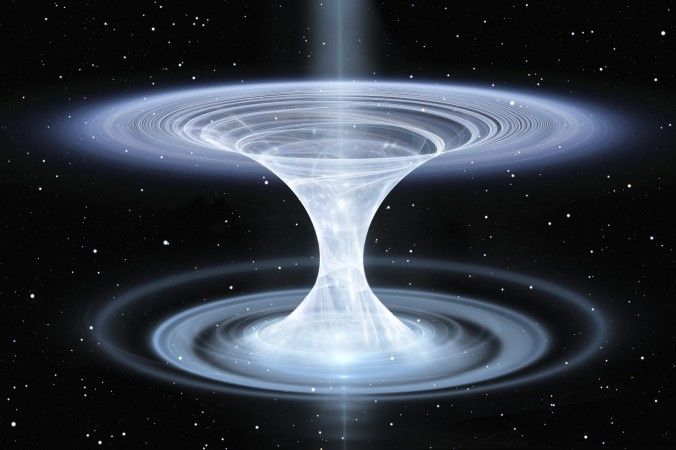
© Pitris/iStock)While theoretical proposals for a quantum internet already exist, the problem for scientists is that there is still debate over which technology provides the most efficient and reliable teleportation system.
For many people the word "teleportation" conjures up "Beam me up, Scotty" images from Star Trek. But in the last two decades, quantum teleportation—transferring the quantum structure of an object from one place to another without physical transmission—has moved from the realms of science fiction to tangible reality.

Quantum teleportation is an important building block for quantum computing, quantum communication, and quantum network and, eventually, a quantum internet. While theoretical proposals for a quantum internet already exist, the problem for scientists is that there is still debate over which technology provides the most efficient and reliable teleportation system.

[QUANTUM INFO 'BEAMED UP' VIA DONUT TELEPORTATION]

In a new paper, published in Nature Photonics, scientists reviewed the theoretical ideas around quantum teleportation focusing on the main experimental approaches and their associated advantages and disadvantages.

Hardhat

Direct link Russian bridge to Crimea going up at lightning speed

Crimea bridge to Russia
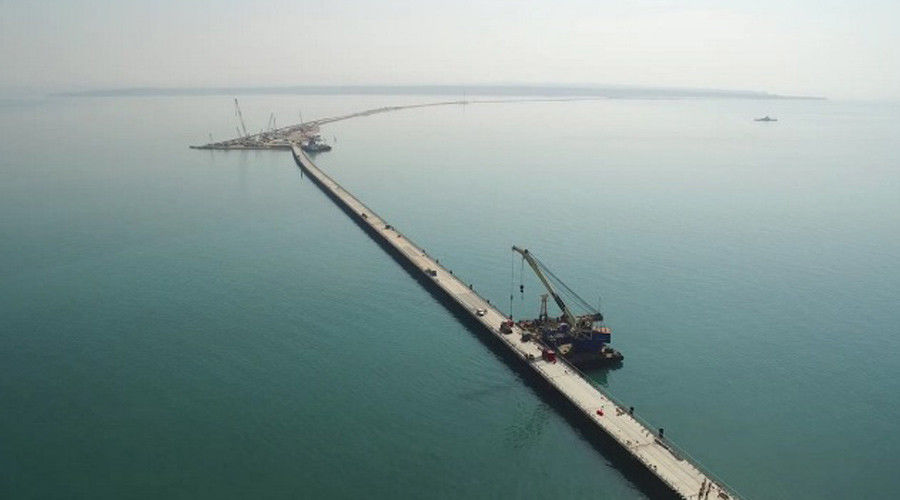
© SGM-Most press-service / KP.ru
Mainland Russia is one step closer to a direct link to Crimea. Workers are building temporary bridges that will carry construction machinery and deliver materials to the Kerch bridge site. Eventually there will be three bridges, one is already working.

The Crimean Peninsula's only land border is with Ukraine, but currently regular passenger and cargo deliveries are organized by direct flights and ferries from ports in southern Russia.

The 19-kilometer long main bridge is expected to open in December 2018 and will connect Kerch in Crimea to mainland Russia and by-pass Ukraine.

Comment: Russia building bridges, US burning them.