Science & TechnologyS


Eye 1

'X-Ray vision': Wifi networks can now identify who you are through walls

wifi through walls
© MIT Computer Science & Artificial Intellegence Laboratory
Who needs a peep hole when a wifi network will do? Researchers from MIT have developed technology that uses wireless signals to see your silhouette through a wall—and it can even tell you apart from other people, too.

The team from MIT's Computer Science and Artificial Intelligence Lab are no strangers to using wireless signals to see what's happening on the other side of a wall. In 2013, they showed off software that could use variations in wifi signal to detect the presence of human motion from the other side of a wall. But in the last two years they've been busy developing the technique, and now they've unveiled the obvious — if slightly alarming — natural progression: they can use the wireless reflections bouncing off a human body to see the silhouette of a person standing behind a wall.

Not only that, the team's technique, known is RF-Capture, is accurate enough to track the hand of a human and, with some repeated measurements, the system can even be trained to recognise different people based just on their wifi silhouette. The research, which is to be presented at SIGGRAPH Asia next month, was published this morning on the research group's website.

Sun

Research suggests that powerful solar storms may be more common than previously thought

solar flare
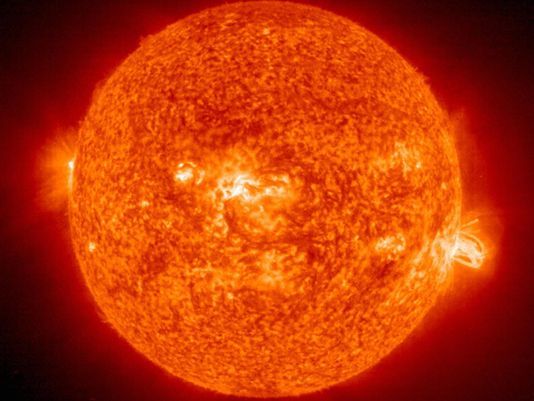
© HO/AFP/Getty ImagesThis 19 August, 2004 NASA Solar and Heliospheric Administration (SOHO) image shows a solar flare(R) erupting from giant sunspot 649. The powerful explosion hurled a coronal mass ejection(CME) into space, but it was directed toward Earth.
Powerful solar storms may be more common than previously thought, according to a study that found two massive storms hit Earth 219 years apart. They were several times stronger than previously recorded ones. Such storms could wreak havoc on technology.

After studying ancient ice cores from Greenland and Antarctica, researchers at Lund University in Sweden found that the two solar storms hit Earth more than 1,000 years ago - the "red crucifix" storm in AD 774/775 and another in AD 993/994.

The study follows the work of researchers in 2012, when they found traces of a rapid increase of radioactive carbon in tree rings from those time periods. The 774/775 event corresponded with a text in an ancient Anglo-Saxon Chronicle, which referred to a "red crucifix" appearing in the heavens after a sunset.

Comment: A Perfect Solar Superstorm: The 1859 Carrington Event


Solar Flares

S1 solar storm warning issued

solar flare
© HO/AFP/Getty ImagesThis 19 August, 2004 NASA Solar and Heliospheric Administration (SOHO) image shows a solar flare(R) erupting from giant sunspot 649. The powerful explosion hurled a coronal mass ejection(CME) into space, but it was directed toward Earth.
The National Oceanic and Atmospheric Administration (NOAA) issued a minor solar radiation storm warning on Thursday morning following readings from a weather satellite in orbit around the Earth.

The warning is expected to last from 12:30 a.m. to 1 p.m. EST, Thursday afternoon.

Officials said that the warning is the result of a coronal mass ejection from the sun that happened around 10:19 p.m. EST on Wednesday as noted by radio signatures.

Fireball 2

Hallowe'en sky show on tap? Taurids meteor shower strengthens this weekend

2015 Taurid meteor stream
© StellariumThe motion of the radiant of the Northern Taurid meteors from mid-October through mid-November. The shower typically peaks around November 12th annually.
Asteroid 2015 TB145 isn't the only cosmic visitor paying our planet a trick-or-treat visit over the coming week. With any luck, the Northern Taurid meteor shower may put on a fine once a decade show heading into early November.

About once a decade, the Northern Taurid meteor stream puts on a good showing. Along with its related shower the Southern Taurids, both are active though late October into early November.

Specifics for 2015

This year sees the Moon reaching Full on Tuesday October 27th, just a few days before Halloween. The Taurid fireballs, however, have a few things going for them that most other showers don't. First is implied in the name: the Northern Taurids, though typically exhibiting a low zenithal hourly rate of around 5 to 10, are, well, fireballs, and thus the light-polluting Moon won't pose much of a problem. Secondly, the Taurid meteor stream is approaching the Earth almost directly from behind, meaning that unlike a majority of meteor showers, the Taurids are just as strong in the early evening as the post midnight early morning hours. As a matter of fact, we saw a brilliant Taurid just last night from light-polluted West Palm Beach in Florida, just opposite to the Full Moon and a partially cloudy sky.

Solar Flares

Strong magnetic fields found in the inner cores of stars

magnetic star
This artist's representation of a red giant star with a strong internal magnetic field shows sound waves propagating in the stellar outer layers, while gravity waves propagate in the inner layers where a magnetic field is present.

Astronomers have for the first time probed the magnetic fields in the mysterious inner regions of stars, finding they are strongly magnetized.

Using a technique called asteroseismology, the scientists were able to calculate the magnetic field strengths in the fusion-powered hearts of dozens of red giants, stars that are evolved versions of our sun.

"In the same way medical ultrasound uses sound waves to image the interior of the human body, asteroseismology uses sound waves generated by turbulence on the surface of stars to probe their inner properties," says Caltech postdoctoral researcher Jim Fuller, who co-led a new study detailing the research.

The findings, published in the October 23 issue of Science, will help astronomers better understand the life and death of stars. Magnetic fields likely determine the interior rotation rates of stars; such rates have dramatic effects on how the stars evolve.

Comet

Oxygen discovered on Comet 67P by Rosetta spacecraft, challenging prevailing theories on formation of solar system

 Rosetta’s lander Philae
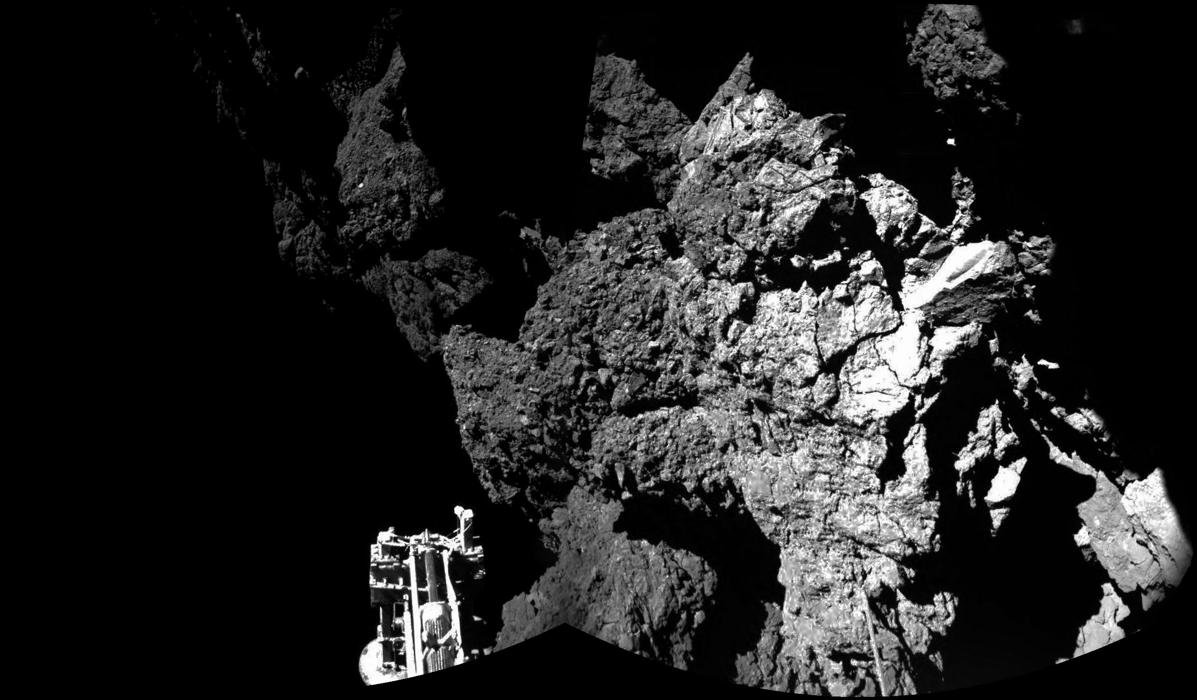
© AP Photo/Esa/Rosetta/PhilaeThe combination photo of different images taken with the CIVA camera system released by the European Space Agency ESA on Thursday Nov. 13, 2014 shows Rosetta’s lander Philae as it is safely on the surface of Comet 67P/Churyumov-Gerasimenko, as these first CIVA images confirm.
Large quantities of oxygen have been discovered in the gassy halo of Comet 67P/Churyumov-Gerasimenko, with stunned scientists saying that the "big surprise" challenges theories about the formation of our Solar System.

"We believe this oxygen is primordial, which means it is older than our Solar System," said scientist Andre Bieler of the University of Michigan.

The oxygen molecules found by the European Space Agency's Rosetta spacecraft in the comet's halo must have existed "before or at" the formation of our solar system, Bieler said.

The discovery challenges prevailing existing theories about the formation of our solar system some 4.6 billion years ago.

Bulb

Researchers use ancient bacteria to create self-ventilating garments

Image
© Rob Chron/MIT Media LabLiving garment - "Second Skin".
Bacteria discovered 1,000 years ago in Japan is being used to grow a "second skin" that responds to a person's sweat. It could revolutionize sportswear and extend to other parts of our daily lives - including our lampshades and tea.

Researchers at MIT Media Lab's Tangible Media Group are using the Bacillus Subtilis natto bacteria to create a synthetic "second skin," known as BioLogic, which physically moves and morphs when it is exposed to moisture. It opens up flaps on the "skin" that will allow sweat to evaporate when a person's body temperature or sweat volume reaches a certain threshold.

The idea to use the bacteria came while MIT PhD student Lining Yao was testing various microorganisms in the lab and realized that the natto bacteria grew and contracted based on how much moisture it was exposed to. The bacteria "becomes a nano-actuator that expands and shrinks depending on different relative humidity conditions, such as the humidity level in the atmosphere or sweat on the skin," Yao said. She then gave herself quite a challenge - to see if those movements could be used to act like a machine, rather than an unpredictable organism.

Image
© MIT Media LabMicroscopic view of the bio- hybrid film with Bacillus Subtilis Natto bacteria (Scanning Electron Microscope from MIT CMSE)
The concept is part of what the MIT group calls Radical Atoms, a vision where materials themselves are interactive - known as "material user interfaces," or MUI. "We are imagining a world where actuators and sensors can be grown rather than manufactured, being derived from nature as opposed to engineered in factories," Yao said in a press release.

Comment: Researchers discover bacteria communicate with each other, coordinate their actions


Eye 1

New wireless technology can see people through walls

Image
© MITCSAIL / YouTubeExample of the RF-Capture results
MIT researchers have developed WiFi technology that is capable of seeing a human through an obstacle ‒ like a wall ‒ and reconstructing the image by analyzing the reflections from the signals. The technology has a variety of practical applications.

The new device, called RF-Capture, is based on previous methods of capturing movements across a house. That technology is currently used by firefighters to determine if they need to save anyone in a burning building, as well as by mothers to see their baby's breathing, Popular Mechanics reported.

Comment: Interesting technology, but we should keep in mind that any form of gigahertz eletcromagnetic radiation is not good for human bodies.


Magnify

Researchers examine how a face comes to represent a whole person in the brain

Image
© Laboratory of Neural Systems at The Rockefeller UniversityThe brain patches activated by the sight of a face (red) or a body (blue) appear above in the flattened representation of the area around one macaque's superior temporal sulcus (dark gray).
The sight of a face offers more than a collection of features; it can provide critical information about the whole individual. A new brain imaging study shows that parts of a primate face processing system prefer faces with bodies, offering some insight into how faces convey social information.

A brain imaging study at the Rockefeller University offers some insight into how faces achieve this special status. The scientists found that certain spots dedicated to processing faces in the primate brain prefer faces with bodies--evidence they are combining both facial and body information to represent an individual.

The study, published on October 13 in the Proceedings of the National Academy of Sciences, was conducted in rhesus macaque monkeys. Humans have a similar system that responds to faces, suggesting the findings have relevance for understanding our own social processing as well.

Telescope

Can the laws of physics be changing?

quasar
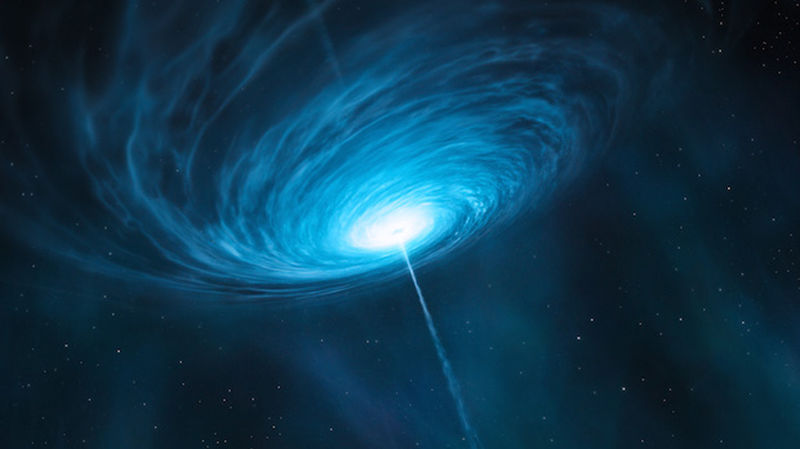
© ESO/M. Kornmesser, adapted under a Creative Commons license.An artist’s impression of the quasar 3C 279. Astrophysicists use light from quasars to look for variations in the fundamental constants.
Can the laws of physics change over time and space?

As far as physicists can tell, the cosmos has been playing by the same rulebook since the time of the Big Bang. But could the laws have been different in the past, and could they change in the future? Might different laws prevail in some distant corner of the cosmos?

"It's not a completely crazy possibility," says Sean Carroll, a theoretical physicist at Caltech, who points out that, when we ask if the laws of physics are mutable, we're actually asking two separate questions: First, do the equations of quantum mechanics and gravity change over time and space? And second, do the numerical constants that populate those equations vary?