Science & TechnologyS


Telescope

Russia opens first static meteor observing station in Siberia

Image
© Irkutst State UniversityOn a clear night, the equipment has registered up to 40 meteorites.
One early visitor: a fireball streaking across the sky and splashing into Lake Baikal.

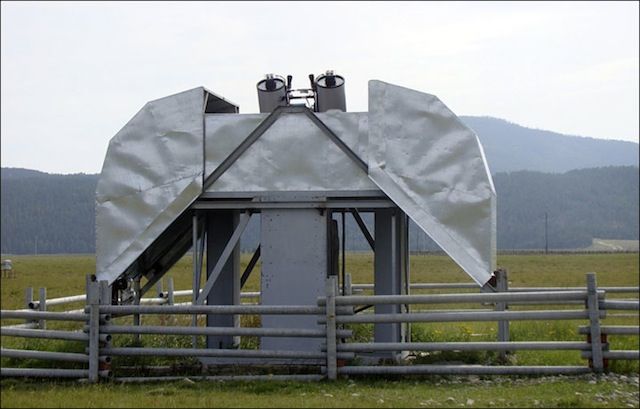
The station is in remote Tunka valley, in the Republic of Buryatia, an ideal vantage point for observing incoming meteors because of the absence of artificial lighting. Created by the astronomical observatory of the Irkutsk State University (ISU), it operates from two unmanned modules some 58 kilometres apart.

This allows researchers to observe the same meteor from two different locations, and to measure its size, light energy, direction, weight of meteoric particles and other parameters, more precisely.

Kirill Ivanov, researcher at ISU's observatory, explained that the cameras are pointed in such a way that the centres of their field of view match at a height of about 100 km. 'They ensure maximum overlap of the field of view, two thirds, at a height of about 80-120 km. The data is stored in industrial computers.' On a clear night, the equipment has registered up to 40 meteorites.
Image
© The Siberian TimesIt operates from two unmanned modules some 58 kilometres apart.

Comment: Huge meteorite crashes in Lake Baikal, Siberia


Comet

Interview with astronomer Bill Napier: Cyclical catastrophes and cometary bombardments

komet, comet graphic
The Tusk has been interested for some time in conducting an occasional interview with players in fields related to cosmic catastrophes in human times. So much of the coverage of our subject is "drive-by" journalism, with uninformed reporters on deadline asking shallow, often misinformed, questions of key scientists and then writing a story which barely informs. The subject deserves something at least a little better. So, in a modest effort to add a more depth to the popular record than is commonly provided, I nominated our blog to try out a few interviews.

It was an easy call whom to approach first, Bill Napier. He is a digital acquaintance of mine, a cool guy and a wiseman. Astronomer, best-selling popular author, frequent contributor to a 40 year canon of astronomical justification for end-times in the peopled past — Bill Napier is simply a Tusk kind of guy!

Napier and his collaborators in the old country are even credited with their own handle, "British Neo-Catastrophists." Post-Newton and Whiston, Post-Velikovsky, concurrent with Alvarez but Pre-Firestone — shunned by NASA and employed by the Queen — they are contributors to a cogent set of astronomical facts termed "Coherent Catastrophism," a body of evidence concluding that quite horrible cosmic encounters have occurred in the human past.

Here goes:

Comment: As a reminder of what can come out of the sky without any warning at all, see the Chelyabinsk meteor from February 2013:


Comment: For more on the very high probability of Earth soon being on the receiving end of a major cometary bombardment, and why, see Laura Knight-Jadczyk's Comets and Catastrophe series: And the books: Comets and the Horns of Moses by Laura Knight-Jadczyk
and Earth Changes and the Human Cosmic Connection: The Secret History of the World - Book 3 by Pierre Lescaudron
and Laura Knight-Jadczyk


Magnify

Study of specially bred chickens reveals evolution much faster than thought

chickens in green grass
© Virginia Tech/John McCormickA selective mating approach within the population that started in 1957 has resulted in an over tenfold difference in the size of the chickens.
A population of chickens studied over the past 50 years reveals that evolution can happen 15 times faster than previously thought.

The study overturns the popular assumption that evolution is only visible over long time scales. The findings are published in the journal Biology Letters.

"Our observations reveal that evolution is always moving quickly, but we tend not to see it because we typically measure it over longer time periods," Greger Larson of Oxford University's Research Laboratory for Archaeology said in a press release.

"Our study shows that evolution can move much faster in the short term than we had believed from fossil-based estimates."

Larson and his team looked at a well-documented, 50-year pedigree of a population of white Plymouth Rock chickens developed at Virginia Tech by Paul Siegel. The researchers focused on reconstructing how the mitochondrial DNA passed from mothers to daughters within the chicken population.

Comment: And yet the chickens are still chickens. So, micro-evolution progresses faster than predicted, yet macro-evolution is still somewhere off in the distance...


Fish

Fisherman designs prize-winning solution for sustainable ocean farming

ocean farming, greenwave
A fisherman working in industrialized fishing environments realized something that affected his fundamental outlook on what he was doing: he was witnessing very efficient fishing technologies and boats ripping up entire ecosystems with trawls; he was seeing efficient technologies being applied in ways that were chasing fish farther and farther out to sea.

Bren Smith eventually went on to develop a model for ocean farming. He is executive director of GreenWave, and he is on a mission to help support ocean life and human life. His farm design has won a prize in the 2015 Buckminster Fuller Challenge given by the Buckminster Fuller Institute.

He is recognized for coming up with an innovative solution in sustainable ocean farming, a model for development of multi-species ocean farms.

Biofuels Digest talked about what is special about Smith's concept—a shift away from growing vulnerable monocultures to vibrant ecosystems, which can result in higher yields.

The push is for sustainable aquaculture that produces high yields while restoring and improving the ocean's ecosystems.

Footprints

Down in the dumps: Study shows loss of big animals and their poop damages Earth

Image
© NOAA/Reuters
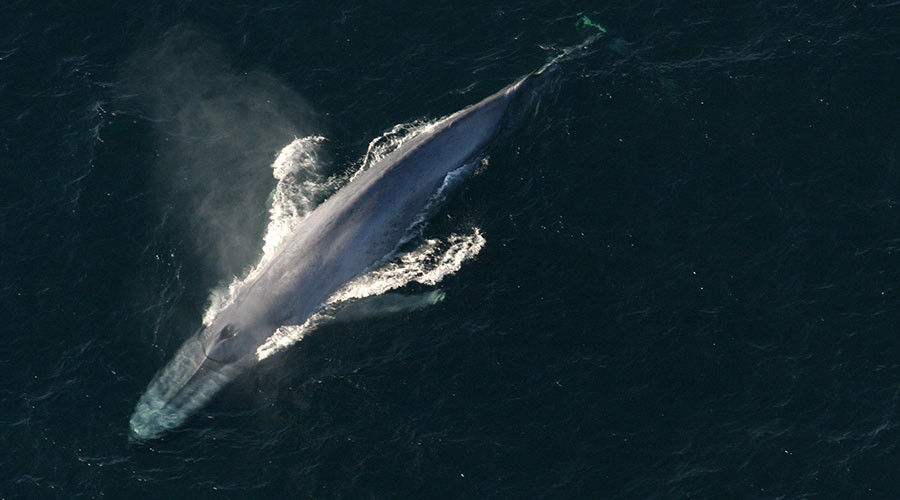
A new study shows that whales and outsized land mammals, as well as seabirds and migrating fish, play a vital role in keeping the planet fertile by transporting nutrients from ocean depths to mountaintops - but their populations are plummeting.

Before the rise of modern humans, there were "deer with twelve-foot antlers, and bison herds to the horizon" that ate huge amounts of plant matter, moving these nutrients to higher ground "through their deposit of feces, urine and, upon death, decomposing bodies. I wanted to know whether the world of the past with all the endemic animals was more fertile than our current world," lead study author Chris Doughty of Oxford University told The Washington Post.

Doughty's team applied a set of mathematical models to estimate the movement of nutrients vertically in the oceans and across the land, and how this movement changed with extinctions and declining animal populations. What researchers found was that these megafauna, or large animals, played a greater role in the spread of nutrients across the planet than scientists realized. Equally, whales and other marine mammals moved phosphorous from deep ocean water to the surface, which was then spread by seabirds and migrating fish across seas, up rivers, and deep inland to the mountaintops.

Previously, scientists studied nutrient cycling related to the weathering of rocks, which broke down and left nutrients in the soil. They also found that microbes and bacteria contributed to nutrient cycling. The team's new finding adds another dimension to the science, finding that fertilized ecosystems maintain natural functions vital to people. "Previously, animals were not thought to play an important role in nutrient movement," said Doughty in a statement.

Comment: For more on how the loss of the flora and fauna effect our terrestrial life, listen to the SOTT editor's interview with Lierre Keith, author of The Vegetarian Myth.

SOTT Talk Radio: Dissecting the Vegetarian Myth - Interview with Lierre Keith


Jupiter

Venus, Mars and Jupiter align in rare event

Image
© BBC
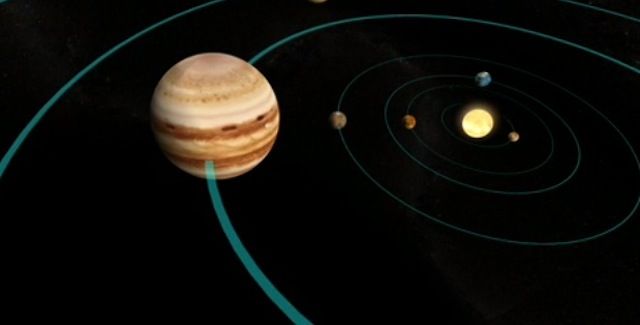
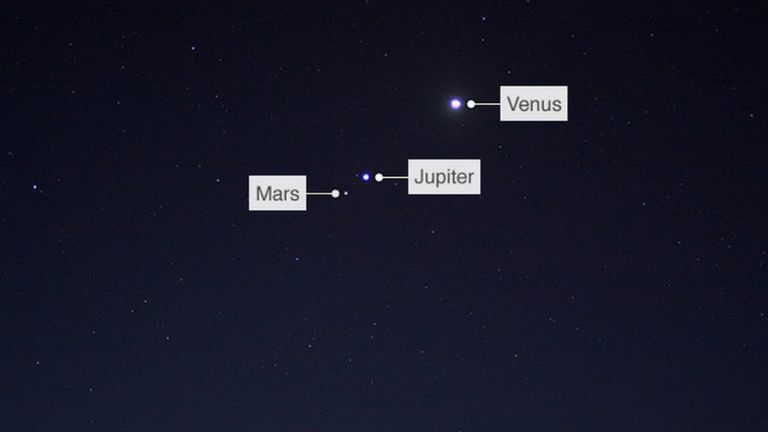
Venus, Jupiter and Mars can all be seen together in the sky this week, in a rare grouping of the three planets.

The planetary conjunction - in which planets "line up" due to the timing of their orbits around the Sun - has been visible for days and will continue until at least the end of the week. The planets are best seen before sunrise and will form a particularly neat triangle on Thursday. The next time the planets cluster this close together will be in January 2021.

But how do would-be astronomers see the spectacle before it is gone?

How do I see it?

The planets can be seen without equipment, towards the east. The best time to see them is just before sunrise because at this time they are high in the sky but it is dark enough to see them. Binoculars and telescopes can be used to see the planets in more detail
Image
© BBC
Which planet is which?

The easiest planet to see is Venus, which is about 12 times brighter than Jupiter. Jupiter appears second brightest. Mars is about 250 times less bright than Venus. To see Mars it may be necessary to get up an hour before sunrise.

Comment: Spectacular Orionid meteor shower 2015 - photos


Info

Tractor beam levitates object using sound waves

Levitation
© Image courtesy of Asier Marzo, Bruce Drinkwater and Sriram SubramanianResearchers recently created an acoustic hologram, or a 3D sound field projected onto a 2D space, which can be used as acoustic tweezers, cages and twisters that manipulate objects as they levitate in air.
It may seem straight out of Star Trek, but it's real: Scientists have created a sonic "tractor beam" that can pull, push and pirouette objects that levitate in thin air.

The sonic tractor beam relies on a precisely timed sequence of sound waves that create a region of low pressure that traps tiny objects that can then be manipulated solely by sound waves, the scientists said in a new study.

Though the new demonstration was just a proof of concept, the same technique could be adapted to remotely manipulate cells inside the human body or target the release of medicine locked in acoustically activated drug capsules, said study co-author Bruce Drinkwater, a mechanical engineer at the University of Bristol in the United Kingdom.

Info

NASA develops 'blackest' man-made material ever produced

carbon-nanotube coating absorbs 99 percent light
© Stephanie Getty, NASA GoddardThis close-up view (only about 0.03 inches wide) shows the internal structure of a carbon-nanotube coating that absorbs about 99 percent of the ultraviolet, visible, infrared, and far-infrared light that strikes it. A section of the coating, which was grown on smooth silicon, was purposely removed to show the tubes' vertical alignment.
NASA engineers have produced a material that absorbs on average more than 99 percent of the ultraviolet, visible, infrared, and far-infrared light that hits it -- a development that promises to open new frontiers in space technology.

The team of engineers at NASA's Goddard Space Flight Center in Greenbelt, Md., reported their findings recently at the SPIE Optics and Photonics conference, the largest interdisciplinary technical meeting in this discipline. The team has since reconfirmed the material's absorption capabilities in additional testing, said John Hagopian, who is leading the effort involving 10 Goddard technologists.

"The reflectance tests showed that our team had extended by 50 times the range of the material's absorption capabilities. Though other researchers are reporting near-perfect absorption levels mainly in the ultraviolet and visible, our material is darn near perfect across multiple wavelength bands, from the ultraviolet to the far infrared," Hagopian said. "No one else has achieved this milestone yet."

Question

Are bilingual's brains wired differently?

brain work
© shutterstock
The frequent switching between languages in bilinguals' brains has led many to ask whether this lifelong exercise also makes bilinguals better at controlling other mental processes, giving them a cognitive edge. That remains to be determined. But in a new study, researchers took a more nuanced look at cognition in bilinguals, and rather than focusing on the question of the so-called bilingual advantage, examined how bilinguals used their brains while performing a simple cognitive task. And, as it turns out, they used them differently than monolinguals.

The idea of the bilingual advantage is supported by a number of studies that have shown that bilinguals may have enhanced executive control — a set of mental skills that help us manage our cognitive processes, from working memory, to multitasking and problem-solving. But some scientists have expressed skepticism about the strength of evidence that suggests bilinguals have a cognitive advantage over monolinguals. In a 2014 study, researchers examined conference abstracts outlining ongoing studies on bilingualism and executive control. They then followed up to see which of those studies eventually got accepted for publication in scientific journals and found that the studies whose results failed to support the idea of the bilingual advantage were less likely to get published than those that supported it. This led them to think that there might be a publication bias that skews the literature on bilingualism's cognitive boost.

Comment: See also:

Bilingualism 'can increase mental agility'
Bilingual brains process information more efficiently


Info

Study suggests Alzheimer's is associated with brain fungus

Fungi in the Brain
© The EconomistScarred by fungi?
Like cancers and heart disease, Alzheimer's is a sickness of the wealthy. That is because it is a sickness of the old. A study carried out in Spain in 2008 suggested that the risk of developing it doubles for every five years you live beyond 65. A richer world means a longer-lived world—and that, in turn, means a world which will suffer more and more from dementia. At least 40m people are thought to be affected by it already. The true number is likely to be higher, as many sufferers, particularly in the early stages of the disease, have yet to be diagnosed.

What actually causes Alzheimer's disease, though, is obscure. Workers in the field know that tangles and plaques of misshapen proteins play a big role. These accumulate in and between nerve cells, eventually killing them to create voids in the brain (see picture). It may be that the accumulation of these proteins is merely a biochemical ill to which human flesh is unfortunately heir, and which is a normal (if unwelcome) consequence of ageing. But some researchers doubt that, and are searching for external causes.

There is evidence, in varying degrees, for everything from bacterial or viral infections, via head injuries to smoking. But a paper just published in Scientific Reports adds another possibility to the pot. A group of researchers led by Luis Carrasco of the Autonomous University of Madrid, in Spain, have raised the idea that the ultimate cause of Alzheimer's is fungal.

Dr Carrasco and his team examined brain tissue from 25 cadavers, 14 of which belonged to people who had had Alzheimer's disease when alive. The other 11 (who had an average age of 61, versus 82 for the Alzheimer's sufferers) had been Alzheimer's-free. That may sound like a small sample from which to draw conclusions, but the signal the researchers found was overwhelming. Every single one of the Alzheimer's patients had signs of fungal cells of various sorts growing in his or her neurons. None of the Alzheimer's-free brains was infected.

Comment: See also: