Science & TechnologyS


Microscope 1

Researchers use 3D printer to create potential replacement bones

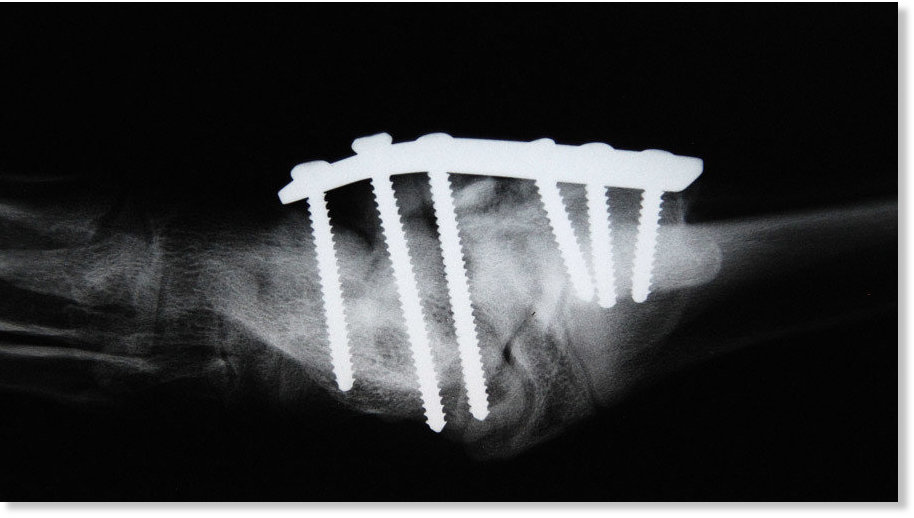
x ray
© Phil Noble / Reuters
Bones made out calcium could be going the way of the flip phone! Not really, but researchers at Northwestern University have developed a breakthrough "hyper-elastic bone" that could be used in living tissue to bind bone and tendons together.

If this new composite bone is approved for humans, it could be used to treat several injuries. The hyper-elastic bone can not only function as a custom bone implant but can also promote bone growth.

The current options for bone grafts range from ceramics to mineralized collagen. But the side effects from current bone grafts pretty much result in what can be expected from introducing a foreign object to the body: infections, pain and implant displacement. However, the hyper-elastic bone could be a viable alternative with minimal side effects.

The first test of the hyper-elastic bone was promising. They began with a mouse and surrounded two of its vertebrae with the porous synthetic bone. Eight weeks later, they discovered that bone and tissue had grown into graft material and fused the vertebrae together.

Satellite

Curtain call: Rosetta spacecraft crashes onto comet for mission finale

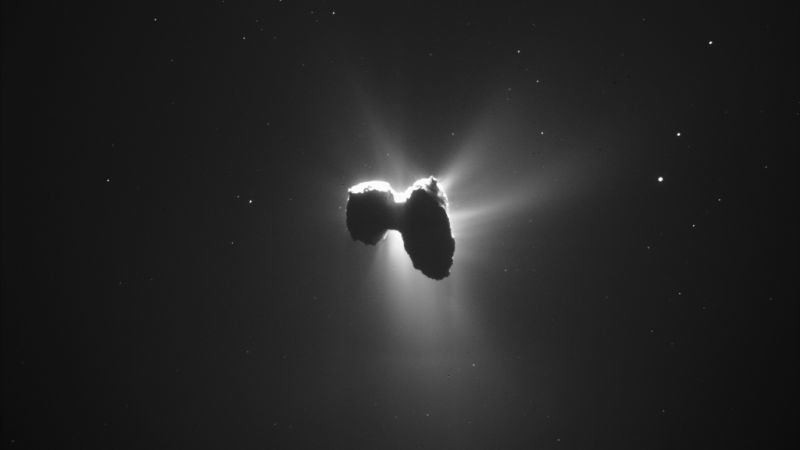
67P/Churyumov-Gerasimenko comet
© rosettamission / Instagram
The European Space Agency's Rosetta spacecraft has crash landed onto a comet, ending its 12-year mission.

The space probe has been studying the 67P/Churyumov-Gerasimenko comet for two years.

In the end, the Rosetta spacecraft's curtain call was met with a sombre silence and then a brief cheer in the ESA's mission control room after it successfully crash landed onto the comet.

Magnify

Genetic analysis reveals four species of giraffe, two of which on the most endangered large animals list

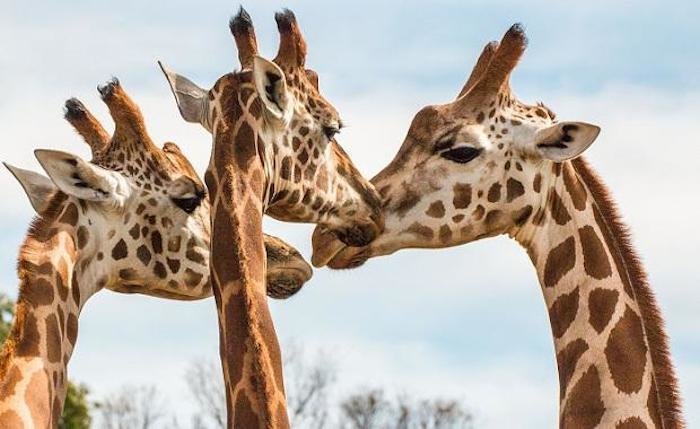
3 giraffes
© www.zoo.orgHeads above the rest, a tall order!
Up until now, scientists had only recognized a single species of giraffe made up of several subspecies. But, according to the most inclusive genetic analysis of giraffe relationships to date, giraffes actually aren't one species, but four. For comparison, the genetic differences among giraffe species are at least as great as those between polar and brown bears. The unexpected findings reported in the Cell Press journal Current Biology on September 8 highlight the urgent need for further study of the four genetically isolated species and for greater conservation efforts for the world's tallest mammal, the researchers say.

"We were extremely surprised, because the morphological and coat pattern differences between giraffe are limited," says Axel Janke, a geneticist at the Senckenberg Biodiversity and Climate Research Centre and Goethe University in Germany. Giraffes are also assumed to have similar ecological requirements across their range, he added, "but no one really knows, because this megafauna has been largely overlooked by science."

Giraffes are in dramatic decline across their range in Africa. Their numbers have dropped substantially over the last three decades, from more than 150,000 individuals to fewer than 100,000. Despite that, the researchers say that there has been relatively little research done on giraffes in comparison to other large animals, such as elephants, rhinoceroses, gorillas, and lions.

Jupiter

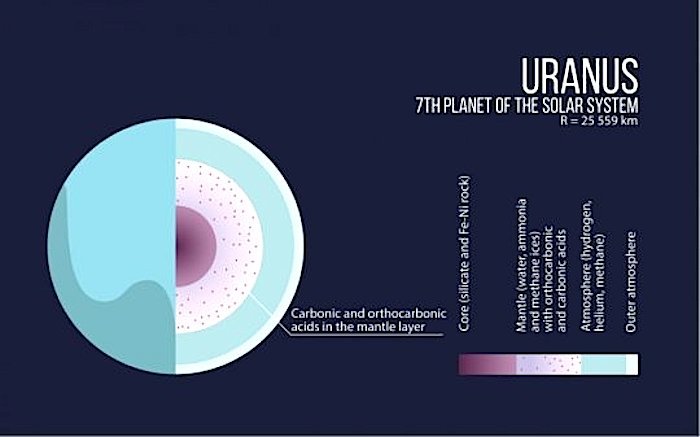
Extraordinary compounds contained inside Uranus and Neptune

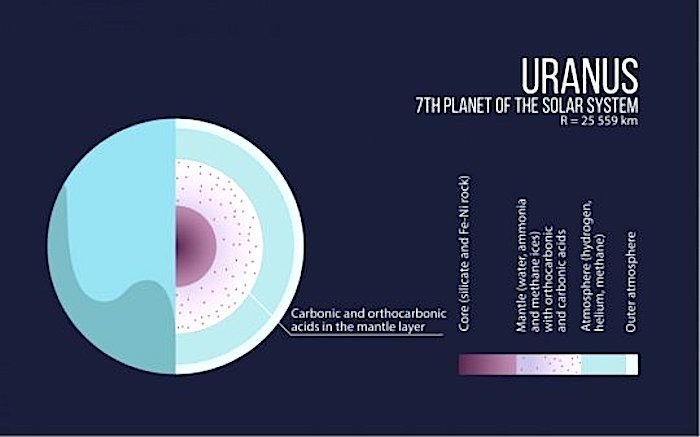
Uranus diagram
© MIPT Press
Using computer modeling, chemists from MIPT and Skoltech (the Skolkovo Institute of Science and Technology) have found out which molecules may be present in the interiors of Uranus, Neptune, and the icy satellites of the giant planets. The scientists discovered that at high pressures, which are typical for the interiors of such planets, exotic molecular and polymeric compounds are formed. These compounds include carbonic acid and orthocarbonic acid, the latter also known as 'Hitler's Acid'. The results of the study have been published in the journal Scientific Reports.

"The smaller gas giants -- Uranus and Neptune -- consist largely of carbon, hydrogen and oxygen. We have found that at a pressure of several million atmospheres unexpected compounds should form in their interiors. The cores of these planets may largely consist of these exotic materials," says Head of Laboratory of Computational Materials Discovery, Professor Artem R. Oganov.

A team led by Professor Oganov developed the world's most universal and powerful algorithm for crystal structure and compound prediction -- USPEX (Universal Structure Predictor: Evolutionary Xtallography). In recent years, scientists have used this algorithm to discover several substances that are 'forbidden' in classical chemistry and that may be stable at high pressures. These include a number of previously unknown variants of salt -- Na3Cl, NaCl3, NaCl7 and even Na3Cl2 and Na4Cl3, as well as exotic new oxides of magnesium, silicon and aluminium which may exist in the interiors of super-Earths.

Now Gabriele Saleh (the first author of this study) from MIPT and Oganov have decided to study the chemical behaviour of the carbon-hydrogen-oxygen system under high pressure. "This is an extremely important system because all organic chemistry 'rests on' these three elements, and until now it had not been entirely clear how they behave under extreme pressures and temperatures. In addition, they play an essential role in the chemistry of the giant planets," says Oganov.

Telescope

Mysterious 'significant' emissions detected in space: Astronomers say strange signals could be from hidden galaxies

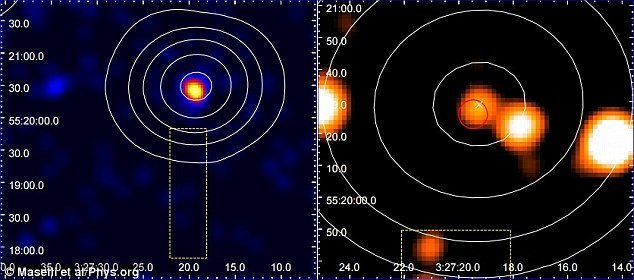
3c86 XRT WISE
© Maselli et al Phys.orgThe team observed 21 bright radio sources from the revised Third Cambridge Catalogue, leading to the detection of ‘significant’ emissions for nine. A sky map showing the direction of a radio source called 3C 86 is shown as observed by XRT, on left, and WISE, on right.
At the end of last year, researchers using Nasa's Swift space observatory launched an investigation to study a group of mysterious radio sources first detected nearly six decades ago.

For four months, team observed 21 bright radio sources from the revised Third Cambridge Catalogue, leading to the detection of 'significant' emissions for nine of them with the X-ray Telescope.

But, when using the spacecraft's Ultraviolet/Optical Telescope, no sources could be found.

These new observations support earlier assumptions that the source of these emissions may be 'heavily obscured' active galaxies.

Telescope

Everything you need to know to watch Rosetta crash into Comet 67P this week

Comet 67P
© n/a
The Rosetta spacecraft has spent three years peering at Comet 67P/Churyumov - Gerasimenko from orbit—but this week, its watch will end. Tomorrow, Rosetta begins a controlled descent to its final resting place on the edge of an enormous pit, where it'll remain frozen until the space rock itself is destroyed, or until the universe expands into oblivion.

It's an emotional time for the Rosetta mission team, but also an exciting one. The final hours of Rosetta's life are expected to yield some of the juiciest scientific data of the entire mission—the sharpest images yet of a comet's surface, our very first whiffs of the gas directly above it, and much more. Best of all, the entire world is going to be able to follow along, with key moments of the descent, including images, streamed online in real time.

Life Preserver

Researchers create 3D printable 'hyperelastic bone' that could quickly mend injuries


If you shatter a bone in the future, a 3D printer and some special ink could be your best medicine. Researchers have created what they call "hyperelastic bone" that can be manufactured on demand and works almost as well as the real thing, at least in monkeys and rats. Though not ready to be implanted in humans, bioengineers are optimistic that the material could be a much-needed leap forward in quickly mending injuries ranging from bones wracked by cancer to broken skulls.

"This is a neat way to overcome the challenges we face in generating bone replacements," says Jos Malda, a biomaterials engineer from Utrecht University in the Netherlands who was not involved in the work. "The scaffold is simpler to make than others and it offers more benefits."

Ark

Physicists release new paper suggesting time is created in the mind of the observer

clocks
© Pete LinForth/Pixabay
Out of all the pressures we face in our everyday lives, there's no denying that the nature of time has the most profound effect. As our days, weeks, months, and years go by, time moves from past to present to future, and never the other way around.

But according to the physics that govern our Universe, the same things will occur regardless of what direction time is travelling in. And now physicists suggest that gravity isn't strong enough to force every object in the Universe into a forward-moving direction anyway.

So does time as we know it actually exist, or is it all in our heads? First off, let's run through a little refresher about the so-called arrow of time.

Thanks to the forward-facing arrow of time, young becomes old, and the past becomes the present, which was once the future. You can't unscramble your eggs, and you can't Control Z a broken leg.

But if we forget our own perspective for a second, zoom right out, and look at the Universe as a whole, as far as we can tell, the only thing that governs the behaviour of the Universe are the laws of physics.

Archaeology

Archaeologists baffled after discovering ancient Roman coins buried in ruins of Japanese castle

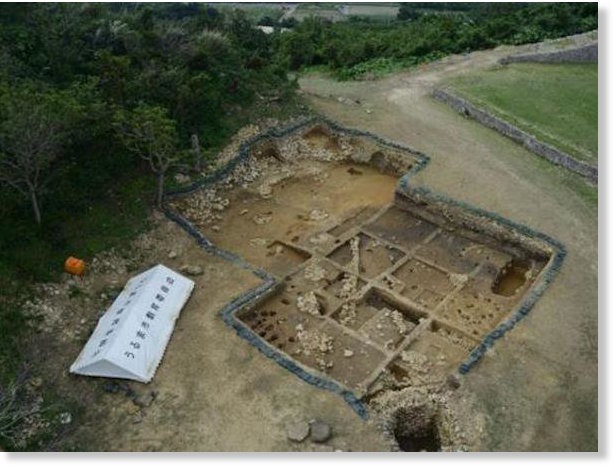
archaeological ruins japan
© Urama Board of EducationOttoman coins and other relics were also found among the ruins
Archaeologists were left baffled by the "strange" discovery of ancient Roman coins buried in the ruins of a castle in Japan.

The four copper coins were retrieved from soil beneath Katsuren Castle on Okinawa Island, and were originally thought to be a hoax before their true provenance was revealed.

The designs on the coins are difficult to decipher as they have been eroded over time, but x-ray analysis revealed several of the relics bore the image of Emperor Constantine I.

Since excavation on the site began in 2013, researchers have also found a further six coins which may be dated back to the Ottoman Empire in the late 17th century.

The Roman coins appear to be much older, dating back to at least 400AD according to estimates.

Brain

How do scientists know which regions of the brain control language?

reading
© Getty
When you read something, you first need to detect the words and then to interpret them by determining context and meaning. This complex process involves many brain regions.

Detecting text usually involves the optic nerve and other nerve bundles delivering signals from the eyes to the visual cortex at the back of the brain. If you are reading in Braille, you use the sensory cortex towards the top of the brain. If you listen to someone else reading, then you use the auditory cortex not far from your ears.

A system of regions towards the back and middle of your brain help you interpret the text. These include the angular gyrus in the parietal lobe, Wernicke's area (comprising mainly the top rear portion of the temporal lobe), insular cortex, basal ganglia and cerebellum.