Science & TechnologyS


Telescope

Cosmic 'Dark Flow' Detected Across Billions Of Light Years

Using data from NASA's Wilkinson Microwave Anisotropy Probe (WMAP), scientists have identified an unexpected motion in distant galaxy clusters. The cause, they suggest, is the gravitational attraction of matter that lies beyond the observable universe.

Galaxy clusters 1E 0657-56
©NASA/WMAP/A. Kashlinsky et al.
Galaxy clusters like 1E 0657-56 (inset) seem to be drifting toward a 20-degree-wide patch of sky (ellipse) between the constellations of Centaurus and Vela.

"The clusters show a small but measurable velocity that is independent of the universe's expansion and does not change as distances increase," says lead researcher Alexander Kashlinsky at NASA's Goddard Space Flight Center in Greenbelt, Md. "We never expected to find anything like this."

Kashlinsky calls this collective motion a "dark flow" in the vein of more familiar cosmological mysteries: dark energy and dark matter. "The distribution of matter in the observed universe cannot account for this motion," he says.

Fish

Primordial Fish Had Rudimentary Fingers

Tetrapods, the first four-legged land animals, are regarded as the first organisms that had fingers and toes. Now researchers at Uppsala University can show that this is wrong. Using medical x-rays, they found rudiments of fingers in the fins in fossil Panderichthys, the "transitional animal," which indicates that rudimentary fingers developed considerably earlier than was previously thought.

Image
©Uppsala University
Scientists found rudiments of fingers in the fins in fossil Panderichthys, the "transitional animal".

Our fish ancestors evolved into the first four-legged animals, tetrapods, 380 million years ago. They are the forerunners of all birds, mammals, crustaceans, and batrachians. Since limbs and their fingers are so important to evolution, researchers have long wondered whether they appeared for the first time in tetrapods, or whether they had evolved from elements that already existed in their fish ancestors.

Telescope

Mars Polar Cap Mystery Solved: Why Southern Ice Cap Is 'Misplaced'

Scientists are now able to better explain why Mars's residual southern ice cap is misplaced, thanks to data from ESA's Mars Express spacecraft - the martian weather system is to blame. And so is the largest impact crater on Mars - even though it is nowhere near the south pole.

Image
©ESA; image courtesy of F. Altieri (IFSI-INAF) and the OMEGA team
This is a mosaic of images taken by the Mars Express's Visible and Infrared Mineralogical Mapping Spectrometer, OMEGA. It shows the residual south polar cap at the end of northern winter on the Red Planet. The cap appears clearly asymmetric, its centre being displaced by 3° from the geographic pole.

Like Earth, Mars has frozen polar caps, but unlike Earth, these caps are made of carbon dioxide ice as well as water ice. During the southern hemisphere's summer, much of the ice cap sublimates, a process in which the ice turns straight back into gas, leaving behind what is known as the residual polar cap. The problem is that while the winter cap is symmetrical about the south pole, the residual cap is offset by some three to four degrees.

This misplacement, which has puzzled planetary scientists for years, was solved by scientists in 2005 but now, thanks to ESA's Mars Express, new information is available to explain the misplacement.

Star

New Cycle 24 Sunspot and SSN wavelet analysis

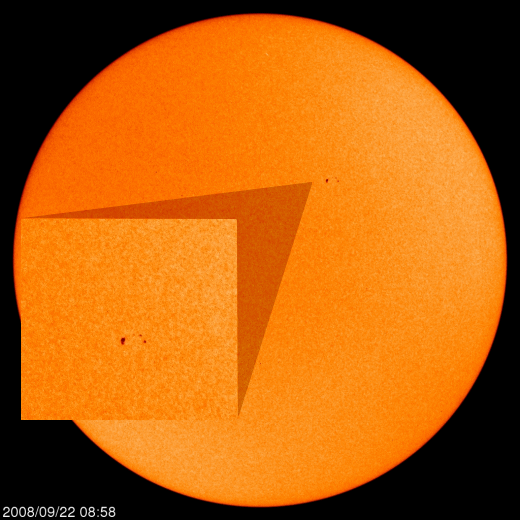
Maybe there is some hope for SC24 ramping up this year yet. This appears to be the largest SC24 spot to date. Previous SC24 spots have faded quickly, we'll see how long this one lasts.

Sun Spot
©NASA

Telescope

Fifth Dwarf Planet Named Haumea

The International Astronomical Union (the IAU) has announced that the object previously known as 2003 EL61 is to be classified as the fifth dwarf planet in the Solar System and named Haumea.

The decision was made after discussions by members of the International Astronomical Union's Committee on Small Body Nomenclature (CSBN) and the IAU Working Group for Planetary System Nomenclature (WGPSN). This now means that the family of dwarf planets in the Solar System is up to five. They are now Ceres, Pluto, Haumea, Eris and Makemake.

The discovery of Haumea was announced in mid-2005, and the object was initially given the provisional designation of 2003 EL61. It is a bizarre object with a shape resembling a plump cigar. Its diameter is approximately the same as that of the dwarf planet Pluto; however, its odd shape means that it is much thinner. It is also known to be spinning very fast, making one rotation in about four hours. Some have suggested that this rapid rotation could be the reason Haumea came to look as it does - the dwarf planet has been drawn out and elongated by its swift spin.

Info

Study Of Satellite Imagery Casts Doubt On Surge's Success In Baghdad

By tracking the amount of light emitted by Baghdad neighborhoods at night, a team of UCLA geographers has uncovered fresh evidence that last year's U.S. troop surge in Iraq may not have been as effective at improving security as some U.S. officials have maintained.

Image
©University of California - Los Angeles
Satellite image of night lights in Baghdad. By tracking the amount of light emitted by Baghdad neighborhoods at night, a team of UCLA geographers has uncovered fresh evidence that last year's U.S. troop surge in Iraq may not have been as effective at improving security as some U.S. officials have maintained.

Night light in neighborhoods populated primarily by embattled Sunni residents declined dramatically just before the February 2007 surge and never returned, suggesting that ethnic cleansing by rival Shiites may have been largely responsible for the decrease in violence for which the U.S. military has claimed credit, the team reports in a new study based on publicly available satellite imagery.

Telescope

Oldest-ever Gamma-ray Burst Detected

NASA's Swift satellite has found the most distant gamma-ray burst ever detected. The blast, designated GRB 080913, arose from an exploding star 12.8 billion light-years away.

Image
©NASA/Swift/Stefan Immler
This image merges the view through Swift's UltraViolet and Optical Telescope, which shows bright stars, and its X-ray Telescope, which

"This is the most amazing burst Swift has seen," said the mission's lead scientist Neil Gehrels at NASA's Goddard Space Flight Center in Greenbelt, Md. "It's coming to us from near the edge of the visible universe."

Because light moves at finite speed, looking farther into the universe means looking back in time. GRB 080913's "lookback time" reveals that the burst occurred less than 825 million years after the universe began.

The star that caused this "shot seen across the cosmos" died when the universe was less than one-seventh its present age. "This burst accompanies the death of a star from one of the universe's early generations," says Patricia Schady of the Mullard Space Science Laboratory at University College London, who is organizing Swift observations of the event.

Star

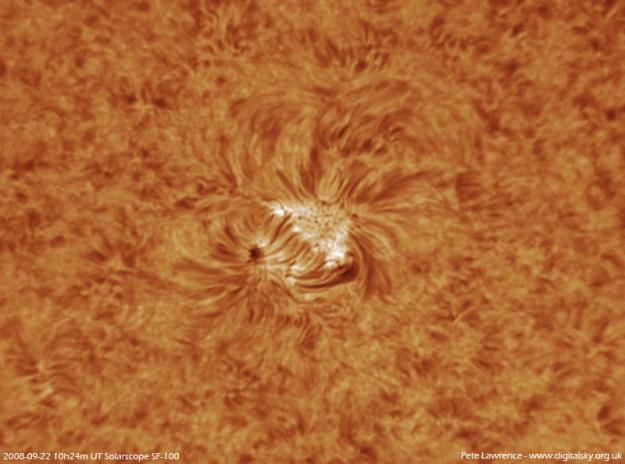
New Sunspot!


New sunspot
©Pete Lawrence

A new sunspot is emerging in the sun's northern hemisphere. After several months of almost-relentlessly blank suns, "this is like a breath of fresh plasma," says photographer Pete Lawrence who sends this picture from Selsey, UK. The magnetic polarity of the emerging spot identifies it as a member of new Sunspot Cycle 24.

Evil Rays

Mosquito causes buzz across the Pond

A device created by a South Wales inventor to disperse unruly youngsters is making a big buzz in the Big Apple.

The Mosquito, which targets gangs of loitering youths, projects a shrill noise audible only to teens and young adults.

It was created by Merthyr Tydfil inventor Howard Stapleton and has already hit the headlines in the UK for both upsetting civil liberties groups and pleasing shop owners.

Comment: Interesting how the police forces in the U.S. love to see citizens "fleeing" from them or their "toys."

Quite telling, actually.


Telescope

Pulsating Stars Enable New Precise Determination Of Rotation Of The Milky Way

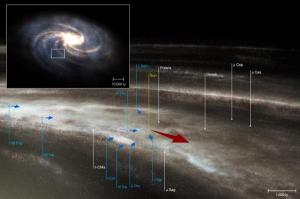
New, very precise measurements have shown that the rotation of the Milky Way is simpler than previously thought. A remarkable result from the most successful ESO instrument HARPS, shows that a much debated, apparent 'fall' of neighbourhood Cepheid stars towards our Sun stems from an intrinsic property of the Cepheids themselves.

Image
©ESO
Artist's impression of the local neighbourhood of the Sun and its setting within our galaxy, the Milky Way (see insert above). The figure shows the positions of some bright stars (in white) in the sky as well as the eight Cepheids used in the investigation (in blue). After the rotation of the Milky Way had been accounted for (red arrow), it seemed that the Cepheids were all 'falling' towards the Sun (blue arrows; these are not to scale: in reality the blue velocities are typically a factor one hundred smaller than the velocity around the Milky Way). New, very precise measurements with the HARPS instrument have shown that this apparent 'fall' is due to effects within the Cepheids themselves and is not related to the way the Milky Way rotates. The motion indicated by the blue arrows is thus an illusion. The scale of the image is given in light-years (ly).