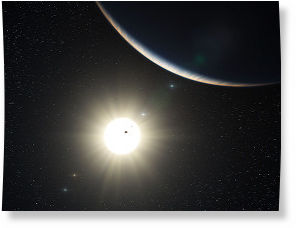
© Scharmer et al/Royal Sweedish Academy of Sciences/SPLInfluential beasts
There are already explanations for why the exact length of a day varies. Changes in winds and ocean currents cause the Earth's spin to slow slightly or speed up to compensate, preserving the planet's total angular momentum. Meanwhile, shifts in how matter is distributed around the planet due to climate change may also affect the speed of Earth's spin.
The latest association, between sunspots, whose abundance rises and falls on an 11-year "solar cycle", and the Earth's spin rate, is perhaps the most bizarre yet.
Researchers have long observed that the spin rate fluctuates with the seasons, in response to shifting wind patterns. Now, a team led by Jean-Louis Le Mouël at the Paris Institute of Geophysics in France has found that this seasonal effect also grows and shrinks in an 11-year cycle, rather like sunspots. Seasons have a bigger effect on spin rate when sunspots are scarce, and a smaller effect when spots are abundant, according to an analysis of data from 1962 to 2009 (Geophysical Research Letters, vol 37, L15307).