Science & TechnologyS


Question

Incoming Cosmic Rays Hit Record High

Heliosphere
© NASAHeliosphere

The Earth was pummeled with record-setting levels of cosmic rays in 2009. Measurements from NASA's Advanced Composition Explorer (ACE) and other spacecraft found that more high-energy particles from galactic space penetrated the inner solar system in the last few years than at any other time since the beginning of the space age.

The spike is almost certainly due to several weird aspects of the most recent solar minimum, and could be the start of a new normal for cosmic ray levels.

"It's sort of like everything's working in the same direction right now, to allow cosmic rays greater access to the inner solar system," said space scientist Richard Mewaldt of Caltech. Mewaldt and colleagues published their findings Oct. 7 in Astrophysical Journal Letters.

Telescope

Astronomers Discover Weird, Warm Spot on an Exoplanet

Image
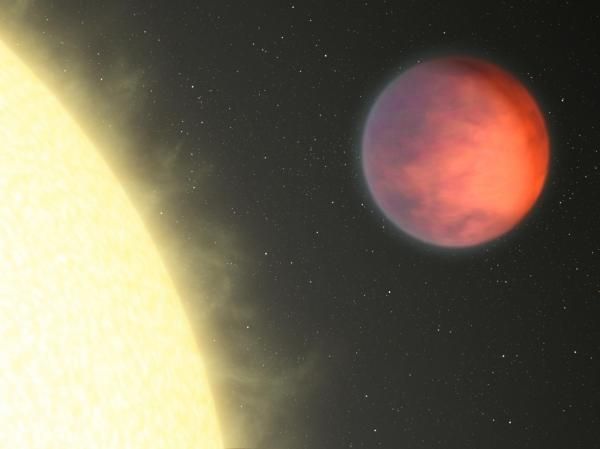
© NASA/JPL-CaltechNASA's Spitzer Space Telescope has found that the hottest part of a distant planet, named upsilon Andromedae b, is not under the glare of its host star as might be expected.
Observations from NASA's Spitzer Space Telescope reveal a distant planet with a warm spot in the wrong place.

The gas-giant planet, named upsilon Andromedae b, orbits tightly around its star, with one face perpetually boiling under the star's heat. It belongs to a class of planets termed hot Jupiters, so called for their scorching temperatures and large, gaseous constitutions.

One might think the hottest part of these planets would be directly under the sun-facing side, but previous observations have shown that their hot spots may be shifted slightly away from this point. Astronomers thought that fierce winds might be pushing hot, gaseous material around.

But the new finding may throw this theory into question. Using Spitzer, an infrared observatory, astronomers found that upsilon Andromedae b's hot spot is offset by a whopping 80 degrees. Basically, the hot spot is over to the side of the planet instead of directly under the glare of the sun.

Meteor

It's Raining Pieces of Halley's Comet!

Orionid meteor_1
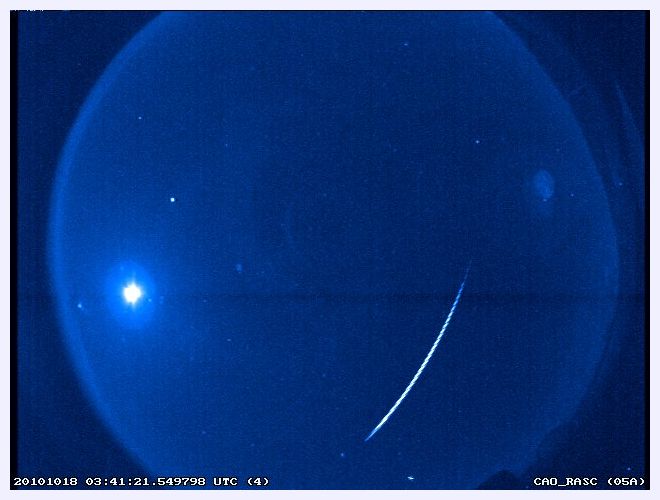
© Meteor Physics Group, University of Western OntarioA 2010 Orionid meteor, seen over Western Ontario, Canada. A waxing gibbous moon shines brightly at the left side of the image.

The most famous of all comets, Comet Halley is noted for producing spectacular displays when it passes near Earth on its 76-year trip around the sun. However, you don't have to wait until 2061 to see a piece of the comet -- you can do it this very week!

Halley's Comet leaves bits of itself behind -- in the form of small conglomerates of dust and ice called meteoroids -- as it moves in its orbit, which the Earth approaches in early May and mid-October. When it does, it collides with these bits of ice and dust, producing a meteor shower as the particles ablate -- or burn up -- many miles above our heads. The May shower is called the Eta Aquarids, as the meteors appear to come from the constellation Aquarius. The October shower has meteors that appear to come from the well-known constellation of Orion the Hunter, hence the name: Orionids.

Orionids move very fast, at a speed of 147,300 miles per hour. At such an enormous speed, the meteors don't last long, burning up very high in the atmosphere. Last year, the NASA allsky cameras at Marshall Space Flight Center in Huntsville, Ala., and in Chickamauga, Ga., recorded 43 definite Orionid meteors. Most of these appeared at an altitude of 68 miles and completely burned up by the time they were 60 miles above the ground, seen in the graph at right.

Meteor

Comets Triggered Aboriginal Tales of Doom

Comet
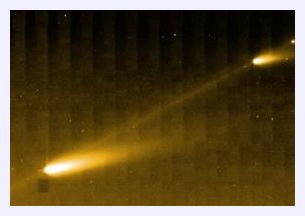
© NASA Jet Propulsion Laboratory (NASA-JPL)Aboriginal culture includes a colourful history of comets in the Australian skies.

Australia's first people viewed comets as portents of doom, a new study of Aboriginal astronomy has found.

Writing on the pre-press website arXiv.org, Duane Hamacher from Sydney's Macquarie University who led the research, says Aboriginal people developed an extensive culture regarding the night sky with stories and detailed observations.

"Different Aboriginal groups had different seasons linked to certain stars which correlated to the availability of certain food sources, or when Indonesian fishermen would come to trade," says Hamacher.

"Aboriginal societies typically associated comets with fear, death, omens of sickness, malevolent spirits and evil magic, which is consistent with many other cultures around the world."

Info

Year on Earth

A year on earth is measured by one complete trip around the sun. Seems simple enough but there is a problem. The earth doesn't travel in a path around the sun that returns it to its starting point. So how do we know when the year starts or ends?


Footprints

Bread Was Around 30,000 Years Ago: Study

Image
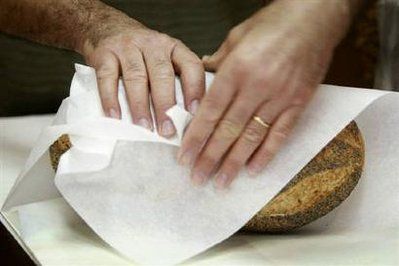
© Reuters/Tim WimborneA baker wraps a loaf of bread in paper in his North Sydney Bakery September 18, 2007. Starch grains found on 30,000-year-old grinding stones suggest that prehistoric man may have dined on an early form of flat bread, contrary to his popular image as primarily a meat-eater.
Starch grains found on 30,000-year-old grinding stones suggest that prehistoric man may have dined on an early form of flat bread, contrary to his popular image as primarily a meat-eater.

The findings, published in the Proceedings of the National Academy of Sciences (PNAS) journal on Monday, indicate that Palaeolithic Europeans ground down plant roots similar to potatoes to make flour, which was later whisked into dough.

"It's like a flat bread, like a pancake with just water and flour," said Laura Longo, a researcher on the team from the Italian Institute of Prehistory and Early History.

"You make a kind of pita and cook it on the hot stone," she said, describing how the team replicated the cooking process. The end product was "crispy like a cracker but not very tasty," she added.

The grinding stones, each of which fit comfortably into an adult's palm, were discovered at archaeological sites in Italy, Russia and the Czech Republic.

Star

How to Weigh a Star Using a Moon

Image
© David A. AguilarArtist’s concept of an exoplanet and its moon transiting a sun-like star. Such a system could be used to directly weigh the star.
Cambridge, Massachusetts - How do astronomers weigh a star that's trillions of miles away and way too big to fit on a bathroom scale? In most cases they can't, although they can get a best estimate using computer models of stellar structure.

New work by astrophysicist David Kipping says that in special cases, we can weigh a star directly. If the star has a planet, and that planet has a moon, and both of them cross in front of their star, then we can measure their sizes and orbits to learn about the star.

Laptop

What is an RSS Feed?

Image
© Unknown
Keeping up with the news from your favorite Web sites can be a daunting task. Dozens of items might get posted in a day and content can surface (and get buried) in multiple places on a home page. Instead of returning over and over to the site, why not let the publication's contents come to you?

That's the idea behind RSS, which stands for Really Simple Syndication. As its name implies, RSS brings to you most or all of everything that publishes on Web sites that offer (free) RSS subscriptions.

Bulb

Lights On! LED Skin Implants Created

Image
© University of Illinois, Urbana-ChampaignOptical image of LEDs on paper.
A new way to make thin, flexible sheets of light-emitting electronics could lead to better medical implants, wearable light sources and high-tech surgical gloves.

By modifying processes used to make computer chips, researchers were able to create mesh-like sheets of miniaturized light-emitting diodes, or LEDs, and put them on any kind of substrate, ranging from aluminum foil and paper to rubber balloons and even leaves.

Pharoah

Ancient Egyptian Priest's Tomb Unearthed in Giza

rudj-ka

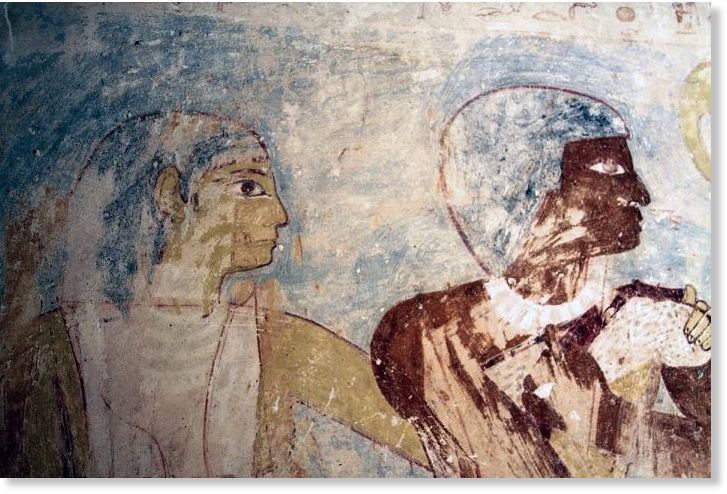
Archaeologists have unearthed a more than 4,000-year-old tomb of a pharaonic priest near the Giza pyramids, Egypt's authorities announced on Monday.

Beautifully decorated, the burial site is located near the tombs of the pyramid-builders.

It belonged to Rudj-Ka, a priest who lived during the Fifth Dynasty (2465 - 2323 B.C.) and was responsible for the mortuary cult of the pharaoh Khafre, also known as Chephren.

The son of Khufu, or Cheops, the Fourth Dynasty king Khafre is best known as the owner of the second largest of the Giza Pyramids.

According to Zahi Hawass, general secretary of Egypt's Supreme Council of Antiquities, Khafre's pyramid complex and mortuary cult remained functioning well after the king's death, thanks to a group of priests who conducted rituals and prayers in honor of the dead pharaoh.