Science & TechnologyS


Satellite

"Telescope" Buried a Mile Under the Antarctic Ice to Find Source of Cosmic Rays

Image
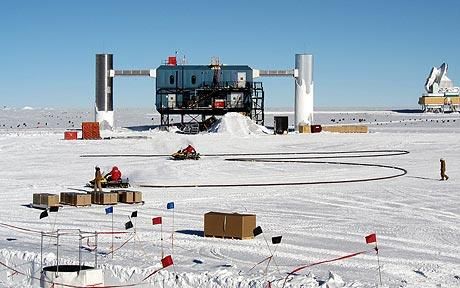
© The TelegraphAntarctica is the best place for the experiment because of the ultra-clear ice, almost completely clear of air bubbles and other distortions
A "telescope" buried deep under Antarctic ice has detected the first signals that scientists hope will allow them to identify the source of mysterious particles that bombard Earth from outer space.

For the past ten years scientists have been planning and building an ambitious experiment to explain the mystery of what produces the cosmic rays and elusive particles known as neutrinos, which constantly pepper our planet.

They have buried thousands of sensors more than a mile below the surface of Antarctica's ice cap to record fleeting flashes of blue light that are given off when these high energy particles and rays collide with atoms in the ice.

By recording the pattern of light from the collisions, the sensors can plot the trajectory of the particles and rays, allowing scientists to pinpoint where in the galaxy they came from.

Analysis has already begun of results from the $271 million (£169 million) IceCube Neutrino Observatory - described by scientists as a "telescope" - although the last of its sensors is not due to be installed until December.

Meteor

Moonlight Meteor Shower Spawned By Halley's Comet

Image
© SPACE.com
A junior version of the famous Perseid meteor shower thought to have originated from the remains of Halley's Comet will hit its peak over the next week, but the light of the moon may intrude on the sky show.

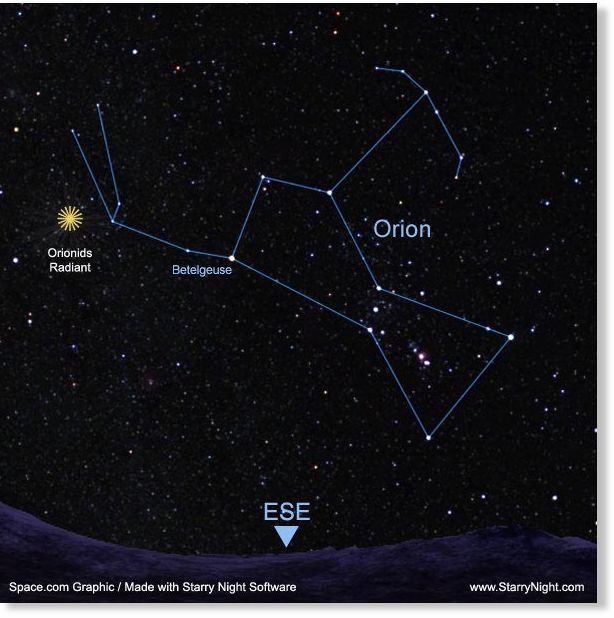
This upcoming meteor display is known as the Orionids because the meteors seem to fan out from a region to the north of the Orion constellation's second brightest star, ruddy Betelgeuse.

The annual event peaks before sunrise on Thursday (Oct. 21) but several viewing opportunities arise before then for skywatchers in North America. [Where to look to see the Orionids]

The shooting stars are created by small bits of space dust - most no larger than sand grains - thought to be left over from the famed Halley's Comet, which orbits the sun once every 76 years.

Question

Enormous Ring is Developing on the Sun

Strange Solar Ring
© Solar Dynamics Observatory/NASA

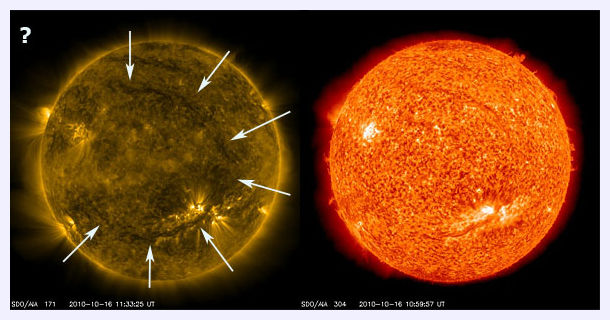
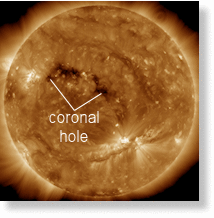
What is this strange ring that has been developing on the Sun during 16-Oct?

Sunspot 1112, located in the southeast quadrant, has been the source of a giant filament that is currently stretching 400,000 km across the surface of the Sun.

However, today, there appears to be development of a enormous circular ring which looks to be linking with the huge magnetic filament of sunspot 1112. Most of today's various wavelength images of the Sun all show this feature over at the SDO (Solar Dynamics Observatory) - NASA website.

SpaceWeather.com today reports,

A vast filament of magnetism is cutting across the Sun's southern hemisphere today. A bright 'hot spot' just north of the filament's midpoint is UV radiation from sunspot 1112. The proximity is no coincidence; the filament appears to be rooted in the sunspot below. If sunspot flares, it could cause the entire structure to erupt. This active region merits watching...

What concerns me is that if indeed this is a huge magnetic filament nearly encircling the entire Sun, it is now currently directly facing the Earth. If sunspot 1112 does erupt, could the entire filament explode into a massive CME?

This particular phenomenon will be all over in a few days as it rotates around the Sun, but it serves to remind us that there are more and more events happening on the Sun as we transit into the next solar cycle maximum (peaking ~ 2012 into 2013).

Sherlock

What Did Tyrannosaurus rex Eat? Each Other

Image
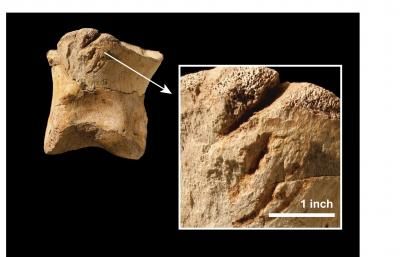
© Nicholas Longrich/Yale UniversityT. rex was the only big carnivore in western North America 65 million years ago that was capable of making such large gouges, such as the ones seen here on a toe bone.
It turns out that the undisputed king of the dinosaurs, Tyrannosaurus rex, didn't just eat other dinosaurs but also each other.

Paleontologists from the United States and Canada have found bite marks on the giants' bones that were made by other T. rex, according to a new study published online Oct. 15 in the journal PLoS ONE.

While searching through dinosaur fossil collections for another study on dinosaur bones with mammal tooth marks, Yale researcher Nick Longrich discovered a bone with especially large gouges in them. Given the age and location of the fossil, the marks had to be made by T. rex, Longrich said. "They're the kind of marks that any big carnivore could have made, but T. rex was the only big carnivore in western North America 65 million years ago."

It was only after discovering the bite marks were from a T. rex that Longrich realized the bone itself also belonged to the behemoth. After searching through a few dozen T. rex bones from several different museum fossil collections, he discovered a total of three foot bones (including two toes) and one arm bone that showed evidence of T. rex cannibalism, representing a significant percentage.

Sherlock

Maghera tomb: 5,000 year old burial site to give up secrets

Maghera,tomb
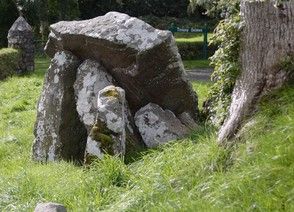
© NAIt might look like just a pile of rocks, but this 5,000-year-old burial site is about to give up its ancient secrets

Archaeologists are to dig out a portal tomb in Northern Ireland for the first time in 50 years.

The collapse of Tirnony Dolmen near Maghera has produced a rare opportunity to discover what lies beneath - and exactly how old it is.

Normally portal tombs, which are among the oldest built structures still standing in Northern Ireland, are off limits to excavators and must be preserved.

But after the massive capstone of this portal tomb fell to the ground earlier this year, archaeologists will be able to uncover the secrets it has held for millennia before repairs are carried out.

Question

White Horse of Uffington is a dog, claims vet

Animal expert says 3,000-year-old Oxfordshire landmark may have to be renamed
white,horse,uffington
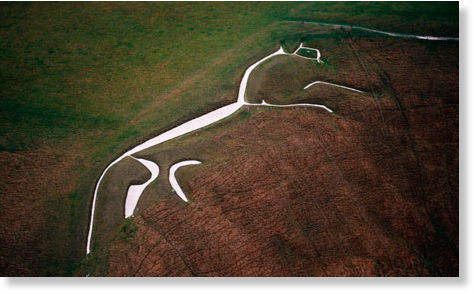
© Photograph: AlamyThe White Horse of Uffington
It is one of Britain's most-loved ancient hill figures, careering across the downland. Now vets are being urged to question whether the White Horse of Uffington was meant to be a horse at all.

Challenging the traditional description of the Oxfordshire landmark, retired vet Olaf Swarbrick asks whether the "beautiful, stylised" figure might instead be a dog such as a greyhound or wolfhound.

In a letter to the Veterinary Record, his profession's journal, the former cattle and poultry specialist suggests a canine origin for the 110-metre by 38.5-metre animal, which was carefully dug into the downland. He invites alternative theories, too.

Swarbrick says: "Looking at it again, it seems that it is not a horse at all: the tail and head are wrong for a horse and more suggestive of a dog. It appears more like a large hound at full stretch. I thought it may be a greyhound, but an anthropologist suggests it is a wolfhound, which (assuming it is not a horse) makes more sense."

Sun

Solar Flare Sunspot 1112

Image
© SOHO
Sunspot 1112 erupted today at 1900 UT, producing the brightest solar flare in nearly three months. Click here to view a movie of the M1-class explosion from NASA's Solar Dynamics Observatory.

Meteor

Comet Hartley 2 Update

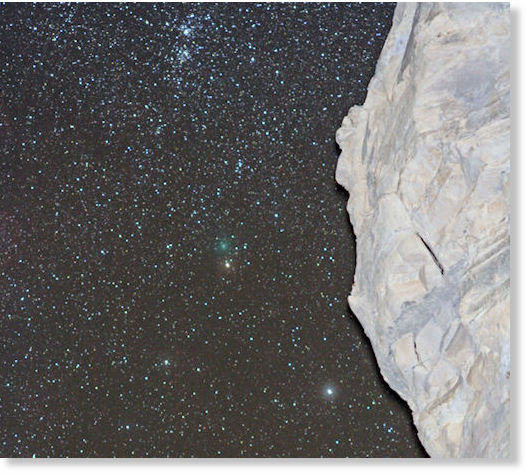
For backyard stargazers, the next few nights are the best time to see green Comet 103P/Hartley 2 as it approaches Earth for an 11-million-mile close encounter on Oct. 20th. Set your alarm for the dark hours before dawn, go outside, and look straight up. You will find Hartley 2 not far from the bright star Capella: sky map. Although the comet is barely visible to the unaided eye, it is easy to find in binoculars and looks great through a backyard telescope.

Doug Zubenel sends this picture (Oct. 9) from the Monument Rocks National Landmark in Kansas:

Image
© Doug Zubenel

Sun

Great Filament Update

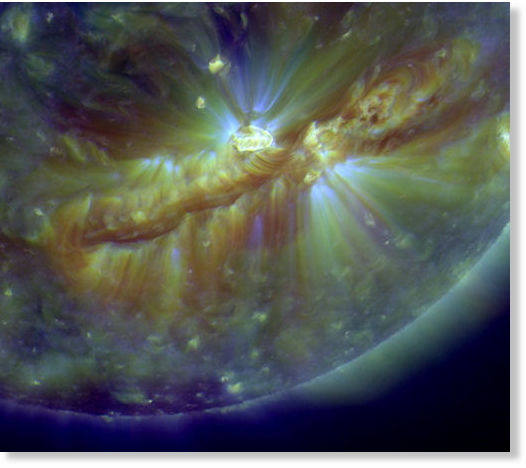
A vast filament of magnetism is cutting across the sun's southern hemisphere today. Run a finger along the golden-brown line in this extreme UV image from the Solar Dynamics Observatory and your digit will have traveled more than 400,000 km:

Image
© Solar Dynamics Observatory
A bright 'hot spot' just north of the filament's midpoint is UV radiation from sunspot 1112. The proximity is no coincidence; the filament appears to be rooted in the sunspot below. If the sunspot flares, it could cause the entire structure to erupt.

Update: Today's M1-flare did not destabilize the filament. Stay tuned, however, because sunspot 1112 is growing and more activity is possible in the hours ahead. Readers with solar telescopes are encouraged to monitor developments.


Robot

Researcher Allows Robot to Punch Colleagues During Lab Experiment

Image
© Borut Povše
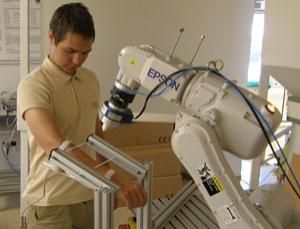
A robotics lab in Slovenia has been conducting experiments to assess human-robot pain thresholds by allowing robots to repeatedly strike human volunteers in the arm with blunt and sharp tools.

Borut Povše, a robotics researcher from the University of Ljubljana, has received "ethical approval" to allow this type of research. He has enlisted six colleagues to participate in the study, where each is to endure physical pain from robots.

"We are taking the first steps to defining the limits of the speed and acceleration of robots, and the ideal size and shape of the tools they use, so they can safely interact with humans," said Povše.

Povše borrowed a production-line robot from the Japanese technology firm Epson, and programmed its arm to travel toward a specified point that is occupied by the human's arm, so that the robot will have to hit it. Each volunteer was struck 18 times by a robot arm that contained two tools at the end of it - one that was round and blunt, and the other that was sharp.