Science & TechnologyS


War Whore

Navy Sets World Record With Incredible, Sci-Fi Weapon

railgun
© FoxNewsU.S. Navy video by John Williams

U.S. Navy engineers at the Office of Naval Research prepared and test-fired a slug from their rail gun in a 2008 test firing. On Friday, December 9, the ONR will attempt to break its own record.
A theoretical dream for decades, the railgun is unlike any other weapon used in warfare. And it's quite real too, as the U.S. Navy has proven in a record-setting test today in Dahlgren, VA.

Rather than relying on a explosion to fire a projectile, the technology uses an electomagnetic current to accelerate a non-explosive bullet at several times the speed of sound. The conductive projectile zips along a set of electrically charged parallel rails and out of the barrel at speeds up to Mach 7.

The result: a weapon that can hit a target 100 miles or more away within minutes.

"It's an over-used term, but it really changes several games," Rear Admiral Nevin P. Carr, Jr., the chief of Naval Research, told FoxNews.com prior to the test.

For a generation raised on shoot-'em-up video games, the word "railgun" invokes sci-fi images of an impossibly destructive weapon annihilating monsters and aliens. But the railgun is nonetheless very real.

War Whore

US Army: Judge Dredd smartgun in every squad from 2014

XM-25 portable airburst artillery piece plans unveiled

The US Army has confirmed plans to equip every infantry squad and special-forces team by 2014 with an XM-25 Judge Dredd style computer smartgun able to hit enemies hiding around corners or behind rocks etc.

newgun
© The RegisterA trench won't do it nowadays.
The XM-25 has been widely covered in the media recently, despite the fact that the last piece of actual news regarding the futuristic weapon - that it would at long last be put in the hands of US combat troops, in Afghanistan - came back in October, as we here on the Reg crazy-guns desk reported at the time (getting the tip from the Soldier Systems blog). However we also mentioned it about six weeks later in our widely-read Thanksgiving crazy-guns-o-the-future feature - and shortly thereafter the XM-25's Afghan deployment decision was in all the mainstream outlets as "news".

Coffee

Vegetable Smarts: Rooting for swarm intelligence in plants

plant roots
© Mike_expert/shutterstockVegetable Smarts: A plant’s roots may turn out to show swarm intelligence, much as honeybees or humans can, sharing information and solving a problem as a group.

They're underfoot and underappreciated. But the roots of a plant may demonstrate the remarkable wisdom of crowds just as swarms of honeybees or humans can.

Three plant scientists now propose that roots growing this way and that in their dark and dangerous soil world may fit a definition for what's called swarm intelligence. Each tip in a root system acquires information at least partly independently, says plant cell biologist František Baluška of the University of Bonn in Germany. If that information gets processed in interactions with other roots and the whole tangle then solves what might be considered a cognitive problem in a way that a lone root couldn't, he says, then that would be swarm intelligence.

The decisions that emerge from groups of individuals have intrigued a wide range of researchers, for in some cases crowds show an eerie wisdom. Honeybees looking for a new home can collectively pick excellent nest sites even as individual scouts advocate for a variety of choices. And combining people's estimates of how many marbles are in a jar or what an animal at a country fair would yield in pounds of butchered meat often come quite close to the correct answer.

Question

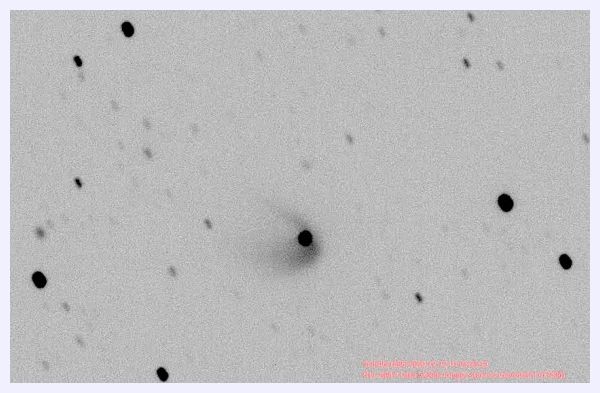
Asteroid Scheila Sprouts a Tail and Coma

Scheila
© Peter Lake(596) Scheila, the asteroid with a tail.

When is an asteroid not an asteroid? When it turns out to be a comet, of course. Has this ever happened before? Why, yes it has. In fact it was just announced December 12, 2010 that the asteroid (596) Scheila has sprouted a tail and coma! This is likely a comet that has been masquerading as an asteroid.

Steve Larson of the Lunar and Planetary Laboratory (LPL), University of Arizona first reported that images of the minor planet (596) Scheila taken on December 11th showed the object to be in outburst, with a comet-like appearance and an increase in brightness from magnitude 14.5 to 13.4. The cometary appearance of the object was confirmed be several other observers within hours.

A quick check of archived Catalina images of Scheila from October 18, November 2 and November 11 showed Scheila to look star-like, which is what asteroids look like from Earth. They just happen to be moving across the field of view in contrast to the fixed background stars. The image taken by Catalina on December 3rd shows some slight diffuseness and an increase in overall brightness. So, it appears this even began on or around December 3rd.

Upon hearing the news, there was some speculation that this might be evidence of an impact event. Had something crashed into asteroid Scheila? It seems unlikely, and this is a story we have heard before.

Info

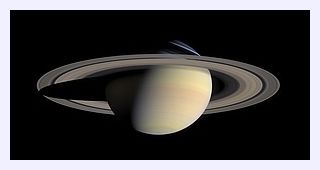
Saturn's Rings: Leftovers From a Cosmic Murder?

Saturn's Rings
© Associated PressSaturn's rings shine in this image taken by the Cassini Saturn Probe. A new theory says the rings may be debris from a missing moon.
Washington - One of the solar system's most evocative mysteries - the origin of Saturn's rings - may be a case of cosmic murder, new research suggests.

The victim: an unnamed moon of Saturn that disappeared about 4.5 billion years ago.

The suspect: a disk of hydrogen gas that once surrounded Saturn when its dozens of moons were forming, but has now fled the crime scene.

The cause of death: A forced plunge into Saturn.

And those spectacular and colorful rings are the only evidence left. As the doomed moon made its death spiral, Saturn robbed its outer layer of ice, which then formed rings, according to a new theory published online Sunday in the journal Nature.

"Saturn was an accomplice and that produced the rings," said study author Robin Canup, an astronomer at the Southwest Research Institute in Boulder, Colo.

The mystery of Saturn's rings "has puzzled people for centuries," said Cornell astronomer Joe Burns, who wasn't involved in the study and said Canup's new theory makes sense.

Cheeseburger

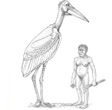
Giant Storks May Have Fed On Real Hobbits

Image
© Inge van Noortwijk.The extinct giant stork Leptoptilos robustus would have dwarfed the "hobbit" Homo floresiensis living on the Indonesian Island of Flores. (artist's impression)
"The fossil remains of what may have been a hobbit-like species of human were discovered in 2003 at the Liang Bua cave on the Indonesian island of Flores." Found with these human bones are the bones of giant, flightless storks that show no evidence of having been butchered by the humans, suggesting to the investigating scientists that the humans may have been dinner for the storks.

In the Lord of the Rings books, hobbits were rescued by giant eagles, but real-life hobbits might have been hunted by giant storks, scientists find.

The fossil remains of what may have been a hobbit-like species of human were discovered in 2003 at the Liang Bua cave on the Indonesian island of Flores. In that cave, scientists also unearthed a large number of bird fossils - including 20,000- to 50,000-year-old wing and leg bones from what appears to have been a stork nearly 6 feet tall (1.8 meters).

"From the size of its bones, we initially were expecting a giant raptor, which are commonly found on islands, not a stork," said Hanneke Meijer, a vertebrate paleontologist at the Smithsonian Institution in Washington.

Sun

Spectacular sundogs and ice halo seen from Stockholm

Last Wednesday in Stockholm, Sweden, the sun was only up for a little while, but it made good use of its time. Sunbeams lanced through ice crystals in the air, producing a busy halo of surpassing beauty:

Image
© Peter Rosén
"This was the most spectacular sun halo I have seen in recent years from Stockholm," says photographer Peter Rosén. "It was visible for the whole (short) day." In addition to the sundogs, upper tangent arc, and 22° halo captured in the snapshot above, Rosén also witnessed "a 46° outer halo and a circumzenithal arc as ice crystals blew in gusts across the sun. What a show!"

Now is the time of year when low-hanging suns shine through high-floating ice to produce such vistas. People of the northern hemisphere should be alert for halos.

Sherlock

New Bacteria Found on Titanic; Eats Metal

Image
© Emory Kristof/National GeographicThe rusted prow of the R.M.S. Titanic sits deep in the North Atlantic.
A new species of bacteria has been discovered on the sunken hull of the Titanic - and it may be speeding up the decay of the historic wreck, new research reports.

Scientists at Dalhousie University in Halifax, Canada, collected samples of the R.M.S. Titanic's icicle-like rust formations, called rusticles, in 1991.

Although the formations were teaming with life, nobody had identified the specific microbes on the ship, instead grouping them into broad categories such as bacteria or fungi.

So Henrietta Mann and then graduate student Bhavleen Kaur, now of the Ontario Science Centre, decided to isolate and identify one species of bacteria from the mess of microscopic life-forms.

The one they chose turned out to be a new species, which the pair dubbed Halomonas titanicae. The bacteria is part of a family that had never been seen before in waters as deep as those in which the Titanic sits, about 2.4 miles (3.8 kilometers) below the surface, Kaur said.

Grey Alien

Evidence For Extra Terrestrial Life is Mounting Daily, But Not Proven

Image
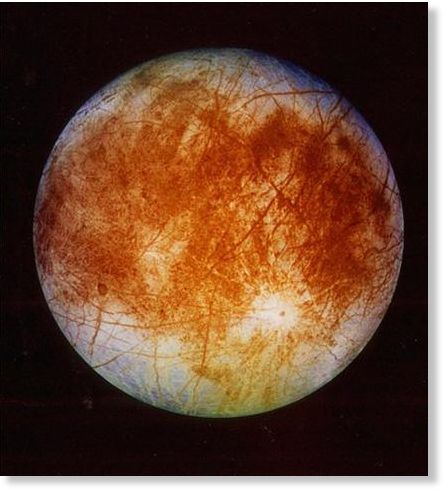
© Associated Press/Jet Propulsion LabThis image, released Nov. 12, 1996, by the Jet Propulsion Laboratory in Pasadena, Calif., shows Jupiter's ice-covered moon, Europa. Every new discovery makes it seem more likely that we are not alone. The case for some kind alien life somewhere else in the universe is steadily building. In the past few days, scientists have revealed there are three times as many stars as they previously thought and that a bacteria can live on arsenic, expanding our understanding of how life can thrive under the harshest and strangest environments. Those came on the heels of the first discovery of a potentially habitable planet.
Lately, a handful of new discoveries make it seem more likely that we are not alone - that there is life somewhere else in the universe.

In the past several days, scientists have reported there are three times as many stars as they previously thought. Another group of researchers discovered a microbe can live on arsenic, expanding our understanding of how life can thrive under the harshest environments. And earlier this year, astronomers for the first time said they'd found a potentially habitable planet.

"The evidence is just getting stronger and stronger," said Carl Pilcher, director of NASA's Astrobiology Institute, which studies the origins, evolution and possibilities of life in the universe. "I think anybody looking at this evidence is going to say, 'There's got to be life out there.'"

A caveat: Since much of this research is new, scientists are still debating how solid the conclusions are. Some scientists this week have publicly criticized how NASA's arsenic-using microbe study was conducted, questioning its validity.

Roses

Plants Remember Winter To Bloom In Spring With Help Of Special Molecule

Image
© unkThe process is known as vernalization, whereby a plant becomes competent to flower after a period of cold.
Austin Texas--The role a key molecule plays in a plant's ability to remember winter, and therefore bloom in the spring, has been identified by University of Texas at Austin scientists.

Many flowering plants bloom in bursts of color in spring after long periods of cold in the winter. The timing of blooming is critical to ensure pollination, and is important for crop production and for droves of people peeping at wildflowers.

One way for the plants to recognize the spring-and not just a warm spell during winter-is that they "remember" they've gone through a long enough period of cold.

"Plants can't literally remember, of course, because they don't have brains," says Sibum Sung, assistant professor in the Section of Molecular Cell and Developmental Biology. "But they do have a cellular memory of winter, and our research provides details on how this process works."

Comment:
.