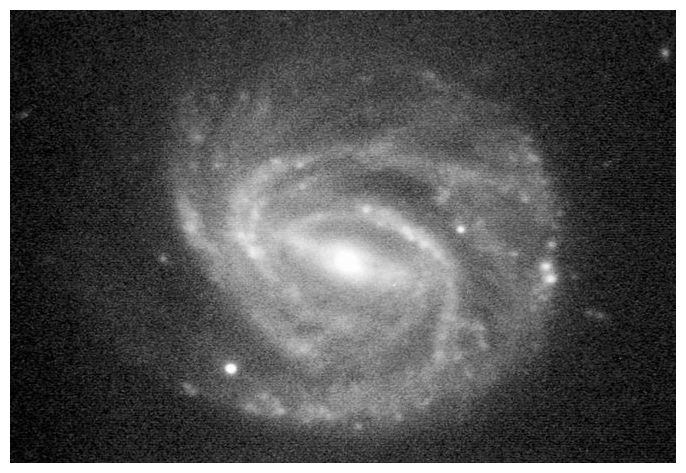
© European Southern ObservatoryThis photo shows the newly discovered Supernova 1992C in the barred spiral galaxy NGC 3367. The supernova is the bright, star-like object in the lower left area (southeast of the centre of the galaxy), at the tip of a spiral arm. The 16.5-magnitude supernova was discovered by ESO astronomer Hans van Winckel on January 28, 1992.
One of these days we might see a supernova. It might seem more correct to say "one of these nights," but a star exploding in our galaxy as a supernova would easily be so bright it would be seen in a blue daytime sky, outshining any star or planet in the night sky.
We are long overdue. Supernovae are very rare, although astronomers say they should occur on the average every few hundred years. The last one seen in the Milky Way Galaxy was in 1680.
A supernova can become so bright - for a brief time- that the star outshines every star in the galaxy. The one in 1680 was not particularly brilliant as seen from Earth, but some have been- notably the great supernova of 1572 in Cassiopeia and another in the year 1054 in Taurus.
Several notable supernovae have been recorded through history, but none in our own galaxy since the early days of the telescope! Much of what we know today about these cosmic catastrophes come from observations of other galaxies.
Distant galaxies generally are so far away we cannot discern individual stars, although large professional observatories have photographed faint stars in nearer galaxies such as the great Andromeda Galaxy, visible to the unaided eye as a hazy patch.
While we wait for the next supernova in our home galaxy to dazzle our eyes, for both professional and amateur backyard-variety astronomers, it is a wonder to see a star within the faint smudge of a far away galaxy, where no star had been seen before.