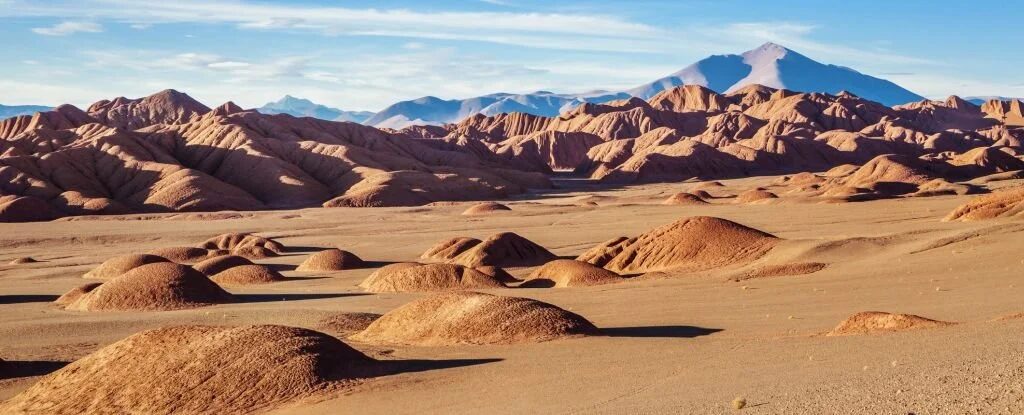
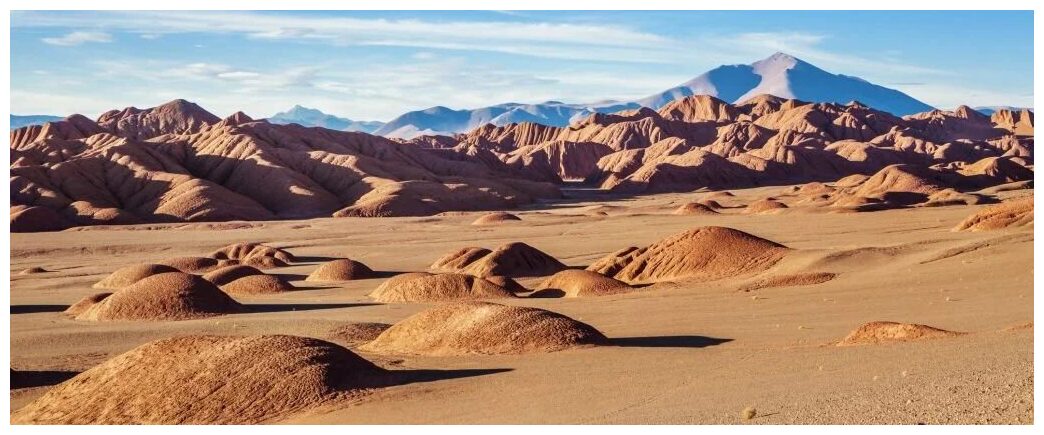
© Gonzalo Azumendi/Stone/Getty ImagesSalar de Arizaro in Argentina.
Moreover, this has been occurring for millions of years - a long geological process that has produced telltale wrinkling and other features on the surface that scientists have discerned through modeling and experimentation.
This might help us identify interior geological activity on other planets that don't have plate tectonics, such as Mars and Venus.
It's called lithospheric dripping, and it's only been identified fairly recently here on Earth.As the rocky crust is warmed up to a certain temperature, it starts to thicken and drip down into the mantle. It's a bit like an extreme
pitch drop... but the formation and release of crustal drops has effects on the surrounding surface of the planet.
First, the pull of the drop forming below creates a basin on the surface above. Then, when the drop breaks off, the surface reacts by springing upward, the effects of which spread widely.
"We have confirmed that a deformation on the surface of an area of the Andes Mountains has a large portion of the lithosphere below avalanched away,"
said geology graduate student and lead author Julia Andersen at the University of Toronto in Canada.
"Owing to its high density, it dripped like cold syrup or honey deeper into the planetary interior and is likely responsible for two major tectonic events in the Central Andes - shifting the surface topography of the region by hundreds of kilometers and both crunching and stretching the surface crust itself."

















Comment: See also: A warning from history: The Carrington event was not unique