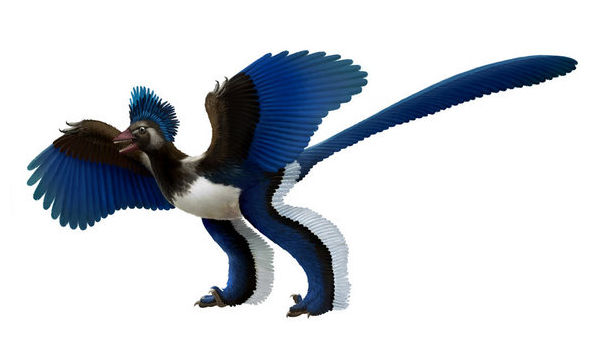
© Xing Lida and Liu YiHere, an artist’s impression of Xiaotingia zhengi, a newly discovered carnivore fossil that boots Archaeopteryx from its throne as earliest bird.
Instead, a newfound fossil from China suggests Archaeopteryx was not a bird after all, but one of many birdlike dinosaurs, a finding that could force scientists to rethink much of what they thought they knew about the origin and evolution of birds.
Archaeopteryx lived about 150 million years ago in what is now Bavaria in Germany, back when Europe was an archipelago of islands in a warm shallow tropical sea. First discovered 150 years ago, the carnivorous fossil, with its blend of avian and reptilian features, seemed an iconic evolutionary link between dinosaurs and birds, bolstering Darwin's theory of evolution published just two years before the fossil discovery. Its place as the earliest and most primitive known bird made it central to the scientific understanding of the evolution of birds and flight.
Still, for decades, there have been doubts as to whether Archaeopteryx was really a bird.
"What's happened over the past 15 or 20 years is that so many of the seemingly uniquely birdlike characteristicsof Archaeopteryx, such as feathers, a wishbone and a three-fingered hand, became a lot less unique," anatomist and paleontologist Lawrence Witmer at Ohio University told LiveScience. "We've started finding a lot of dinosaurs with feathers, and lots and lots have a wishbone, even T. rex, for this progressive erosion of the avian status of Archaeopteryx."