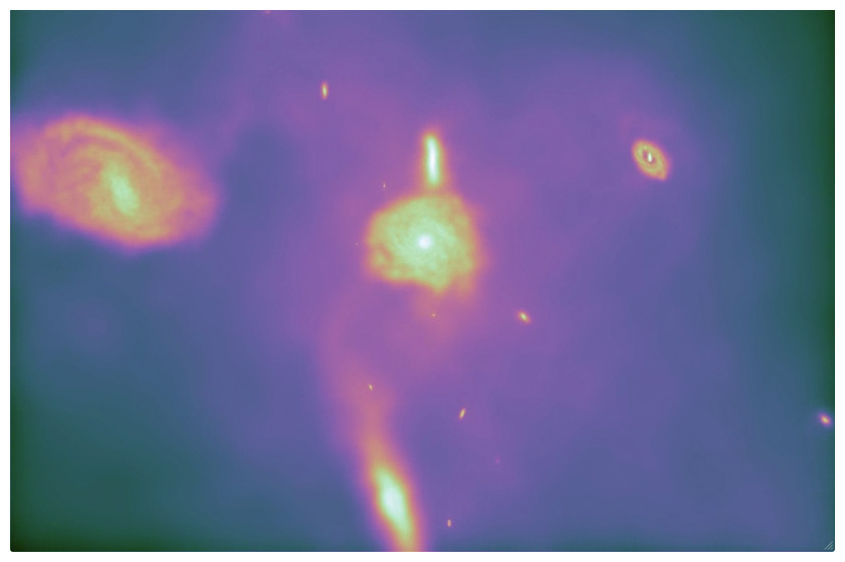
© CfA/UCSD/HITS/M. Vogelsberger (CfA) & V. Springel (HITS)This still frame is taken from the Arepo-generated animation shown above. It demonstrates Arepo's key ability to produce realistic spiral galaxies.
Our galaxy, the Milky Way, is a spiral galaxy with a broad disk and outstretched arms, as are many in our cosmic neighborhood, such as Andromeda, the Pinwheel and the Whirlpool galaxies. Spiral galaxies are common, but past computer models that aimed to accurately simulate the birth and evolution of the universe over billions of years had trouble creating them. Instead, they often generated lots of blobby galaxies clumped into balls.
New computer simulations can now recreate the kind of galactic communities seen in our universe, starting with the observed afterglow of the Big Bang and evolving forward in time. Harvard's Odyssey supercomputer allowed simulations that compressed nearly 14 billion years into only a few months.
"We've created the full variety of galaxies we see in the local universe," said study author Mark Vogelsberger at the Harvard-Smithsonian Center for Astrophysics.
The new software is called Arepo and was created by Volker Springel at the Heidelberg Institute for Theoretical Studies in Germany. Previous simulations divided space into a fixed grid of cubes, with each cube simulating the behavior of substances within that space.