Science & TechnologyS


Chalkboard

ALICE scientists enter primeval plasma wonderland

Scientists at CERN have smashed together various particles for the first time, moving closer to learning what was in the super-hot plasma wonderland that formed right after the primeval Big Bang, the European physics research centre said on Thursday.

The announcement followed another boost for physicists at CERN near Geneva with the effective endorsement by independent experts in a key journal of their claimed discovery of a new particle, the Higgs Boson.

CERN's ALICE experiment, one of six grouped around its underground Large Hadron Collider (LHC), has been analyzing particles that emerged from the overnight smashing together of tiny hydrogen-derived protons and much larger lead nuclei.

"It was really a pilot run to see if the LHC can produce these asymmetric collision systems. It showed that it can, and it worked like a charm," Johannes Wessels, an ALICE scientist, told Reuters. "We are very excited about the results."

Attention

Psychopathic Traits Make Good Presidents

Psychopaths
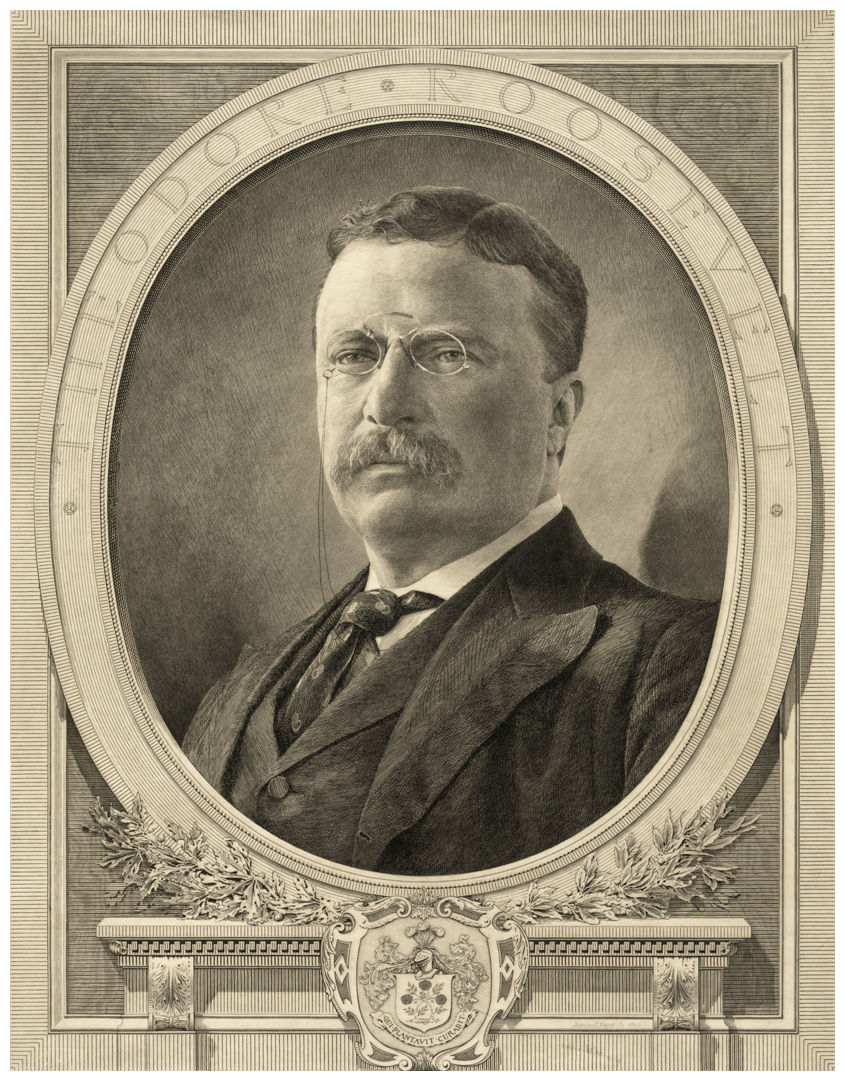
© Corbis"Fearless dominance" is a trait that many successful presidents have in common with psychopaths. Teddy Roosevelt was at the top of the list of presidents who had this trait.
The highest-performing Presidents of the United States so far share a personality trait in common with psychopaths.

With its long days and endless pressures to restore everything from economic crises to world peace, the job of President of the United States is stressful and usually thankless. And yet, every four years, plenty of candidates are crazy enough to devote their lives to getting votes.

Craziness might not be the most scientific word for it. But a new study found that those who do well as presidents tend to score high on measures of a personality trait that they share in common with psychopaths.

The trait, known as fearless dominance, describes people who are socially and physically bold, as well as emotionally resilient -- an outlook on life well summarized by Teddy Roosevelt's motto: "Speak softly and carry a big stick." Throughout our nation's history, the study found, bold presidents seem to have been particularly persuasive, driven by vision, and good at managing crises.

Presidents aren't psychopaths, nor should they be, emphasized lead author Scott Lilienfeld, a psychologist at Emory University in Atlanta. Instead, his research suggests that certain traits associated with psychopathy may give people a leg up in some situations.

"Most psychopaths end up being pretty unsuccessful and maladaptive, and they end up in prison, which is usually where psychologists study them," Lilienfeld said. "Even though the psychopathic personality as a whole shebang is not a good thing to have, this study raises the interesting possibility that at least some traits of this condition -- especially those linked to lack of social and physical apprehensiveness, immunity to stress, and resilience -- might be adaptive in real-world settings."

"Is it good to have a psychopathic president?" he added. "The answer to that is easy: It's no. But maybe having a certain dash of those traits might give presidents a certain edge."

Better Earth

4 new bat species discovered - check out their freaky noses!

Image
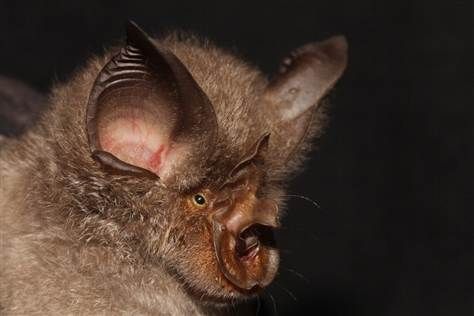
© PLoS ONEA portrait of Rhinolophus smithersi, a newly discovered cryptic bat species.
Researchers have identified four new species of horseshoe bats with large, strangely shaped noses in eastern Africa.

Scientists had thought all four belonged to a single species, Hildebrandt's horseshoe bat (Rhinolophus hildebrandtii), first described in 1878. But reports of different echolocation frequencies recorded among the bats suggested there might be rifts in the species. (Sonar calls are often used to identify different types of bats.)

Researchers led by Peter J. Taylor of South Africa's University of Venda found R.hildebrandtii indeed included four cryptic species with subtle differences in their sonar calls, skull shape and DNA. Cryptic species often cannot be distinguished by their physical features, putting the burden on genetics research to identify new creatures.

The horseshoe bat family is characterized by their intricately shaped flaps dubbed "noseleaves" around their nostrils. While most bats emit sonar from their mouths, these bats send out their echolocation signals from their noses. Previous research showed that grooves created by the horseshoe bats' noseleaves help focus their sonar calls.

The newly identified species include Cohen's horseshoe bat (Rhinolophus cohenae), found in South Africa's Mpumalanga Province; the Mount Mabu horseshoe bat (Rhinolophus mabuensis), of the mountainous region of northern Mozambique; Smithers' horseshoe bat (Rhinolophus smithersi), found across savanna woodlands of the Limpopo and Zambezi valleys; and the Mozambican horseshoe bat (Rhinolophus mossambicus), which likely lives across the savanna region of Zimbabwe and Mozambique, the researchers said.

The new bats were described Wednesday in the journal PLoS ONE.

Binoculars

The "Lesula" Monkey: A New Species Discovered in the Congo

Image
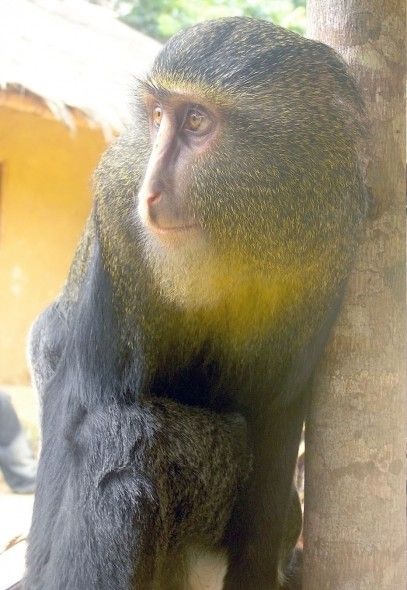
© M. Emetshu via FAUA new species of monkey discovered in the Congo
A monkey known as the lesula to local people in a remote part of the Democratic Republic of the Congo has been found to be a species new to science, researchers reported this week in the journal PLOS ONE. The species has been discovered just as it is being threatened with being hunted and eaten into extinction.

It is only the second new species of African monkey discovered in the last 28 years, according to PLOS ONE.

"The first lesula found was a young captive animal seen in 2007 in a school director's compound in the town of Opala in the Democratic Republic of Congo," the journal said in a news statement. "The young monkey bore a resemblance to the owl faced monkey, but its coloration was unlike that of any other known species."

Since the initial sighting, researchers report in their PLOS ONE paper, the lesula was also found in the wild, where biologists were able to observe its behavior and ecology and determine its genetic and anatomical distinctiveness. The monkey has been assigned the scientific nameCercopithecus lomamiensis.

The new monkey's range covers one of Congo's last "biologically unexplored" forest blocks, the PLOS ONE statement said, adding that although its range is remote and only lightly settled at present, the lesula is threatened by local bush meat hunting.

Info

First-Ever Direct Observations of a Supernova

Supernovae
© Romano Corradi and the Instituto de Astrofísica de Canarisa
Astronomers have provided the first-ever direct observations of a Type 1a supernova progenitor system. They collected evidence indicating that the progenitor system contained a red giant star. They also show that the system previously underwent at least one much smaller nova eruption before it ended its life in a destructive supernova.

Above, you see an artist's conception of a binary star system that produces recurrent novae, and ultimately, the supernova PTF 11kx. A red giant star (foreground) loses some of its outer layers though a stellar wind, and some of it forms a disk around a companion white dwarf star. This material falls onto the white dwarf, causing it to experience periodic nova eruptions every few decades. When the mass builds to the limit a white dwarf star can take, it explodes as a Type 1a supernova, destroying the white dwarf.

Bug

Remote-Control Roaches Seek Out Disaster Victims

Image
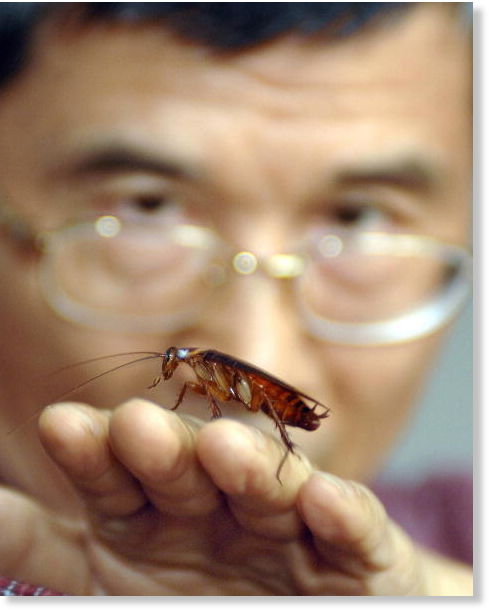
© Agence France-Presse/Getty Images/Sam YehRemote-controlled cockroaches may be able to find disaster victims through the use of wireless remote control.
Remote-controlled cockroaches may soon be coming to the rescue of trapped disaster victims.

A team of researchers at North Carolina State University have harnessed the insect's movements through electrical signals and believe it could help find people trapped in collapsed buildings and other disaster zones unnavigable by humans.

"The trick is to fire wireless signals at a roach's antennae and other sensory organs to guide it to a desired destination," Alper Bozkurt, an assistant professor in North Carolina State University's Department of Electrical and Computer Engineering, told scientificamerican.com. "What we do is similar to riding a horse."

Bozkurt, working with doctoral candidate Tahmid Latif, communicated with Madagascar hissing cockroaches by saddling them with electrical devices that look like backpacks. Each insect backpack included a thin, rigid, printed circuit board with a microcontroller, a wireless signal receiver, miniature plugs for connecting stimulation electrodes and a lithium-ion polymer battery.

Telescope

Planets Can Form in the Galactic Center

Image
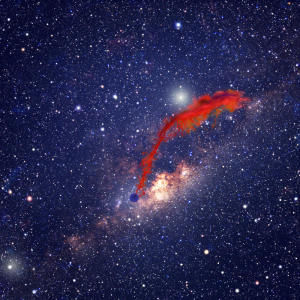
© David A. Aguilar In this artist's conception, a protoplanetary disk of gas and dust (red) is being shredded by the powerful gravitational tides of our galaxy's central black hole.
At first glance, the center of the Milky Way seems like a very inhospitable place to try to form a planet. Stars crowd each other as they whiz through space like cars on a rush-hour freeway. Supernova explosions blast out shock waves and bathe the region in intense radiation. Powerful gravitational forces from a supermassive black hole twist and warp the fabric of space itself.

Yet new research by astronomers at the Harvard-Smithsonian Center for Astrophysics shows that planets still can form in this cosmic maelstrom. For proof, they point to the recent discovery of a cloud of hydrogen and helium plunging toward the galactic center. They argue that this cloud represents the shredded remains of a planet-forming disk orbiting an unseen star.

"This unfortunate star got tossed toward the central black hole. Now it's on the ride of its life, and while it will survive the encounter, its protoplanetary disk won't be so lucky," said lead author Ruth Murray-Clay of the CfA. The results are appearing in the journal Nature.

The cloud in question was discovered last year by a team of astronomers using the Very Large Telescope in Chile. They speculated that it formed when gas streaming from two nearby stars collided, like windblown sand gathering into a dune.

Comment: James McCanney, author of Planet X, Comets, and Earth Changes, hypothesized that planets form in the galactic center in the 1980s. As usual, mainstream science is still playing catch-up!


Info

Crows Hold Grudges in Humanlike Fashion

Crows
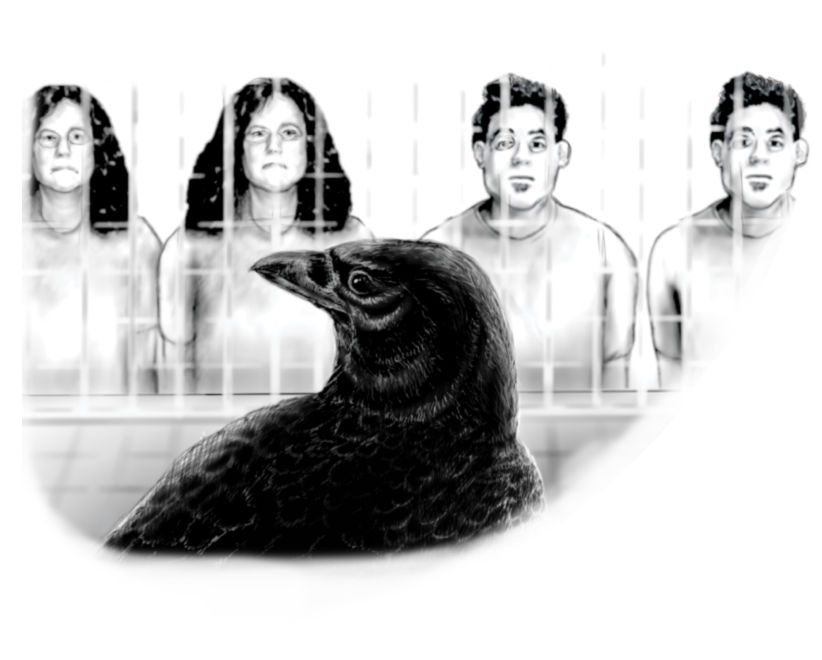
© Jack DeLap/University of WashingtonBefore brain scanning, a crow was exposed on and off for about 15 minutes to a person wearing either a caring mask or a threatening mask, but not both.
Crows don't forget a face - and they hold grudges, too.

Researchers in Seattle revealed last year that captured crows remember the face of their abductor. Even though years had passed since they saw the threatening face, the crows in the experiment would taunt their captor and dive-bomb him, suggesting the birds held tightly to a negative association.

Now the researchers' follow-up study shows that the birds' brains light up much like the human mind when they see a face they know.

"The regions of the crow brain that work together are not unlike those that work together in mammals, including humans," lead researcher John Marzluff, of the University of Washington, said in a statement from the school. "These regions were suspected to work in birds but not documented until now."

In the study, 12 male adult crows were captured by researchers all wearing one type of mask, referred to in the study as the threatening face. Then during four weeks of captivity, the birds were fed by people wearing a different mask. Though both disguises had neutral expressions, this mask was referred to ask the caring face.

To see what was going on in the birds' brains when they saw both faces, the researchers injected a glucose fluid into the bodies of fully alert crows. The crows were then put in the presence of someone wearing either the threatening or caring mask for about 15 minutes before the birds were sedated and given a brain scan.

Einstein

Mathematician Claims Proof of Connection between Prime Numbers

Last Theorem
© ShutterstockThe Pythagorean Theorem, a special case of Fermat's Last Theorem, the proof of which follows from the ABC conjecture.
A Japanese mathematician claims to have the proof for the ABC conjecture, a statement about the relationship between prime numbers that has been called the most important unsolved problem in number theory.

If Shinichi Mochizuki's 500-page proof stands up to scrutiny, mathematicians say it will represent one of the most astounding achievements of mathematics of the twenty-first century. The proof will also have ramifications all over mathematics, and even in the real-world field of data encryption.

The ABC conjecture, proposed independently by the mathematicians David Masser and Joseph Oesterle in 1985 but not proven by them, involves the concept of square-free numbers, or numbers that cannot be divided by the square of any number. (A square number is the product of some integer with itself). According to the mathematics writer Ivars Peterson in an article for the Mathematical Association of America, the square-free part of a number n, denoted by sqp(n), is the largest square-free number that can be obtained by multiplying the distinct prime factors of n. Prime numbers are numbers that can only be evenly divided by 1 and themselves, such as 5 and 17.

The ABC conjecture makes a statement about pairs of numbers that have no prime factors in common, Peterson explained. If A and B are two such numbers and C is their sum, the ABC conjecture holds that the square-free part of the product A x B x C, denoted by sqp(ABC), divided by C is always greater than 0. Meanwhile, sqp(ABC) raised to any power greater than 1 and divided by C is always greater than 1.

Meteor

Jupiter Hit Again!

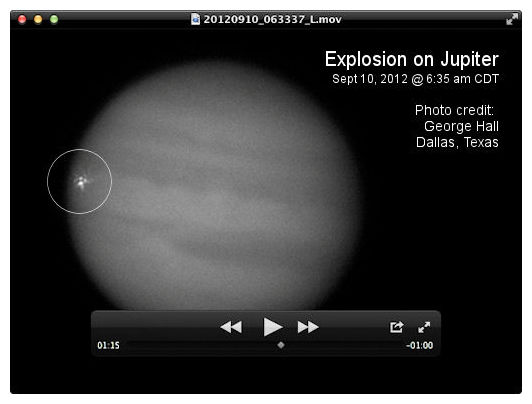
Apparently, something hit Jupiter during the early hours of Sept. 10th (11:35 UT), igniting a ferocious fireball in the giant planet's cloud tops. Amateur astronomer Dan Peterson Racine, Wisconsin, saw it first through his Meade 12" LX200 telescope. "It was a bright white flash that lasted only 1.5 - 2 seconds," he reports. Another amateur astronomer, George Hall of Dallas, Texas, was video-recording Jupiter at the time, and he confirmed the fireball with this video screenshot:
Jupiter Impact
© George HallImpact site coordinates: longitude 335o (system 1) and latitude +12o, inside the North Equatorial Belt's southern section.
The fireball was probably caused by a small asteroid or comet hitting Jupiter. Similar impacts were observed in June and August 2010. An analysis of those earlier events suggests that Jupiter is frequently struck by 10 meter-class asteroids--one of the hazards of orbiting near the asteroid belt and having such a strong gravitational pull.