Science & TechnologyS


Eye 1

Eye Color Can Be Window Into Your Personality

Eye Color
© Medical Daily
It is said that eyes are the window into a person's soul. But can they also be a window into a person's personality?

One study, published in Current Psychology, thinks that they can.

Researchers from the University of Queensland and the University of New South Wales found that eye color could be an indicator of how agreeable a person is. The researchers found that Northern Europeans with lighter-colored eyes tended to be less agreeable and more competitive than their peers.

The study was conducted in Australia. Researchers conducted a study among 336 participants, 63 percent of whom were Northern European in ancestry.

Study participants were asked to report their eye color, as well as answer a series of questionnaires that measured aspects of their personalities, like agreeableness, conscientiousness and neuroticism.


Info

Massive Diamond Find in Russian Impact Crater

Impact Diamonds
© Thinkstock A massive find of 'impact diamonds' in a huge Siberian meteorite crater could have a big impact on world industry - but not the jewellery business, say Russian scientists.
Russian scientists are claiming that a gigantic deposit of industrial diamonds found in a huge Siberian meteorite crater during Soviet times could revolutionize industry.

The Siberian branch of Russian Academy of Sciences said that the Popigai crater in eastern Siberia contains "many trillions of carats" of so-called "impact diamonds" good for technological purposes, not for jewellery, and far exceeding the currently known global deposits of conventional diamonds.

Nikolai Pokhilenko, the head of the Geological and Mineralogical Institute in Novosibirsk, told the RIA Novosti news agency on Monday that the diamonds include other molecular forms of carbon. He said they could be twice as hard as conventional diamonds and therefore have superlative industrial qualities.

He said the minerals could lead to a "revolution" in various industries. "But they can't upset a diamond market because it is shaped by diamonds for jewelry purposes."

Info

Big Breakout on Jupiter

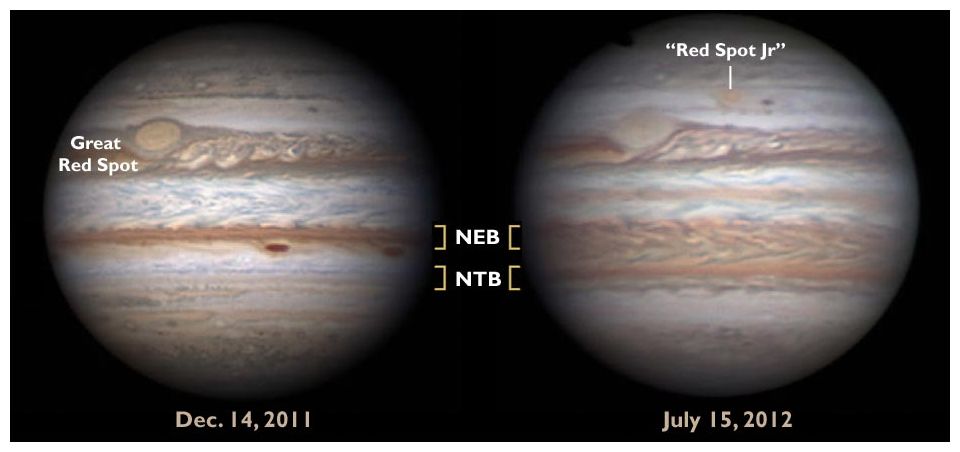
After thinning to practically nothing last year, Jupiter's North Equatorial Belt has erupted with a broad dark band full of bright and dark spots that can be observed with backyard telescopes.

The King of Planets has been putting on quite a show lately. Last week two observers spotted a bright fireball in Jupiter's midsection, the sixth such impact to be witnessed since the late 1970s. But even before that fleeting flash, the planet had been roiling with a vigorous outbreak of activity in its North Equatorial Belt.

The NEB is one of two iconic dark bands that bound the planet's brighter Equatorial Zone, an Oreo-cookie arrangement that's visible even in the smallest of backyard telescopes. You might recall that the South Equatorial Belt disappeared in mid-2010, apparently masked by bright, high-altitude clouds. It returned to view by year's end.
Jupiter
© Christopher GoThese images, taken six months apart, reveal big changes on Jupiter. In that interval the planet's North Equatorial Belt (NEB) greatly expanded and its North Temperate Belt (NTB) experienced a resurgence. South is up, to match the inverted view seen through many astronomical telescopes.
Now the NEB is taking its turn in the spotlight. Last year the dark band started narrowing, its northern edge gradually whittling away. This in itself wasn't unusual - the same thing has occurred every few years for decades, most recently in 2009. According to John Rogers, who heads the Jupiter Section of the British Astronomical Association, these thinnings often precede a rapid expansion.

Telescope

Hubble Sees NGC 7090 - An Actively Star-Forming Galaxy

Image
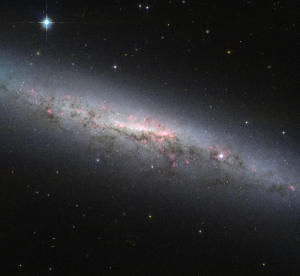
© ESA/Hubble & NASA / Acknowledgement: R. TugralGalaxy NGC 7090.
A new image portrays a beautiful view of the galaxy NGC 7090, as seen by the NASA/ESA Hubble Space Telescope. The galaxy is viewed edge-on from Earth, meaning we cannot easily see the spiral arms, which are full of young, hot stars.

However, a side-on view shows the galaxy's disc and the bulging central core, where typically a large group of cool old stars are packed in a compact, spheroidal region. In addition, there are two interesting features present in the image that are worth mentioning.

First, we are able to distinguish an intricate pattern of pinkish red regions over the whole galaxy. This indicates the presence of clouds of hydrogen gas. These structures trace the location of ongoing star formation, visual confirmation of recent studies that classify NGC 7090 as an actively star-forming galaxy.

Second, we observe dust lanes, depicted as dark regions inside the disc of the galaxy. In NGC 7090, these regions are mostly located in lower half of the galaxy, showing an intricate filamentary structure. Looking from the outside in through the whole disc, the light emitted from the bright center of the galaxy is absorbed by the dust, silhouetting the dusty regions against the bright light in the background.

Rocket

Nasa Curiosity Rover Begins Mars Science Mission Today

Curiosity insturment cluster
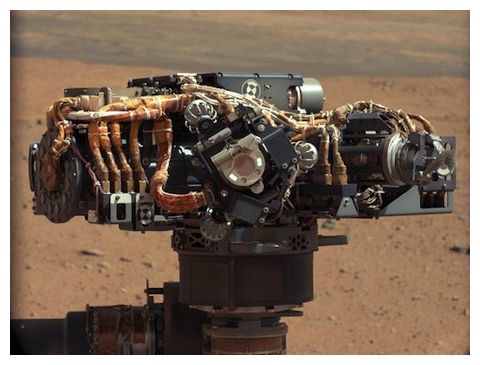
© Nasa/JPL-Caltech/MSSSCuriosity's instrument cluster is all ready to perform some science.
Let the science begin! Curiosity begins its quest to determine whether Mars was once habitable, metre by metre, rock by rock

This is the moment the scientists have been waiting for. Nasa's Mars Curiosity rover will begin driving today in search of the first rock to analyse with its robot arm. After five and a half weeks of instrument checks, software updates and test drives, today the scientists take over from the engineers.

Searching for the right rock could take days or weeks depending upon what the rover happens to pass. Curiosity will make slow but steady progress, driving at no more than 40 metres per Martian day, or sol as the scientists call them, before radioing its progress back to Earth.

From now on, the science team will meet as soon as the data is received to determine what has been achieved and what they would like to do next. This could be driving to a new location, analysing a rock or soil sample, or taking images.

Camera

World's Most Powerful Digital Camera Opens Eye, Records First Images in Hunt for Dark Energy

Image
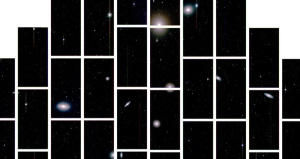
© Dark Energy Survey CollaborationZoomed-in image from the Dark Energy Camera of the Fornax cluster of galaxies, which lies about 60 million light years from Earth.
Eight billion years ago, rays of light from distant galaxies began their long journey to Earth. That ancient starlight has now found its way to a mountaintop in Chile, where the newly-constructed Dark Energy Camera, the most powerful sky-mapping machine ever created, has captured and recorded it for the first time.

That light may hold within it the answer to one of the biggest mysteries in physics -- why the expansion of the universe is speeding up.

Scientists in the international Dark Energy Survey collaboration announced this week that the Dark Energy Camera, the product of eight years of planning and construction by scientists, engineers, and technicians on three continents, has achieved first light. The first pictures of the southern sky were taken by the 570-megapixel camera on Sept. 12.

"The achievement of first light through the Dark Energy Camera begins a significant new era in our exploration of the cosmic frontier," said James Siegrist, associate director of science for high energy physics with the U.S. Department of Energy. "The results of this survey will bring us closer to understanding the mystery of dark energy, and what it means for the universe."

UFO 2

Warp Drive May Be More Feasible Than Thought, Scientists Say

Warp Drive
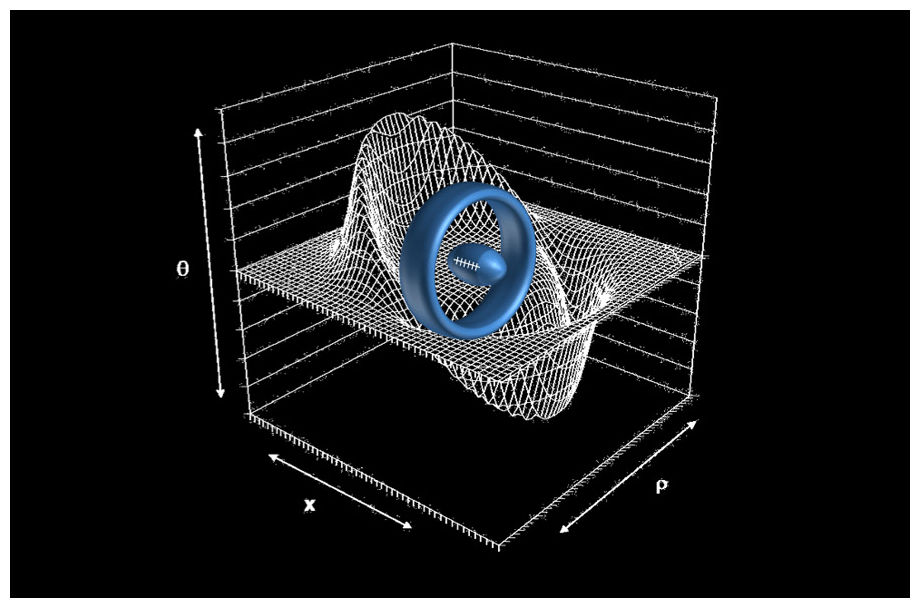
© Harold WhiteA ring-shaped warp drive device could transport a football-shape starship (center) to effective speeds faster than light. The concept was first proposed by Mexican physicist Miguel Alcubierre.
Houston - A warp drive to achieve faster-than-light travel - a concept popularized in television's Star Trek - may not be as unrealistic as once thought, scientists say.

A warp drive would manipulate space-time itself to move a starship, taking advantage of a loophole in the laws of physics that prevent anything from moving faster than light. A concept for a real-life warp drive was suggested in 1994 by Mexican physicist Miguel Alcubierre, however subsequent calculations found that such a device would require prohibitive amounts of energy.

Now physicists say that adjustments can be made to the proposed warp drive that would enable it to run on significantly less energy, potentially brining the idea back from the realm of science fiction into science.

"There is hope," Harold "Sonny" White of NASA's Johnson Space Center said here Friday (Sept. 14) at the 100 Year Starship Symposium, a meeting to discuss the challenges of interstellar spaceflight.

Info

Einstein Thought Dowsing Was Genuine and Now 17 Experts Will Explain Why

Dowsing
© The Ancient Standard
Chino Valley, Arizona - To celebrate the possibilities dowsing offers, 17 international experts will be presenting their knowledge and use of dowsing at the inaugural Dowsing World Summit, held online here, beginning September 25th and lasting for 4 weeks.

If ever people think of dowsing, they think of an old man using a stick to find water. But dowsing is so much more than that. It is a simple skill, easily learned, and documents date it back to at least the 16th century to the time when it was used to locate minerals as well as water. Anecdotal evidence places it back even earlier.

Einstein himself respected dowsing and what it implied. He said: "I know very well that many scientists consider dowsing as a type of ancient superstition. According to my conviction this is, however, unjustified. The dowsing rod is a simple instrument which shows the reaction of the human nervous system to certain factors which are unknown to us at this time."

In this unique online event here, presenters from Canada, the US, The UK and Australia will explain how they use this natural skill in areas such as Feng Shui, animal communication, health and even in the garden as well as in finding water.

Meteor

European Space Agency plans to build radars for tracking incoming meteors and comet fragments

Image
There is nothing any government or private institution can do to prevent a rain of fire from above.
The European Space Agency today said it would develop a radar system that will be capable of tracking space hazards such as asteroids and orbital debris.

ESA and France's Office National d'Etudes et Recherches Aérospatiales - research center will work with five other partners in France, Spain and Switzerland to this month design a test surveillance radar and develop a $6 million demonstrator model.

ESA says the radar will make use of what's known as "bistatic" technology where the radar emitter and receiver are set up at separate locations and the energy is emitted continuously. For the new test radar, the emitter will be located at a former airport near Crucey-Villages, about 100 km west of Paris, while the receiver will be near Palaiseau, to the south of Paris.

Conversely in 2010 ESA contracted with Spain's Indra Espacio SA to develop a test radar that uses a "monostatic" approach where the radar emitter and the receiver are at the same spot and the energy is emitted in discrete pulses, the ESA stated.

Comment: "Threatening asteroids" passing between here and the moon are not what they are really focused on (although the increased presence of near-miss asteroids certainly points to us passing through denser concentrations of cometary debris). The fact that they're planning such things also makes a farce out of the official stance that there is nothing to fear from space.

Beyond civilian space programmes operated by agencies like the ESA, what the deep-state military types are up to is something else entirely. They appear to be actively tracking cometary bodies, meteors and so on, entering our atmosphere, then launching missiles in the vicinity in order to mask the celestial phenomenon as a military one:

Disguising Celestial Intentions US Military claims it launched three test missiles over Southwestern US


Meteor

Spheres spark new Martian mystery


Eight years ago, NASA's Opportunity rover came across strange-looking spheres that were nicknamed Martian blueberries - and now the rover has sent back a picture showing a different flavor of Marsberry that has the experts scratching their heads.

"This is one of the most extraordinary pictures from the whole mission," Cornell astronomer Steve Squyres, the rover mission's principal investigator, said today in a news release.

The golf-cart-sized Opportunity rover used the microscopic imager on the end of its robotic arm to take a super-close look at the spherical shapes. These particular berries, measuring as much as one-eighth of an inch (3 millimeters) in diameter, cover an outcrop called Kirkwood in the Cape York segment of Endeavour Crater's western rim.

"Kirkwood is chock full of a dense accumulation of these small spherical objects," Squyres said. "Of course, we immediately thought of the blueberries, but this is something different. We never have seen such a dense accumulation of spherules in a rock outcrop on Mars."

Iron-rich Martian blueberries first came to light soon after Opportunity headed out from its landing site on Mars' Meridiani Planum in early 2004. The fact that they have layers of a mineral called hematite suggests that the spherules were formed by the action of mineral-laden water percolating through rocks. That's how similar spherules formed on Earth, where they're known as thunderballs, shaman stones or Moqui marbles.