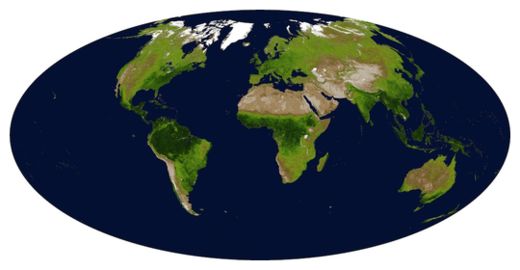
© MODIS Land Group/Vegetation Indices, Alfredo Huete, Principal Investigator, and Kamel Didan, University of Arizona.Satellite instruments such as NASA's Moderate-resolution Imaging Spectroradiometer (MODIS) can detect green leafy vegetation on Earth from space.
Humans may be very close to extracting all of the Earth's available plant resources, says a University of Montana researcher.
In fact, said Steven Running, a professor in the university's College of Forestry and Conservation, humanity may realistically have only 10 percent or so of our
planet's annual plant resources in reserve, with little ability to boost yearly growth. The calculations don't suggest that humanity is on the verge of starvation, Running said, but they do indicate there are limits to our species' growth.
"Economic logic just seems to be about endless growth with no limits," Running told LiveScience. "And this is my attempt to say that on the planet we at least have some biophysical limits, and here's one."
Boundaries to growthThe concept of resource-imposed limits to growth, or "planetary boundaries" first came up in the 1970s with the book
Limits to Growth (Club of Rome, 1972). The authors of that book modeled the planet's productivity and predicted that population and economic growth would run up against basic resource scarcity sometime around 2030. The calculations were somewhat primitive, Running said. The methodology and findings of the modeling were criticized, though researchers have recently revisited the predictions and found them to be relatively accurate. One
2011 analysis, published in book form by SpringerBriefs in Energy found that "reality seems to be closely following the curves that the [Limits to Growth] scenarios had generated."
Climate change and other environmental concerns have prompted scientists to revisit the idea of planetary boundaries, Running said. Likewise, he said, environmental policy-makers have become more interested in whether those boundaries can be defined. Researchers have suggested that important boundaries might include climate change, ocean acidification, land-use change and loss of species.