Science & TechnologyS


Attention

How we know that they know that deadly viruses come from space

Image
© AP
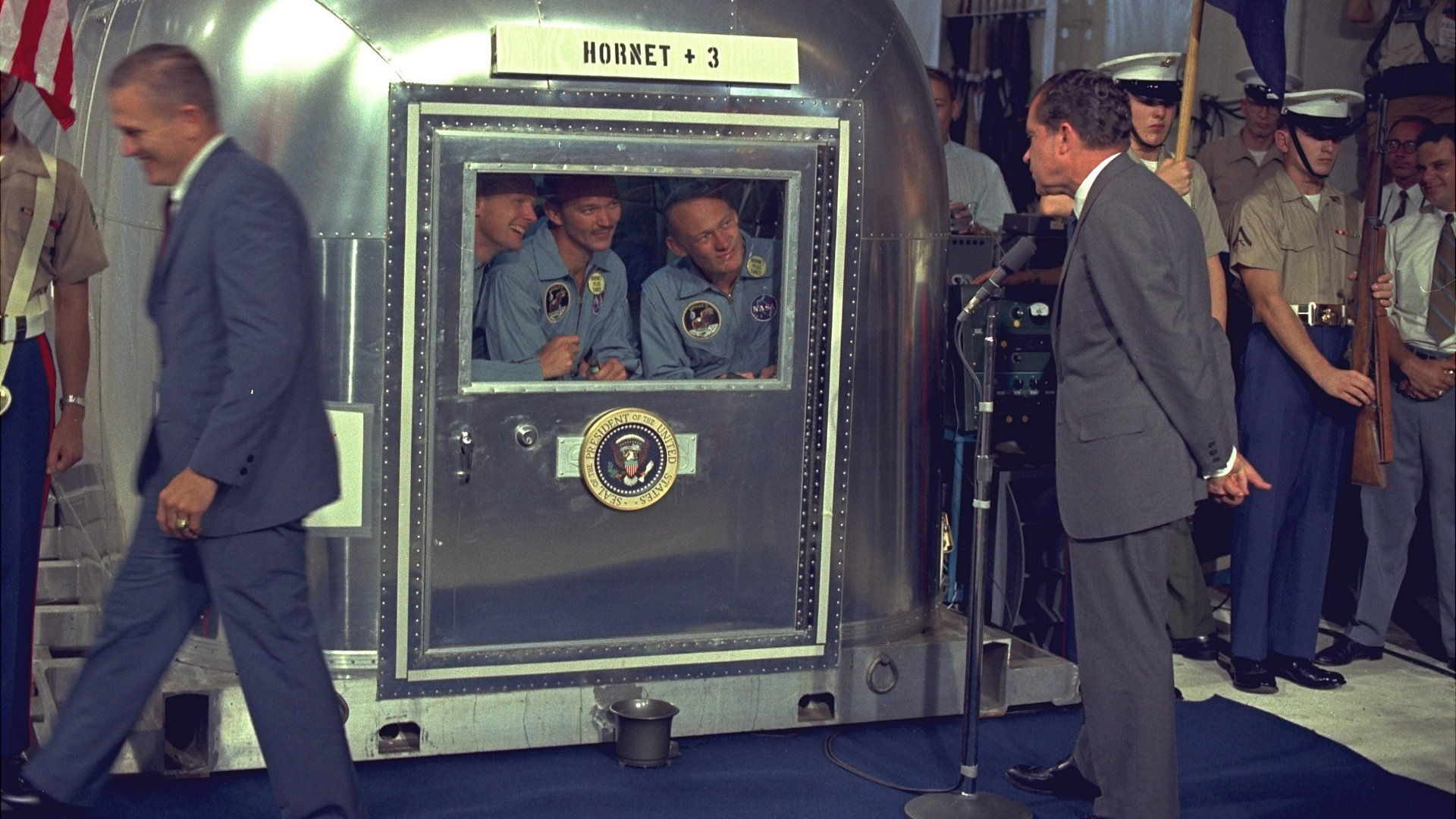
In the early days of space exploration, NASA basically made up procedure on the fly. With little knowledge of the world outside our atmosphere, agency physicians worried what humans might encounter out there. Maybe John Glenn would go Space Blind. Maybe the Apollo 11 crew would track an Andromeda Strain through the Lunar Command Module, unleashing a deadly moon virus on a defenseless earth.

Better safe than sorry, NASA figured. Here's how scientists attempted to protect our planet - and the rest of the solar system - from the threat of extraterrestrial microbes.

The early days of decontamination

First of all, NASA always took planetary protection very seriously. The Office of Planetary Protection (OPR) was formed in 1967, as part of the United Nations Treaty on Principles Governing the Activities of States in the Exploration and Use of Outer Space, Including the Moon and Other Bodies. This treaty states that party countries "shall pursue studies of outer space, including the moon and other celestial bodies, and conduct exploration of them so as to avoid their harmful contamination."

Comment:

..."such an occasion does not come without risks."

You can say that again!

New Light on the Black Death: The Viral and Cosmic Connection


Meteor

How Many Asteroids Are Out There?


Answer: a LOT. And there's new ones being discovered all the time, as this fascinating animation by Scott Manley shows.

Created using data from the IAU's Minor Planet Center and Lowell Observatory, Scott's animation shows the progression of new asteroid discoveries since 1980. The years are noted in the lower left corner.

As the inner planets circle the Sun, asteroids light up as they're identified like clusters of fireflies on a late summer evening. The clusters are mainly positioned along the outer edge of Earth's orbit, as this is the field of view of most of our telescopes.

Once NASA's WISE spacecraft begins its search around 2010 the field of view expands dramatically, as well as does the rate of new discoveries. This is because WISE's infrared capabilities allowed it to spot asteroids that are composed of very dark material and thus reflect little sunlight, yet still emit a telltale heat signature.

Info

Famous Uncertainty Principle Has Been Misunderstood, Scientists Say

Uncertainity Principle
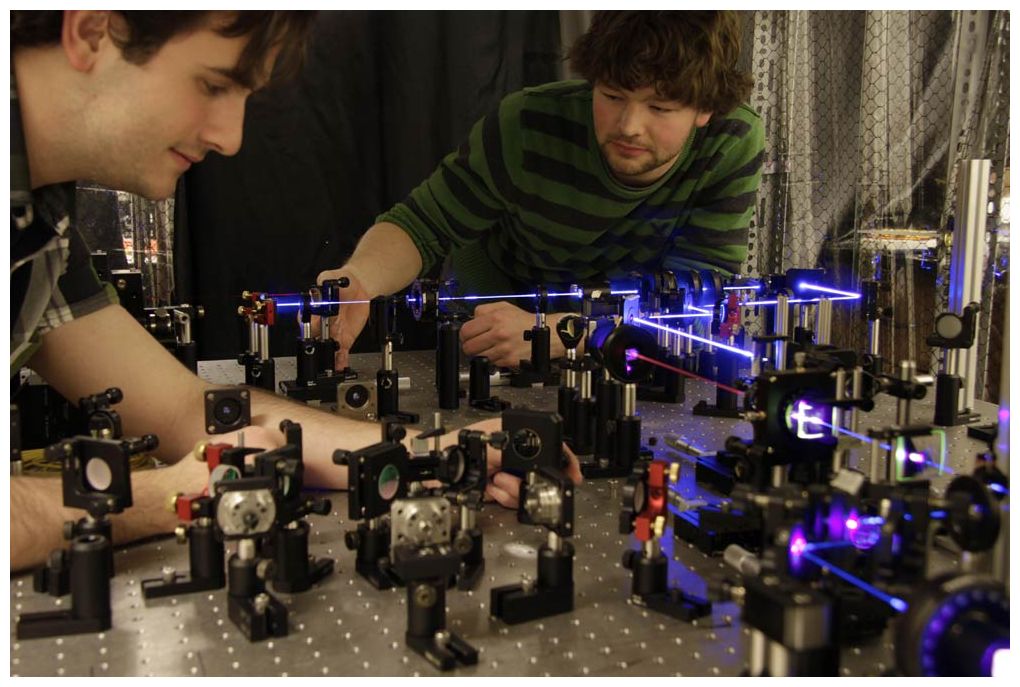
© Dylan Mahler, University of TorontoUniv. of Toronto's Dylan Mahler (l) and Lee Rozema (r) prepare pairs of entangled photons to study the disturbance caused by measuring them. Their work suggests some measurements don't wreak so much havoc on a quantum system.
More than 80 years after the uncertainty principle was first proposed, scientists are ironing out some uncertainties about the famous physics notion.

The uncertainty principle, proposed in 1927 by German physicist Werner Heisenberg, states that the more precisely a particle's position is measured, the less precisely its momentum can be known, and vice versa. It has long been invoked to describe the way measuring an object disturbs that object.

But a new experiment shows this doesn't have to be true.

"You don't have to add more uncertainty to a quantum system by measuring it," said Lee Rozema, a graduate student at the University of Toronto who led a new study of the uncertainty principle.

Rozema and his colleagues found this aspect of the uncertainty principle is often misunderstood, and that quantum measurements don't wreak as much havoc on what they're measuring as many people, including physicists, assume.

The researchers used the test case of a particle of light, called a photon. They wanted to measure the polarization, or orientation, of the photon. In order to avoid disturbing the photon any more than was absolutely necessary, they employed a method called weak measurement, which indirectly measures a quantum system by analyzing its interactions with a related quantum system.

Meteor

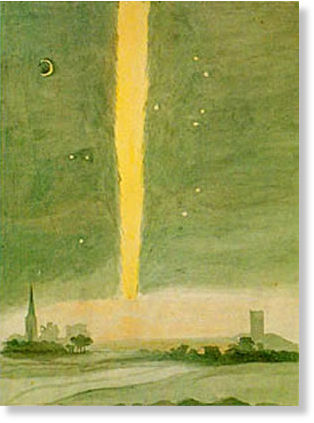
Is Newly Discovered Comet ISON Half of the Great Comet of 1680? - Curious similarity between the orbit of Comet ISON and that of the Great Comet of 1680

Image
© Painting by Atlas van StolkThe Great Comet of 1680 - Rotterdam
Astronomy forums are buzzing with speculation about newly-discovered Comet C/2012 S1 (ISON). Currently located beyond the orbit of Jupiter, Comet ISON is heading for a very close encounter with the sun next year. In Nov. 2013, it will pass less than 0.012 AU (1.8 million km) from the solar surface. The fierce heating it experiences then could turn the comet into a bright naked-eye object

Much about this comet--and its ultimate fate--remains unknown. "At this stage we're just throwing darts at the board," says Karl Battams of the NASA-supported Sungrazer Comet Project, who lays out two possibilities:

"In the best case, the comet is big, bright, and skirts the sun next November. It would be extremely bright -- negative magnitudes maybe -- and naked-eye visible for observers in the Northern Hemisphere for at least a couple of months."

Einstein

Einstein's Brain is Now Interactive iPad App

Image
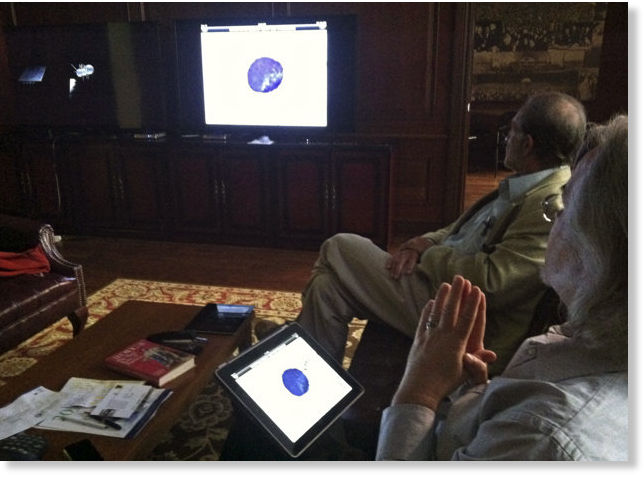
© The Associated Press/Carla K. JohnsonIn this Monday, Sept. 24, 2012 photo, Dr. Phillip Epstein, left, and Steve Landers of the National Museum of Health and Medicine Chicago talk about the new iPad app being released Tuesday, Sept. 25 that allows users to see Albert Einstein's brain as if they were looking through a microscope.
Chicago - The brain that revolutionized physics now can be downloaded as an app for $9.99. But it won't help you win at Angry Birds.

While Albert Einstein's genius isn't included, an exclusive iPad application launched Tuesday promises to make detailed images of his brain more accessible to scientists than ever before. Teachers, students and anyone who's curious also can get a look.

A medical museum under development in Chicago obtained funding to scan and digitize nearly 350 fragile and priceless slides made from slices of Einstein's brain after his death in 1955. The application will allow researchers and novices to peer into the eccentric Nobel winner's brain as if they were looking through a microscope.

"I can't wait to find out what they'll discover," said Steve Landers, a consultant for the National Museum of Health and Medicine Chicago who designed the app. "I'd like to think Einstein would have been excited."

After Einstein died, a pathologist named Thomas Harvey performed an autopsy, removing the great man's brain in hopes that future researchers could discover the secrets behind his genius.

Harvey gave samples to researchers and collaborated on a 1999 study published in the Lancet. That study showed a region of Einstein's brain - the parietal lobe - was 15 percent wider than normal. The parietal lobe is important to the understanding of math, language and spatial relationships.

Meteor

New Comet: C/2012 S1 (ISON)

Cbet nr. 3238, issued on 2012, September 24, announces the discovery of a new comet (discovery magnitude 18.8) by Vitali Nevski (Vitebsk, Belarus) and Artyom Novichonok (Kondopoga, Russia) on CCD images obtained on Sept. 21.06 UT with a 0.4-m f/3 Santel reflector of the International Scientific Optical Network (ISON) near Kislovodsk, Russia. The new comet has been designated C/2012 S1 (ISON).

Comet C/2012 S1 (ISON) will get to within 0.012AU of the Sun (extremely close) at the end of November 2013 and then to ~0.4AU from Earth at the beginning of January 2014! According to its orbit, this comet might become a naked-eye object in the period November 2013 - January 2014. And it might reach a negative magnitude at the end of November 2013.

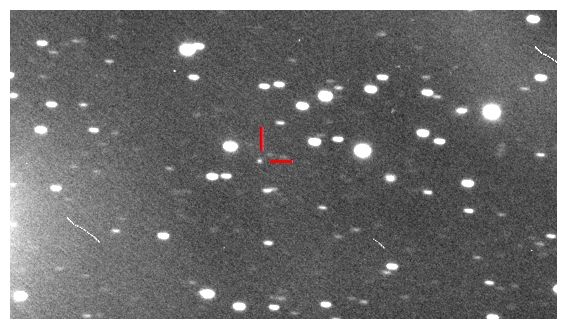
We performed some follow-up measurements of this object, while it was still on the neocp. Stacking of 24 unfiltered exposures, 120-sec each, obtained remotely on 2012, September 22.4 from H06 (ITelescope network near Mayhill, NM) through a 0.25-m, f/3.4 reflector + CCD, shows that this object is slightly diffused, with a 5" coma. The FWHM of this object was measured about 15% wider than that of nearby field stars of similar brightness.

Our confirmation image
C/2012 S1
© Remanzacco Observatory
Here you can see an animation showing the movement of the comet in about 30 minutes

Satellite

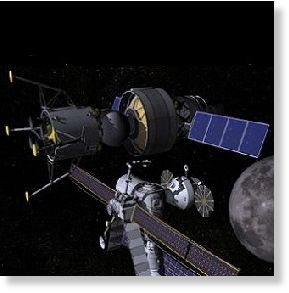
NASA considers construction of an orbital outpost near Moon

Image
Top NASA officials have picked a leading candidate for the agency's next major mission: construction of an outpost that would send astronauts farther from Earth than they've ever been. The "gateway spacecraft" would hover in orbit on the far side of the moon, support a small crew and function as a staging area for future missions to the moon and Mars.

At 277,000 miles from Earth, the outpost would be far more remote than the current space station, which orbits a little more than 200 miles above Earth. The distance raises complex questions of how to protect astronauts from the radiation of deep space - and rescue them if something goes wrong.

NASA Administrator Charles Bolden briefed the White House earlier this month on details of the proposal, but it was unclear whether it had the administration's support. Of critical importance is the cost, which would probably be billions, if not tens of billions, of dollars.

Info

Eunuchs May Outlive Other Men

Eunuch
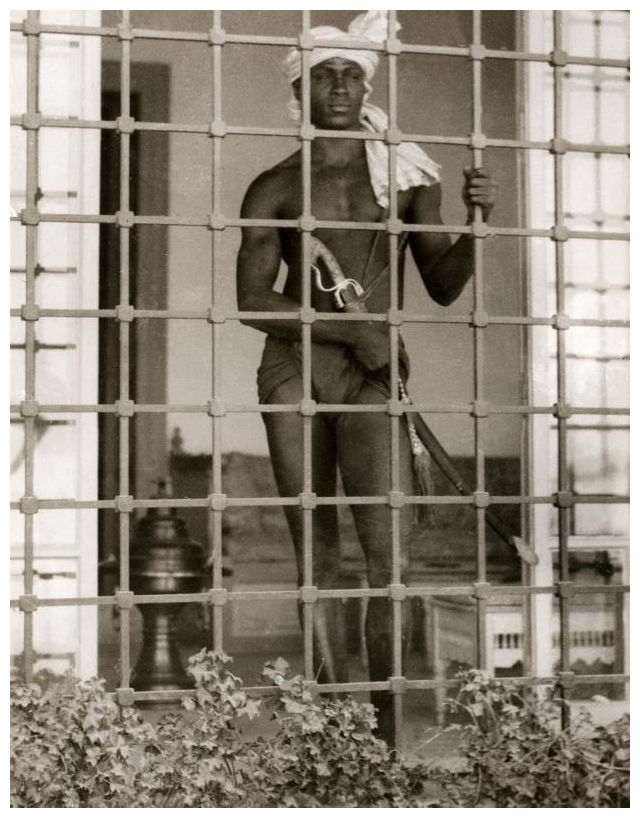
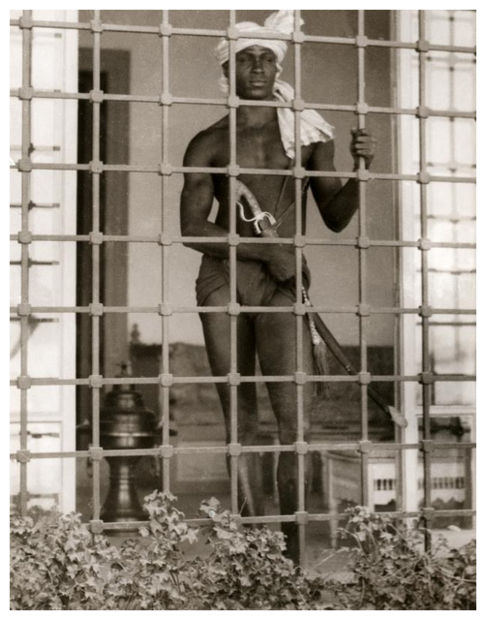
© Nationaal Archief/Spaarnestad Photo/Het LevenA eunuch carrying a weapon keeps an eye on a harem in Tunis, Tunisia, 1931. New research on Korean court eunuchs suggests these castrated men may get a lifespan boost.
It's a life-extending strategy most men probably won't want to pursue, but new research suggests eunuchs live longer than non-castrated guys.

Historical Korean eunuchs - men who had their testicles removed in order to secure high positions in the palace hierarchy - outlived their non-castrated counterparts by as much as 20 years, the study finds.

The results will be published tomorrow (Sept. 25) in the journal Current Biology.

In animals, castration tends to lengthen life span, likely because male sex hormones aren't great for the health. Testosterone is an immune-system suppressor, for example, and can also increase the risk for cardiovascular disease.

But in humans, results have been mixed as to whether castration lengthens life span. One study on patients in a mental hospital found that it does, while another on castrated and non-castrated male singers found that it does not.

Nevertheless, researchers have theorized that testosterone's effects may be the reason women outlive men on average. Other research has suggested a genetic explanation for this life-span gap.

In the new study, Inha University researcher Kyung-Jin Min and his colleagues scoured the historical records from Korea's Chosun (or Joseon) Dynasty, which ran from 1392 to 1910.

Until 1894, castration was a way for men to gain access to political power and prestige in the dynasty. Eunuchs could achieve official ranks and marry and adopt girls and similarly castrated boys in order to maintain a family lineage. Eunuchs and male royal family members were the only men allowed to stay overnight in the royal palace.

Eye 1

DARPA combines human brains and 120-megapixel cameras to create the ultimate military threat detection system

DARPA
© ExtremeTech
After more than four years of research, DARPA has created a system that successfully combines soldiers, EEG brainwave scanners, 120-megapixel cameras, and multiple computers running cognitive visual processing algorithms into a cybernetic hivemind. Called the Cognitive Technology Threat Warning System (CT2WS), it will be used in a combat setting to significantly improve the US Army's threat detection capabilities.

There are two discrete parts to the system: The 120-megapixel camera, which is tripod-mounted and looks over the battlefield (pictured below); and the computer system, where a soldier sits in front of a computer monitor with an EEG strapped to his head (pictured above). Images from the camera are fed into the computer system, which runs cognitive visual processing algorithms to detect possible threats (enemy combatants, sniper nests, IEDs). These possible threats are then shown to a soldier whose brain then works out if they're real threats - or a false alarm (a tree branch, a shadow thrown by an overheard bird).

Eye 1

Manchester airport to quit 'naked' security scanners and replace with radio-wave technology

naked scanner
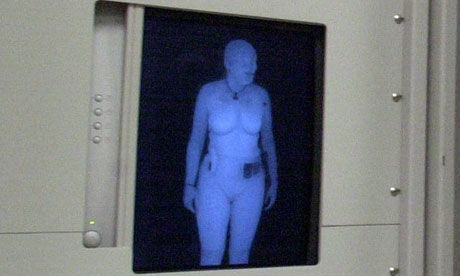
© Brian Branch-Price/APAn image from the backscatter security scanner, which Manchester airport will cease using in October. The European Commission failed to approve it after a three-year trial.
Manchester airport is abandoning the use of controversial security scanners that produce "naked" images after failing to get approval from the European Commission.

The backscatter body scanners, Doctor Who Tardis-like blue boxes between which passengers must stand to produce a ghostly image of the body's naked outline, will cease to be used from the end of October. The decision was made because the commission has failed to give permission in time for an existing three-year trial to be made permanent.

The scanners have proved controversial amid claims they are an invasion of passengers' privacy. There have also been questions over safety, but a panel of independent European health experts unanimously found in March this year that there was "no evidence" they posed health risks.

Comment: One always needs to question the findings of 'independent' 'panels' of 'experts'. Disappointing, yet predictable, that the machines will be replaced with alternatives. But for the technology companies supplying the scanners, airport security is a racket.