
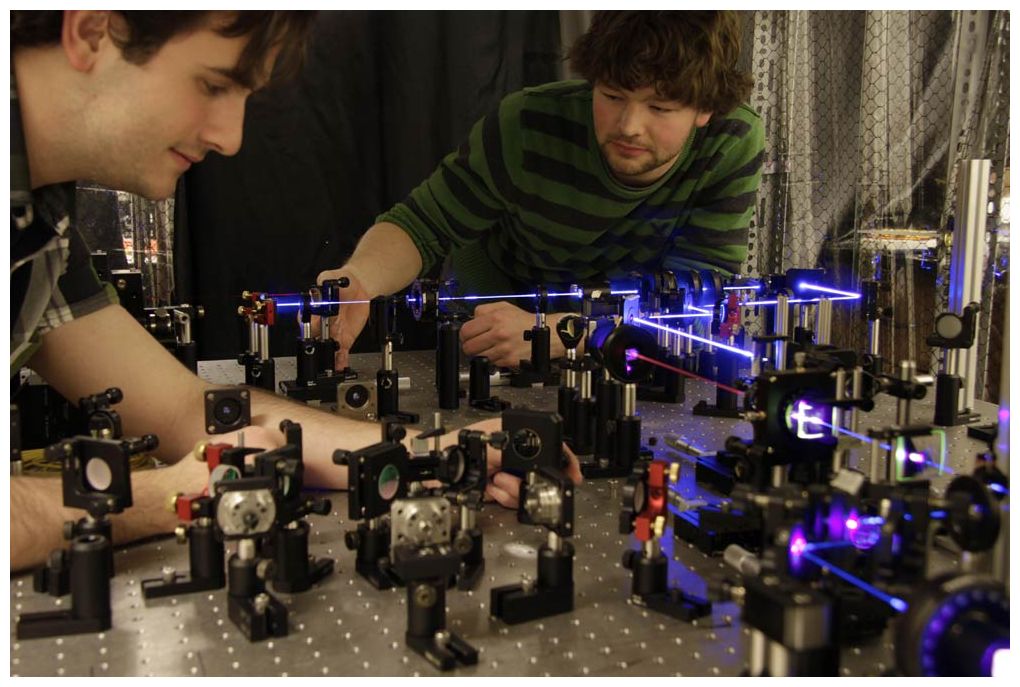
© Dylan Mahler, University of TorontoUniv. of Toronto's Dylan Mahler (l) and Lee Rozema (r) prepare pairs of entangled photons to study the disturbance caused by measuring them. Their work suggests some measurements don't wreak so much havoc on a quantum system.
The uncertainty principle, proposed in 1927 by German physicist Werner Heisenberg, states that the more precisely a particle's position is measured, the less precisely its momentum can be known, and vice versa. It has long been invoked to describe the way measuring an object disturbs that object.
But a new experiment shows this doesn't have to be true.
"You don't have to add more uncertainty to a quantum system by measuring it," said Lee Rozema, a graduate student at the University of Toronto who led a new study of the uncertainty principle.
Rozema and his colleagues found this aspect of the uncertainty principle is often misunderstood, and that quantum measurements don't wreak as much havoc on what they're measuring as many people, including physicists, assume.
The researchers used the test case of a particle of light, called a photon. They wanted to measure the polarization, or orientation, of the photon. In order to avoid disturbing the photon any more than was absolutely necessary, they employed a method called weak measurement, which indirectly measures a quantum system by analyzing its interactions with a related quantum system.
"If you want to make a measurement without disturbing your system, then you can make the interaction very weak, but then you don't get very much information on the system," Rozema told LiveScience. "What we do instead is do it many, many times and build up statistics."
In the case of the photon, the physicists measured the interaction between the particle's polarization and its position in space. After repeated measurements, they arrived at an estimation of the photon's polarization. They then used an apparatus to directly measure the photon's polarization, and compared the results.
"The disturbance that we found is less than what you'd get if you naively applied the Heisenberg uncertainty principle to the measurements," Rozema said.
Previously, researchers have had a hard time studying how much a measurement disturbs a system, because they haven't been able to separate the intrinsic disturbance any measurement would make from the disturbance particular to the measuring apparatus. Weak measurement solves this problem.
The findings don't disprove Heisenberg's uncertainty principle, but they help clarify it, Rozema said. The uncertainty quantified in the principle isn't a result of measurement, but originates in the intrinsic uncertainty of all subatomic, quantum systems, due to the fact that particles exist in states of probability, rather than certainty.
"Your quantum system still has the uncertainty in it that Heisenberg's uncertainty principle says it does," Rozema said. "But you don't have to add more uncertainty to the quantum system by measuring it."
A paper detailing the study was published earlier this month in the journal Physical Review of Letters.




As the Iranian mathematician Lotfi A. Zadeh ( [Link]) proposse
in his famous research thequestions of True or False have a specific degree os Gray...
From the initial FALSE (0) to the final TRUE (1) he proposes that there is a fine gray ZONE ( 0.1 0.2 ... 0.8 0.9)
where nothing is absolutely Just True or False.
So in that regard we can see FREE WILL with a shades o Gray... so that we can make a Weak "interference" in the system
without Openly violating the Uncertainty Principle...
That explains why some Hyperdimensional beings can "interfere" in our reality without openly violating our Free Will.
But the inverse is Possible too..