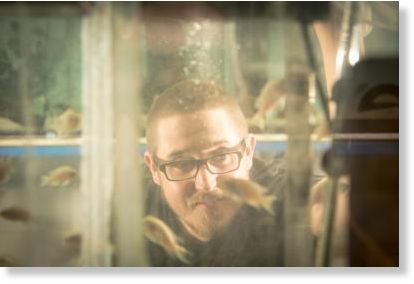
© McMaster UniversityThis is McMaster University researcher Adam Reddon.
Researchers have discovered that a form of oxytocin - the hormone responsible for making humans fall in love - has a similar effect on fish, suggesting it is a key regulator of social behaviour that has evolved and endured since ancient times.
The findings, published in the latest edition of the journal
Animal Behaviour, help answer an important evolutionary question: why do some species develop complex social behaviours while others spend much of their lives alone?
"We know how this hormone affects humans," explains Adam Reddon, lead researcher and a graduate student in the Department of Psychology, Neuroscience & Behaviour at McMaster University. "It is related to love, monogamy, even risky behaviour, but much less is known about its effects on fish."
Specifically, researchers examined the cichlid fish
Neolamprologus pulcher, a highly social species found in Lake Tanganyika in Africa.
These cichlids are unusual because they form permanent hierarchical social groups made up of a dominant breeding pair and many helpers that look after the young and defend their territory.
For the experiments, researchers injected the cichlids with either isotocin - a "fish version" of oxytocin - or a control saline solution.
When placed in a simulated territorial competition with a single perceived rival, the isotocin-treated fish were more aggressive towards large opponents, regardless of their own size.







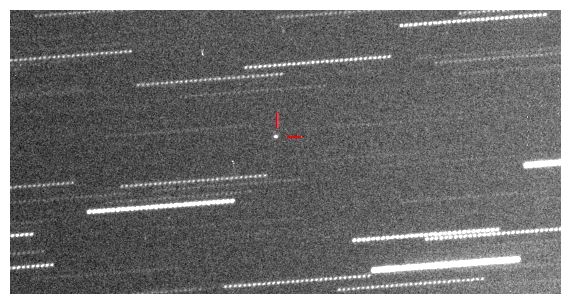







Comment: Just five weeks ago, the Russians were playing down the threat posed by Apophis: Russian scientists say chances of Apophis striking Earth in 2029 very slim
In any event, it's not large bodies we need to be concerned about. In her book, The Apocalypse: Comets, Asteroids and Cyclical Catastrophes, Laura Knight-Jadczyk writes: