
Using the unique observing capabilities of Herschel, astronomers have for the first time determined the composition of the dust in the cold outskirts of this planetary system. Of particular interest was the mineral olivine, which crystallizes out of the protoplanetary disc material close to newborn stars and is eventually incorporated into asteroids, comets and planets.
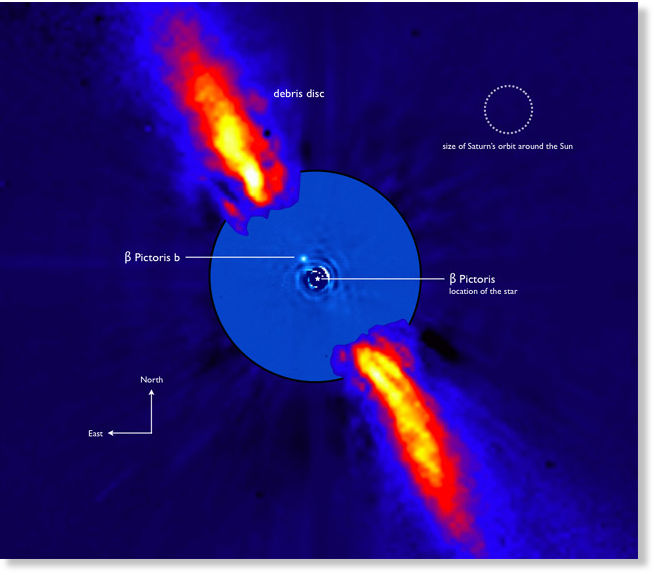
© ESO /A.-M. Lagrange et alThis composite image shows the close environment of Beta Pictoris as seen in near infrared light. The outer part of the image shows the reflected light on the dust disc, as observed in 1996 with the ADONIS instrument on ESO’s 3.6 m telescope; the inner part is the innermost part of the system, as seen at 3.6 microns with NACO on the Very Large Telescope. Astronomers using ESA’s Herschel Space Observatory have recently detected the mineral olivine in a dust belt around this young star
Using the unique observing capabilities of Herschel, astronomers have for the first time determined the composition of the dust in the cold outskirts of this planetary system. Of particular interest was the mineral olivine, which crystallizes out of the protoplanetary disc material close to newborn stars and is eventually incorporated into asteroids, comets and planets.
"As far as olivine is concerned, it comes in different 'flavors'," said Dr Ben de Vries of the University of Leuven in Belgium, lead author of the study published in the journal Nature. "A magnesium-rich variety is found in small and primitive icy bodies like comets, whereas iron-rich olivine is typically found in large asteroids that have undergone more heating, or processing."
The astronomers detected the pristine magnesium-rich variety in the Beta Pictoris system at 15 - 45 astronomical units (AUs) from the star, where temperatures are around - 310 ºF ( - 190 ºC). For comparison, Earth lies at 1 AU from our Sun and the Solar System's Kuiper Belt extends from the orbit of Neptune at about 30 AU out to 50 AU from the Sun.
The Herschel observations allowed astronomers to calculate that the olivine crystals make up around 4% of the total mass of the dust found in this region. In turn, this finding led them to conclude that the olivine was originally bound up inside comets and released into space by collisions between the icy objects.
"The 4% value is strikingly similar to that of Solar system comets 17P/Holmes and 73P/Schwassmann-Wachmann 3, which contain 2 - 10% magnesium-rich olivine," Dr de Vries said. "Since olivine can only crystallize within about 10 AU of the central star, finding it in a cold debris disc means that it must have been transported from the inner region of the system to the outskirts."
"Our findings are an indication that the efficiency of these transport processes must have been similar between the young Solar system and within the Beta Pictoris system, and that these processes are likely independent of the detailed properties of the system," Dr de Vries said.
Indeed, Beta Pictoris is over one and a half times the mass of our Sun, eight times as bright, and its planetary system architecture is different to our own Solar system today.
"Thanks to Herschel, we were able to measure the properties of pristine material left over from the initial planet-building process in another solar system with a precision that is comparable to what we could achieve in the laboratory if we had the material here on Earth," explained study co-author Dr Göran Pilbratt of the ESA's Research and Scientific Support Department.
_______
Bibliographic information: B. L. de Vries et al. 2012. Comet-like mineralogy of olivine crystals in an extrasolar proto-Kuiper belt. Nature 490, 74 - 76; doi: 10.1038/nature11469


Reader Comments
to our Newsletter