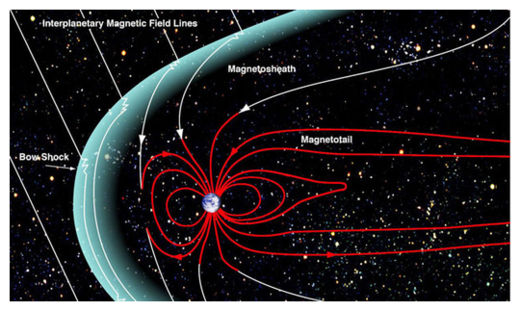
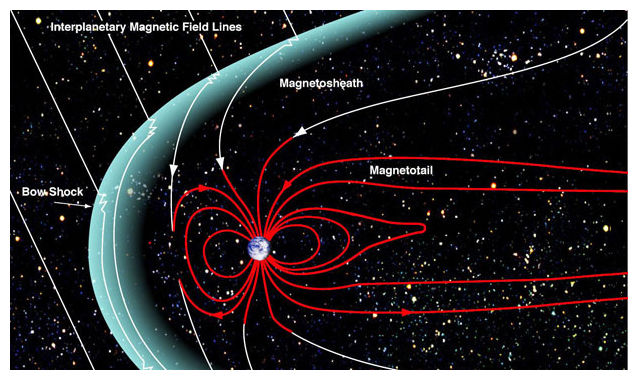
© Aaron Kaase/NASAA magnetosphere is that area of space, around a planet, that is controlled by the planet's magnetic field. It holds a planet's atmosphere to the world.
The discovery by NASA rover Curiosity of evidence that water once flowed on Mars - the most Earth-like planet in the solar system - should intensify interest in what the future could hold for mankind.
The only thing stopping Earth having a lifeless environment like Mars is the magnetic field that shields us from deadly solar radiation and helps some animals migrate, and it may be a lot more fragile and febrile than one might think.
Scientists say earth's magnetic field is weakening and could all but disappear in as little as 500 years as a precursor to flipping upside down.
It has happened before - the geological record suggests the magnetic field has reversed every 250,000 years, meaning that, with the last event 800,000 years ago, another would seem to be overdue.
"Magnetic north has migrated more than 1,500 kilometres over the past century," said Conall Mac Niocaill, an earth scientist at Oxford University. "In the past 150 years, the strength of the magnetic field has lessened by 10 percent, which could indicate a reversal is on the cards."
While the effects are hard to predict, the consequences may be enormous. The loss of the magnetic field on Mars billions of years ago put paid to life on the planet if there ever was any, scientists say.
Mac Niocaill said Mars probably lost its magnetic field 3.5-4.0 billion years ago, based on observations that rocks in the planet's southern hemisphere have magnetisation.
The northern half of Mars looks younger because it has fewer impact craters, and has no magnetic structure to speak of, so the field must have shut down before the rocks there were formed, which would have been about 3.8 billion years ago.
"With the field dying away, the solar wind was then able to strip the atmosphere away, and you would also have an increase in the cosmic radiation making it to the surface," he said.
"Both of these things would be bad news for any life that might have formed on the surface - either wiping it out, or forcing it to migrate into the interior of the planet."














Comment: To better understand the depth of moral depravity and criminal negligence at all levels in the scientific community and how their actions keep us in the dark and often put our lives in harm's way, read:
The Corruption of Science in America
The Corruption of Science: Pressure for positive results puts science under threat, study shows