Science & TechnologyS


Info

Magnets can cause cancer cells to "self-destruct"

Magnets to Kill Cancer Cells
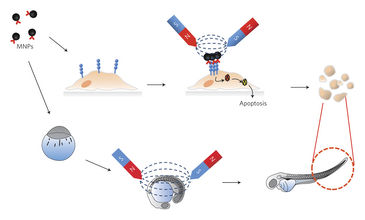
© NatureA schematic representation of the magnetic switch for apoptosis signalling in in vitro cells and in a zebrafish.
Scientists have created magnets that trigger tumors to 'self-destruct' in a breakthrough that could revolutionize cancer therapy.

Researchers in South Korea have developed a method that uses a magnetic field to flip a "self-destruct" switch in tumors in both living fish and laboratory cancer cells. Researchers from the latest study, published in the journal Nature Materials, plan on testing the new technique on a variety of other cancers to see if it can destroy other tumors.

Programmed cell death, or apoptosis, is a process in which the body rids itself of old, faulty or infected cells, and according to researchers, the cell-death process is often blocked, which often renders some drugs to be ineffective and tumor cells to continue to develop and spread uncontrollably throughout the body.

In the latest study, researchers developed a new magnetic therapy that involves creating tiny iron oxide nanoparticles attached to antibodies or proteins produced by the body's immune system when it detects harmful foreign substances.

Einstein

Hidden in Einstein's math: Faster-than-light travel?

Special Relativity
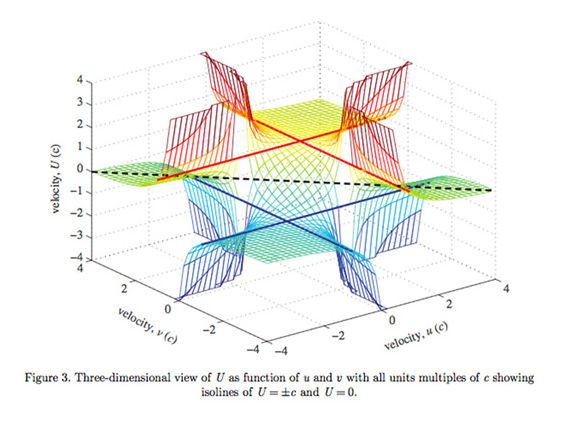
© Hill, Cox/Proceedings of the Royal Society AScientists have extended Einstein's equations for faster-than-light travel. Here a three-dimensional (right) graph shows the relationship between three different velocities: v, u and U, where v is the velocity of a second observer measured by a first observer, u is the velocity of a moving particle measured by the second observer, and U is the relative velocity of the particle to the first observer.
Although Einstein's theories suggest nothing can move faster than the speed of light, two scientists have extended his equations to show what would happen if faster-than-light travel were possible.

Despite an apparent prohibition on such travel by Einstein's theory of special relativity, the scientists said the theory actually lends itself easily to a description of velocities that exceed the speed of light.

"We started thinking about it, and we think this is a very natural extension of Einstein's equations," said applied mathematician James Hill, who co-authored the new paper with his University of Adelaide, Australia, colleague Barry Cox. The paper was published Oct. 3 in the journal Proceedings of the Royal Society A: Mathematical and Physical Sciences.

Special relativity, proposed by Albert Einstein in 1905, showed how concepts like speed are all relative: A moving observer will measure the speed of an object to be different than a stationary observer will. Furthermore, relativity revealed the concept of time dilation, which says that the faster you go, the more time seems to slow down. Thus, the crew of a speeding spaceship might perceive their trip to another planet to take two weeks, while people left behind on Earth would observe their passage taking 20 years.

Info

Shell Game: Earth's wandering outer layers mystify

Earth's Mantle
© ESRF/Denis Andrault/Henri SamuelAn illustration showing how a mantle plume can be emitted from the core-mantle boundary of the Earth to reach the Earth's crust. Due to the movement of tectonic plates at the Earth's surface, the mantle plumes can create a series of aligned hot spot volcanoes. A mid-ocean ridge and a subducted plate are also shown in this schematic from a study in the July 19, 2012 issue of the journal Nature.
The entire outermost part of Earth may be wandering over the planet's whirling molten core, new research suggests.

Knowing whether the Earth's outer layers are roaming in this manner is key to understanding the big picture of how the planet's surface is evolving overall, scientists added.

At various times in Earth's history, the planet's solid exterior - its crust and mantle layers - has apparently drifted over the planet's spinning core. To picture this, imagine that a peach's flesh somehow became detached from a peach's pit and was free to move about over it.

This movement of the Earth's outer layers is known as "true polar wander." It differs from the motion of the individual tectonic plates making up Earth's crust, known as tectonic drift, or the motions of Earth's magnetic pole, called apparent polar wander.

Laptop

Hacker cracks 4 million hotel locks with 'James Bond Dry Erase Marker'

James Bond
© Metro-Goldwyn-Mayer/Allmoviephoto
This new hacker invention may look like a harmless dry erase marker, but in truth it's the ultimate electronic lock pick.

In a post titled 'James Bond's Dry Erase Marker,' hotel hacker Matthew Jakubowski demonstrates how anyone can build this pocket-sized device which will open the lock on an estimated 4 million hotel rooms.

'I guess we wanted to show that this sort of attack can happen with a very small concealable device,' says Matthew Jakubowski, a security researcher with Trustwave, told Forbes. 'Someone using this could be searched and even then it wouldn't be obvious that this isn't just a pen.'

The device exploits a vulnerability in Onity locks, a cheap lock used on millions of hotel room doors.

Onity's site boasts their locks are used in 22,000 hotel worldwide.

The lock has a small port on its bottom designed for hotels to set master keys.

Hacker Cody Brocious discovered you could read the lock's memory through this port, including a decryption key.

Fireball

Close Approach of Asteroid 2012 TV

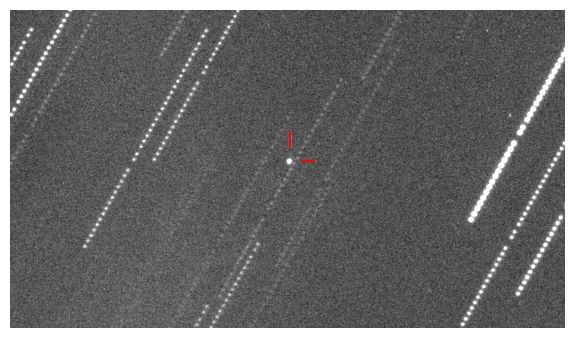
M.P.E.C. 2012-T16, issued on 2012 Oct. 6, reports the discovery of the asteroid 2012 TV (discovery magnitude 17.6) by Tenagra II Observatory on images taken on October 05.3 with a 0.41-m f/3.75 astrograph + CCD.

2012 TV has an estimated size of 24 m - 55 m (H=25.1) and it will have a close approach with Earth at about 0.66 LD (Lunar Distances = ~384,000 kilometers) or 0.0017 AU (1 AU = ~150 million kilometers) at 1504 UT on 7 Oct. 2012. This asteroid will reach the magnitude 13.5 on October 07 around 13-14UT.

We performed some follow-up measurements of this object, from the H06 ITelescope network (near Mayhill, NM) on 2012, Oct. 06.3, through a 0.25-m f/3.4 reflector + CCD.

Below you can see our image, stack of 40x15-second exposures, taken with the asteroid at magnitude ~15.6 and moving at 14.30"/min. At the moment of the close approach on October 07, 2012 TV will move at ~ 815"/min.
Asteroid 2012 TV
© Remanzacco Observatory
Here you can see a short animation showing the movement of 2012 TV (each frame is a 15-second exposure).

Camera

Universal map of vision in the human brain

Image
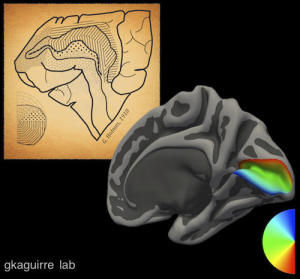
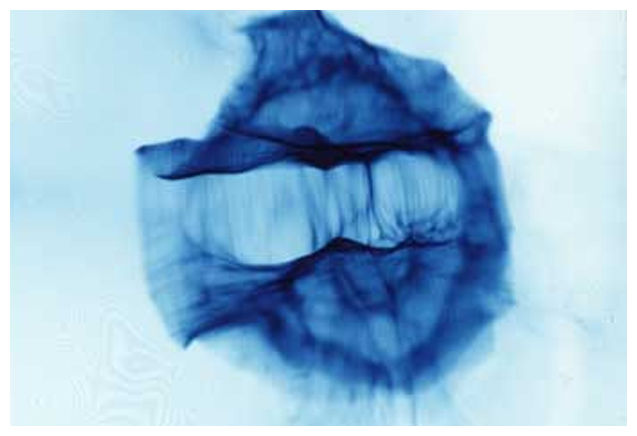
© University of Pennsylvania School of MedicineThe modern map of the representation of vision in the brain is compared to the 1918 original.
Nearly 100 years after a British neurologist first mapped the blind spots caused by missile wounds to the brains of soldiers, Perelman School of Medicine researchers at the University of Pennsylvania have perfected his map using modern-day technology. Their results create a map of vision in the brain based upon an individual's brain structure, even for people who cannot see. Their result can, among other things, guide efforts to restore vision using a neural prosthesis that stimulates the surface of the brain.

The study appears in the latest issue of Current Biology, a Cell Press journal.

Scientists frequently use a brain imaging technique called functional MRI (fMRI) to measure the seemingly unique activation map of vision on an individual's brain. This fMRI test requires staring at a flashing screen for many minutes while brain activity is measured, which is an impossibility for people blinded by eye disease. The Penn team has solved this problem by finding a common mathematical description across people of the relationship between visual function and brain anatomy.

"By measuring brain anatomy and applying an algorithm, we can now accurately predict how the visual world for an individual should be arranged on the surface of the brain," said senior author Geoffrey Aguirre, MD, PhD, assistant professor of Neurology. "We are already using this advance to study how vision loss changes the organization of the brain."

Meteor

Next year's "brightest comet in modern times" to be "once in a civilization" event

Image
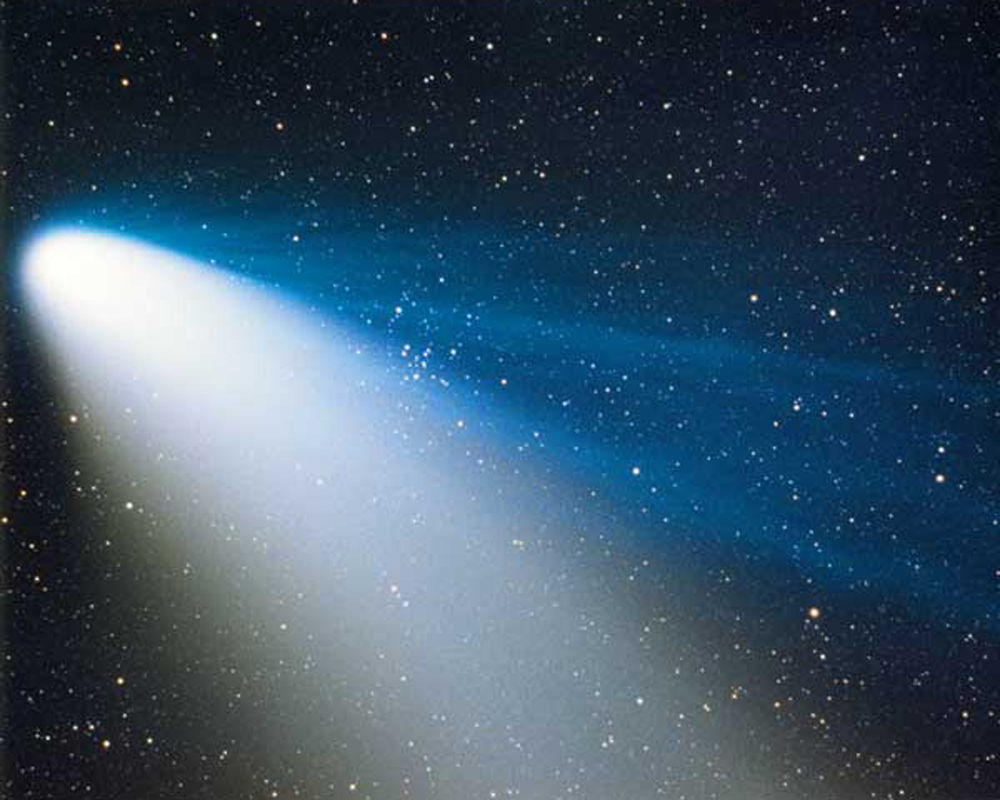
File photo
As it flares out of the distant Oort Cloud, the newly discovered comet C/2012 S1 (ISON) appears to be heading on a trajectory that could make for one of the most spectacular night-sky events in living memory. Why is this comet expected to be so unique? Two reasons:

Astronomers predict that the comet will pass just 1.16 million miles from the Sun as it swings around its perihelion, or closest approach. (This may seem like a lot, but remember - the Sun is big. If we were to scale the Sun down to the size of Earth, the comet would pass well within the orbits of dozens of satellites.) The close approach will melt enormous amounts of the comet's ice, releasing dust and gas and forming what should be a magnificent tail.

After it loops around the Sun and forms this tail, the comet should then pass relatively close to Earth - not near enough to cause any worry, but close enough to put on a great show. Viewers in the Northern Hemisphere will get the best view as the comet blooms in the weeks approaching Christmas 2013. The comet could grow as bright as the full moon.

Comment: The good news is that it looks like we are certainly going to get a great show... the bad news is that even if the comet body itself comes nowhere near us, it is only a matter of time before Earth interacts with the enormous quantity of debris it leaves in its wake. The wrath of the gods might once more need to be assuaged, portending a bad day for the Powers That Be.

Here is the full text of the 1680 comet description quoted above:
The Dutch and Quaker Colonies in America by John Fiske

Chapter XI, 'New York in the Year 1680'

Late in the autumn of 1680 the good people of Manhattan were overcome with terror at a sight in the heavens such as has seldom greeted human eyes. An enormous comet, perhaps the most magnificent one on record, suddenly made its appearance. At first it was tailless and dim, like a nebulous cloud, but at the end of a week the tail began to show itself and in a second week had attained a length of 30 degrees; in the third week it extended to 70 degrees, while the whole mass was growing brighter. After five weeks it seemed to be absorbed into the intense glare of the sun, but in four days more it reappeared like a blazing sun itself in the throes of some giant convulsion and threw out a tail in the opposite direction as far as the whole distance between the sun and the earth. Sir Isaac Newton, who was then at work upon the mighty problems soon to be published to the world in his Principia, welcomed this strange visitor as affording him a beautiful instance for testing the truth of his new theory of gravitation. But most people throughout the civilized world, the learned as well as the multitude, feared that the end of all things was at hand. Every church in Europe, from the grandest cathedral to the humblest chapel, resounded with supplications, and in the province of New York a day of fasting and humiliation was appointed,in order that the wrath of God might be assuaged.
Astronomy Now's choice of words is interesting... A re-examination of history in light of cyclic catastrophes reveals "once-in-a-civilization" events to be such because they are civilization-ending events!


Meteor

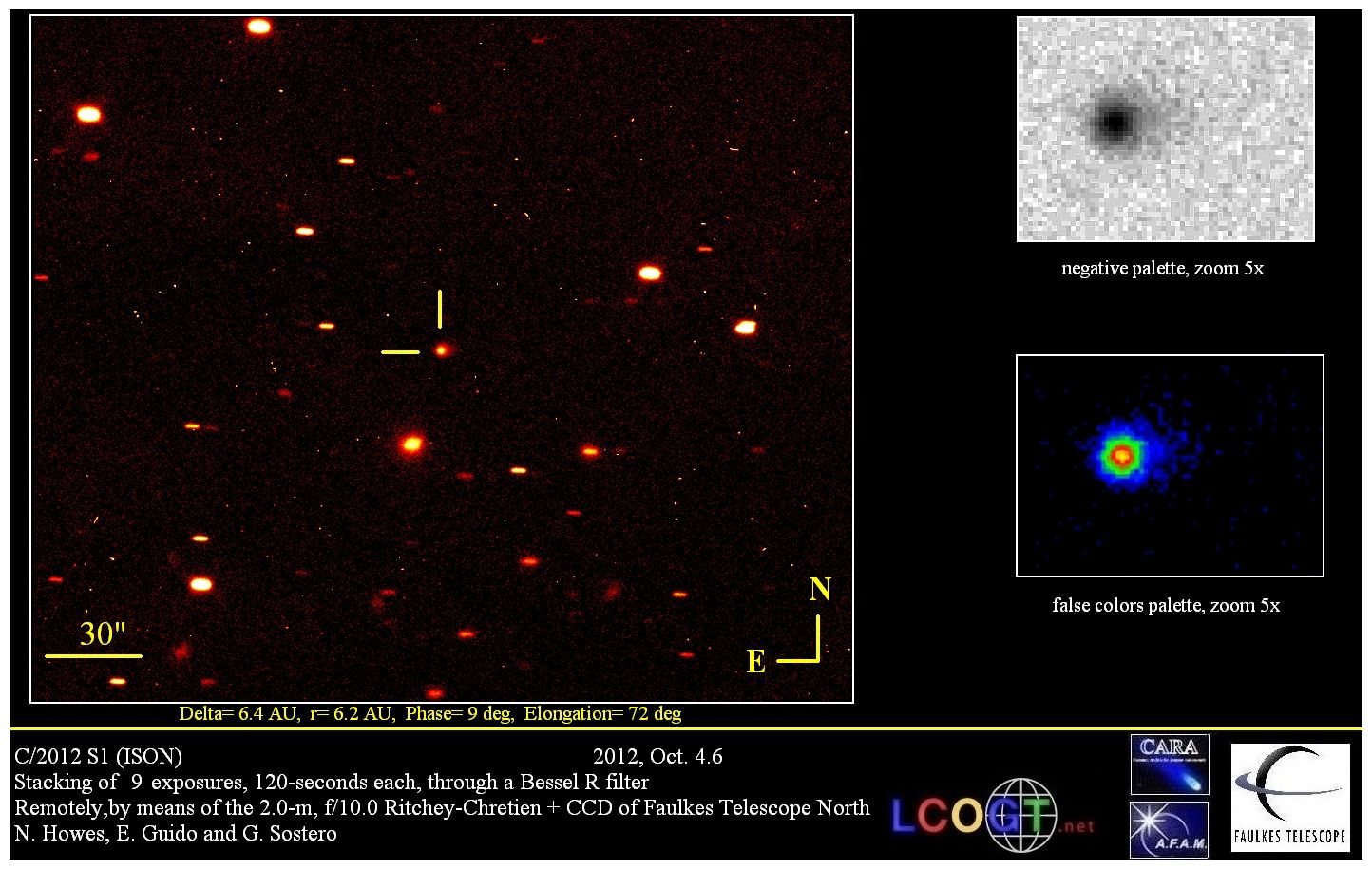
Comet C/2012 S1 (ISON) - Update 2012, Oct. 4

We obtained further follow-up on C/2012 S1 (ISON) on 2012, Oct. 4.6, again through the 2.0-m f/10.0 Ritchey-Chretien + CCD + Bessel R filter of Faulkes Telescope North (F65) Haleakala.

Stacking of 9 exposures, 120 seconds each, produced an image where a well developed and elongated coma measuring nearly 6"x9" is now visible, extended toward PA 280 deg.
Comet ISON
© Remanzacco Observatory

Info

Order can emerge from chaos in the cosmos, study finds

Plasma Streams
© Lawrence Livermore National Laboratory Plasmas stream from the top and bottom to form large-scale electromagnetic fields.
Researchers' discovery of self-organized electromagnetic fields in counter-streaming ionized gases is paving the way for scientists to have new ways to explore how order can emerge from chaos in the universe.

"We've created a model for exploring how electromagnetic fields help organize ionized gas or plasma in astrophysical settings, such as in the plasma flows that emerge from young stars," said lead author Nathan Kugland, a postdoctoral researcher in the High Energy Density Science Group at LLNL.

He said these fields helped to shape the flows, and could play a supporting role alongside gravity in the formation of solar systems. This means it could have also eventually lead to the creation of planets like Earth.

Hye-Sook Park, team leader and staff physicist at LLNL, said the observations were completely unexpected, because plasmas move so quickly they should freely stream past each other.

Comment: For more information on self-organizing fields and their implications for scientific materialism, see Rupert Sheldrake's new book Science Set Free.


Satellite

Martian 'island of silver' in stunning detail - complete with mountain peaks topped by carbon dioxide frost

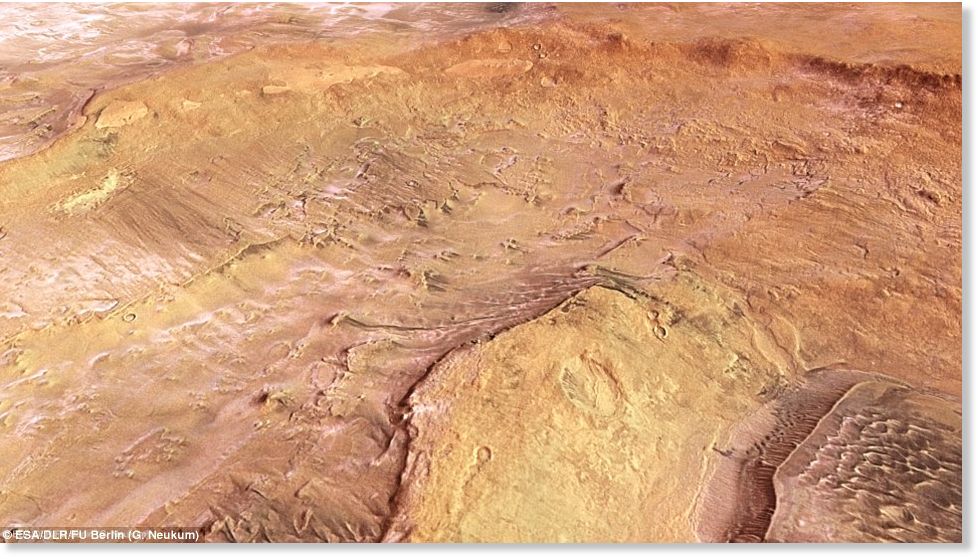
While America's Curiosity rover has excelled at sending back pictures of rocks on the Martian surface, Europe has not been left behind - as these stunning images of the Martian landscape show. On 8 June, the high-resolution stereo camera on Mars Express captured a region within the 1800 km-wide and 5 km-deep Argyre basin, which was created by a gigantic impact in the planet's early history.

It reveals the astonishing beauty of the red planet, with mountains frosted in carbon dioxide, and vast craters in an area researchers have dubbed the 'island of silver' due to the frost topped peaks.
Image
© ESAThe Argyre and Hooke Craters on mars, with a frosting of carbon dioxide clearly visible in the top right of the image, taken from the Mars Express spacecraft