Science & TechnologyS


Info

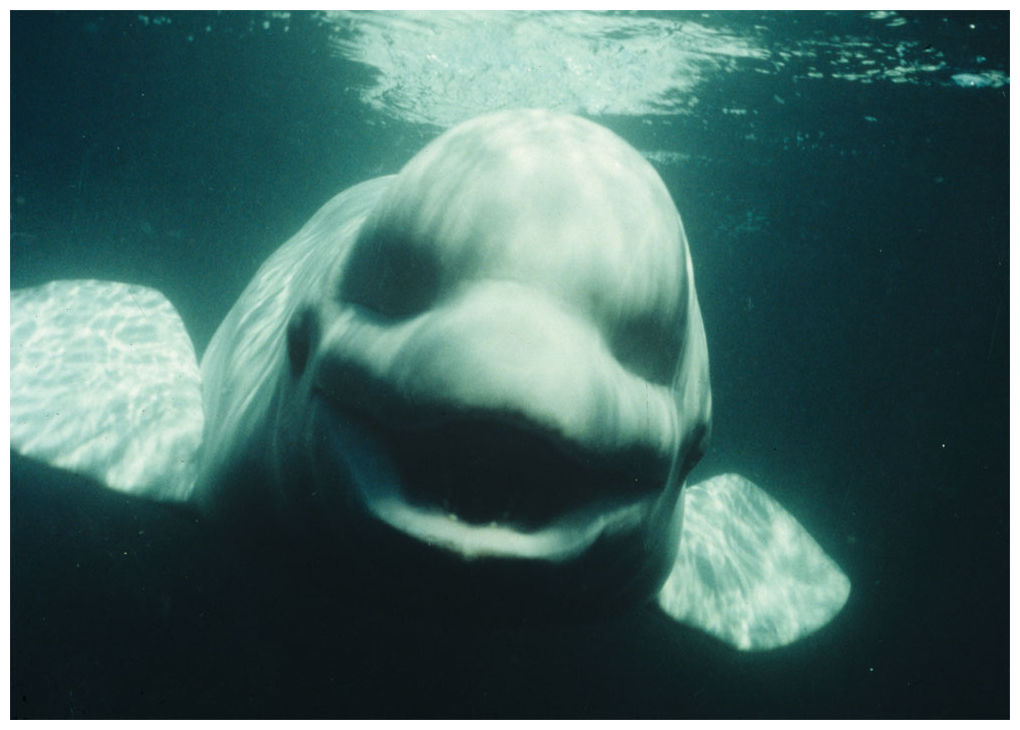
Male beluga whale mimics human voice

Noc Beluga
© U.S. NavyThis male beluga whale named Noc can mimic the voices of humans, scientists report Oct. 23, 2012 in the journal Current Biology.
Move over, Moby Dick. Scientists have found a white whale capable of imitating human speech.

These findings, the first to show that whales can mimic the voices of humans, suggest that researchers might want to analyze other whales for similar abilities.

Beluga whales, also known as white whales, are known as "the canaries of the sea" because of how vocal they are. They are not the same kind of whale as the monstrous giant of the story Moby Dick, which was a white sperm whale - belugas are actually among the smallest species of whales.

Fireball 4

One-of-a-kind celestial happening will occur on Tuesday, October 23rd: Slooh space camera to broadcast a live view of comets converging in the night-sky

A fantastic, one-of-a-kind celestial happening will occur on Tuesday, October 23rd, as Comet 168P/Hergenrother and Comet C/2012 J1 (Catalina) will pass each other in space like ships in the night - but only during a very narrow viewing window. Slooh Space Camera will provide live coverage of this spectacular event on Tuesday, October 23rd, live on Slooh.com, free to the public starting at 2 p.m. PDT / 5 p.m. EDT / 21:00 UTC - accompanied by real-time discussions with Slooh President Patrick Paolucci, Slooh Outreach Coordinator Paul Cox, and Astronomy Magazine columnist Bob Berman. Viewers can watch live on their PC or iOS/Android mobile device.

Slooh was first alerted to this unusual event by long-time Slooh member Maynard Pittendreig; he and other members have been tracking both comets. The comets will appear close in the sky to fall within the reach of a single field-of-view of Slooh's robotic telescopes. The pair will have an apparent separation of 43.5 arcminutes, as shown in this sky chart: goo.gl/hq8hK Comet 168P/Hergenrother has been through a number of "outbursts" over the last 6-weeks. Each of these unexpected increases in brightness has been witnessed and actively imaged by Slooh members. The outbursts could be a sign that the comet nucleus is starting to break apart, which is why the comet is being observed every night by Slooh members. Comet C/2012 J1 (Catalina) has been a superb contrast to Hergenrother; exhibiting a far more stable and expected increase in brightness as it orbits the Sun. Both comets have shown relatively bright comas and small tails.

Fish

Fish break law of physics, become invisible

Sardine
© SEFSC Pascagoula Laboratory; Collection of Brandi NobleSardine.

Silver-colored fish, such as herrings, sardines and sprat, are breaking a basic law of physics, according to a new study published in Nature Photonics. The ability allows the fish to become invisible to predators.

The physics law has to do with how light reflects.

As researchers Tom Jordan and Julian Partridge from Bristol University explain, reflective surfaces polarize light, a phenomenon that fishermen or photographers overcome by using polarizing sunglasses or polarizing filters to cut our reflective glare.

Jordan and Partridge, however, found that silvery fish have overcome this basic law of reflection.

The fish's skin contains multilayer arrangements of reflective guanine crystals. (Here's a factoid: guanine is also one of the key components of guano, aka bird and fish poop. The terms originate from an ancient word for dung, "wanu.") It was previously thought that fish skin would fully polarize light when reflected. As the light becomes polarized, there should then be a drop in reflectivity.

But that's not what always happens, as it turns out.

Propaganda

Pipe dream: Russia envisions asteroid-smashing rocket

Image
Fantasy vs Reality: no, Bruce Willis can't save the day, and neither can your government.
Existing Russian rocket carriers could be redesigned to produce a rocket capable of destroying an asteroid, Energia chief Vitaly Lopota told the Russian state newspaper Rossiyskaya Gazeta Friday.

"There are three large asteroids, including Apophis, whose orbits cross the Earth's orbit and which could hit the Earth in the next several decades," he said.

Astronomers say Apophis, discovered in 2004, could approach Earth as close as 24,000 miles -- one-tenth the distance between Earth and the moon -- in 2029.

A 70-ton rocket would be needed to change the orbit of an asteroid of Apophis' size by "towing" it away from Earth or destroying it with a thermonuclear blast, Lopota said.

Energia was prepared to construct such a rocket within three to five years, he said.

Comment: Not gonna happen...
Can Bruce Willis save us from asteroid 'Armageddon'? No, and neither can your government

Could it actually happen? Definitely not, say physics graduate students at the University of Leicester in England. [...]

Ben Hall, Gregory Brown, Ashley Back and Stuart Turner devised a formula to calculate how much energy would be needed to split an asteroid of the size depicted in the film. They reported in two related papers in the University of Leicester Journal of Special Physical Topics that it would require 800 trillion terajoules of energy to split the asteroid in two with both pieces clearing the planet. Unfortunately, the largest nuclear bomb known, a Russian monster known as Big Ivan, yields only 418,000 joules. Hence, they said, the project would require a bomb a billion times as powerful to save the Earth.

Moreover, the asteroid would have to be split at a distance of about 8 billion miles from Earth. That is, coincidentally, about the maximum distance at which such an asteroid could be detected, leaving no time for the group to assemble and travel to the body -- much less to have time for meaningful encounters with Ben Affleck and Liv Tyler along the way.
8 billion miles from Earth? Even with today's technology they can only spot extinction level event-sized asteroids the day before they whizz by...

13 June 2012: Huge Asteroid to Fly by Earth Thursday

28 January 2012: Bus-sized asteroid shaves Earth with one day's notice


Info

Metamaterial may redefine printed circuit board manufacturing, recycling

Circuit Board
© iprostocks / Shutterstock
It's probably a safe bet that you have never been in a big electronics retailer like Best Buy or Comp USA and seen a sign boasting the percentage of recycled electronic components that a laptop or smart TV uses. This suits the electronics industry, as many of the leading companies make their money selling more and more new components.

A new technology from Oxford University, however, may just change this paradigm forever.

"It is a technology that is going to fundamentally change the way we build computers," says Dr. Mark Gostock, a technology transfer manager at the University of Oxford's ISIS Innovation. "And there are going to be a lot of people who make a whole lot of money from the way we do it now who aren't going to be happy when they hear what we have got."

"The PCB [printed circuit board] industry in particular has already made a big investment in manufacturing infrastructure and they are not going to want to change," said Chris Stevens, engineering lecturer and successful academic-entrepreneur.

The team started with the technology behind the Pentagon's cloaking device and came up with a new technology to replace the solder, pins and wiring from conventional computers with LEGO-like blocks of silicon. The blocks are stuck to a Velcro-like metamaterial board capable of wirelessly transmitting or conducting both data and power. This is science fiction transformed into reality, with wallpaper that can connect the components of your entertainment system and computers designed as wristbands.

Fireball 4

How Convenient... Newfound Meteor Shower May Spawn "Significant Meteor Storm" in 2014

While the Orionid meteor shower from Halley's Comet has our full attention this weekend, recent calculations made by meteor experts suggest there's a far-greater celestial fireworks display coming to in 2014.

In May 2014 there appears to be a reasonably good chance that a new, and very significant meteor shower, will take place. At the moment, conservative forecasts suggest anywhere from 100 to 400 meteors per hour may be seen, but the actual rate could peak much higher and potentially reach "meteor storm" levels (1,000 per hour!).

The progenitor of this possible display is comet 209P/LINEAR, a periodic comet discovered on Feb. 3, 2004, by the Lincoln Near-Earth Asteroid Research project (LINEAR) using a 1-meter (39 inches) reflector telescope. The comet was given the permanent number 209P on Dec. 12, 2008.

Comment: A "new very significant" meteor shower, eh? 2014 could certainly turn out to be quite the year...

In the meantime, the show has already begun:

Meteorite Impacts Earth in Minden, Louisiana - Media and Government Cover It Up


Info

Scientists read dreams

Dream
© Glowimages Researchers in Japan can predict certain features of dreams by looking at the brain activity of sleeping volunteers.
Scientists have learned how to discover what you are dreaming about while you sleep.

A team of researchers led by Yukiyasu Kamitani of the ATR Computational Neuroscience Laboratories in Kyoto, Japan, used functional neuroimaging to scan the brains of three people as they slept, simultaneously recording their brain waves using electroencephalography (EEG).

The researchers woke the participants whenever they detected the pattern of brain waves associated with sleep onset, asked them what they had just dreamed about, and then asked them to go back to sleep.

This was done in three-hour blocks, and repeated between seven and ten times, on different days, for each participant. During each block, participants were woken up ten times per hour. Each volunteer reported having visual dreams six or seven times every hour, giving the researchers a total of around 200 dream reports.

Blackbox

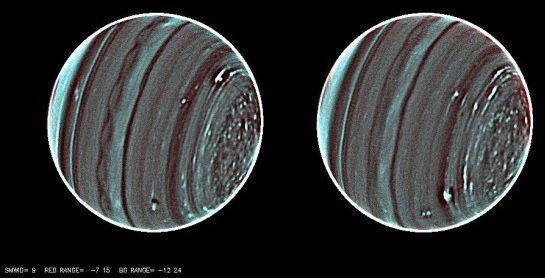
Uranus: The bizarre weather of a planet that was once thought to be rather placid

Here's the scene: a thick, tempestuous atmosphere with winds blowing at a clip of 900 km/h (560 mph); massive storms that would engulf continents here on Earth, and temperatures in the -220 C (-360 degree F) range. Sounds like a cold Hell, but this is the picture emerging of the planet Uranus, revealed in new high-resolution infrared images from the Keck Observatory in Hawaii, exposing in incredible detail the bizarre weather of a planet that was once thought to be rather placid.

"My first reaction to these images was 'wow' and then my second reaction was 'WOW,'" said Heidi Hammel, a co-investigator on the new observations. "These images reveal an astonishing amount of complexity in Uranus' atmosphere. We knew the planet was active, but until now much of the activity was masked by noise in our data."

Image
© NASA/ESA/L. A. Sromovsky/P. M. Fry/H. B. Hammel/I. de Pater/K. A. Rages New infrared images of Uranus show details not seen before.

Comment: Perhaps there's more to this 'bizarre weather' on Uranus than meets the eye:
NASA scientists struggle to understand signs of massive climate shift on Jupiter as giant planet is bombarded with cometary debris and Jupiter photos reveal big changes on giant planet


Comet 2

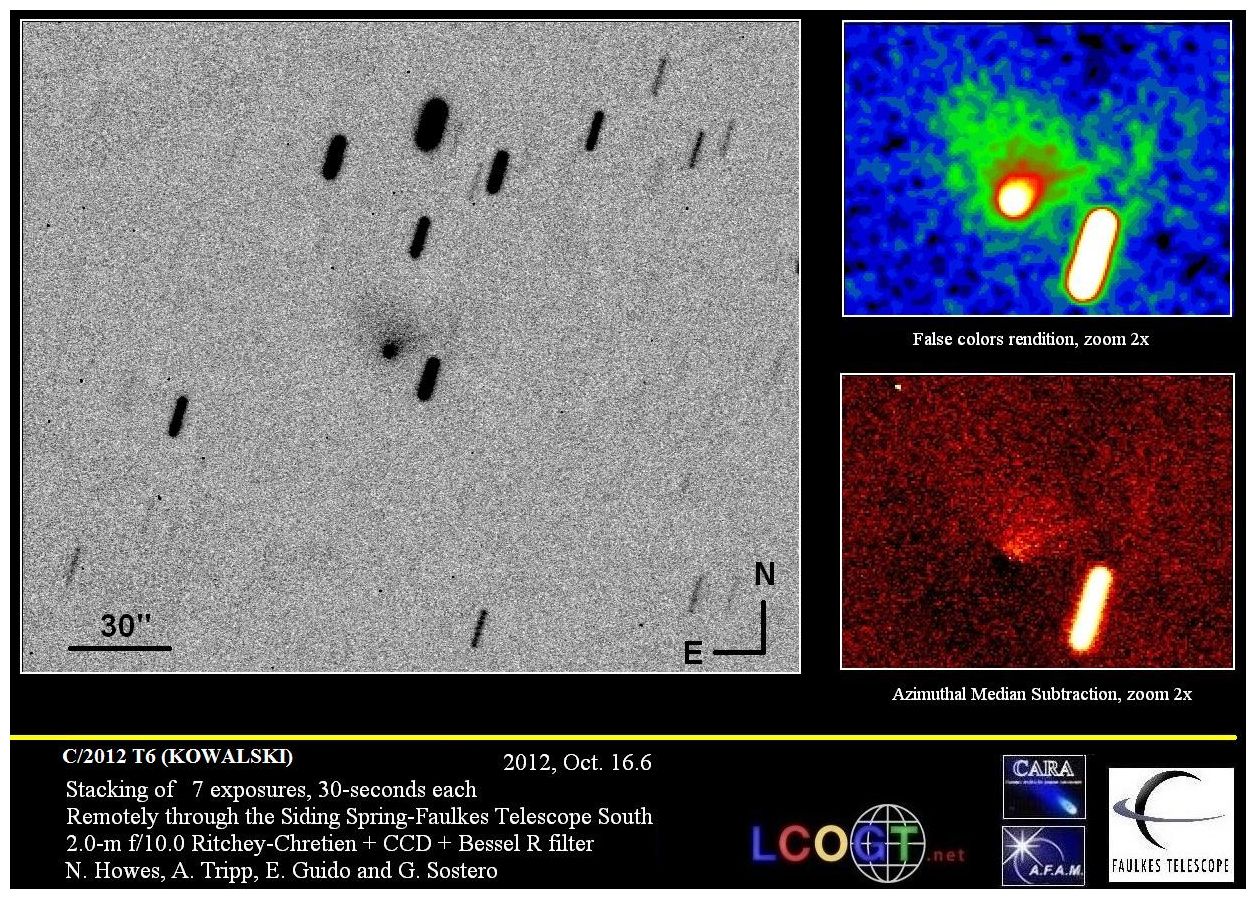
New Comet: C/2012 T6 (KOWALSKI)

Cbet nr. 3259, issued on 2012, October 18, announces the discovery of a new comet (discovery magnitude 17.6) by R. A. Kowalski on Catalina Sky Survey images obtained with the 0.68-m Schmidt telescope on October 15.4. The new comet has been designated C/2012 T6 (KOWALSKI).

We performed some follow-up measurements of this object, while it was still on the neocp. Stacking of 7 R-filtered exposures, 30-sec each, obtained remotely,from the Siding Spring-Faulkes Telescope South on 2012, Oct. 16.63, through a 2.0-m f/10.0 Ritchey-Chretien + CCD under good seeing conditions,shows that this object is a comet: narrow tail nearly 13" long in PA 290 and a wide, fan-shaped tail about 20" long toward the North-northwest sharp coma about 7" in diameter.

Our confirmation image:
C/2012 T6
© Remanzacco Observatory
M.P.E.C. 2012-U39 assigns the following preliminary parabolic orbital elements to comet C/2012 T6: T 2012 Aug. 25.08; e= 1.0; Peri. = 196.47; q = 1.79 AU; Incl.= 34.28.

Comet 2

New Comet: C/2012 T5 (BRESSI)

Cbet nr. 3258, issued on 2012, October 18, announces the discovery of a new comet (discovery magnitude 18.6) by T. H. Bressi on CCD mosaic images taken with the Spacewatch 0.9-m f/3 reflector at Kitt Peak on October 14.4. The new comet has been designated C/2012 T5 (BRESSI).

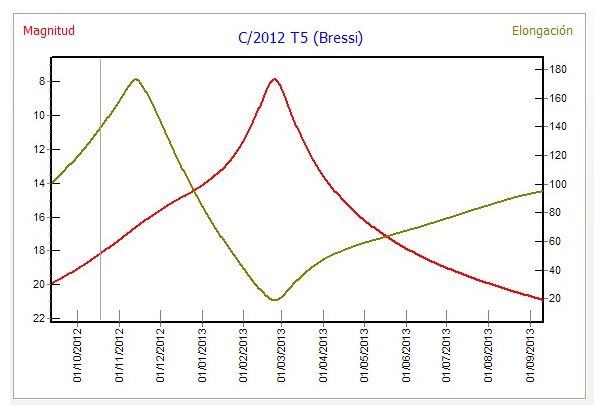
According to its preliminary parabolic orbital, comet C/2012 T5 (BRESSI) has it perihelion on T 2013 Feb. 23 with q = 0.31 and it might reach the peak magnitude ~8. (graph generated using the software Orbitas.
C/2012 T5
© Remanzacco Observatory
We performed some follow-up measurements of this object, while it was still on the neocp. Stacking of 7 R-filtered exposures, 120-sec each,obtained remotely,from H06 (ITelescope network near Mayhill, NM) on 2012, Oct. 18.33, through a 0.43-m f/6.8 astrograph + CCD + f/4.5 focal reducer shows that this object is a comet: compact coma about 5" in diameter and tail nearly 12" long in PA 270.