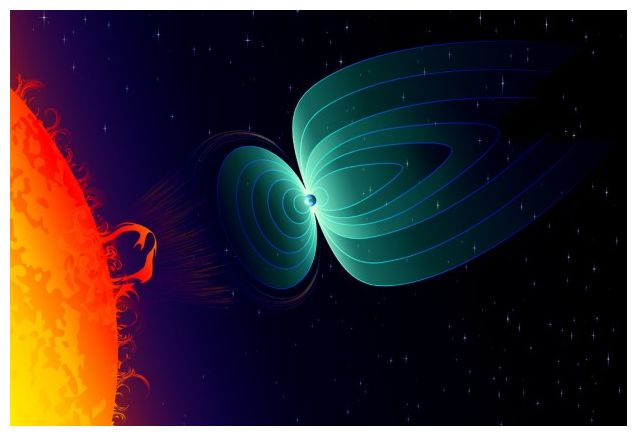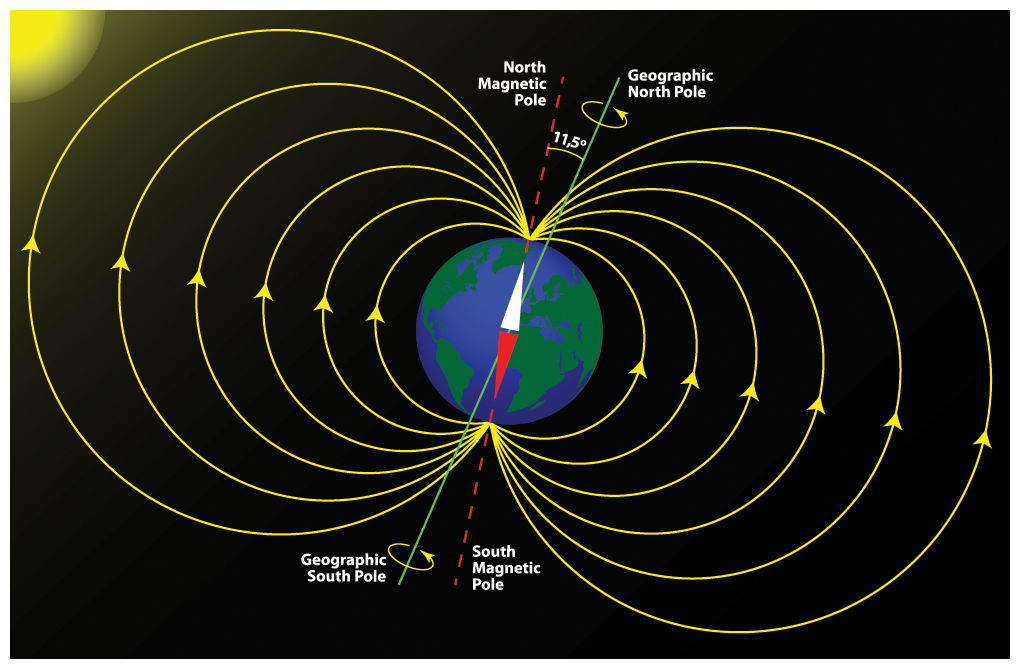
© ShutterstockThe Earth's magnetic field, magnetic poles and geographic poles.
These findings, detailed Oct. 15 in the journal Earth and Planetary Science Letters,could shed light on how and why magnetic field reversals happen, and how they leave Earth vulnerable to solar and space radiation, the study scientists said.
Earth's metal core acts like a giant magnet that emanates a magnetic field with two poles, north and south. These two magnetic poles very roughly match where the planet's geographic north and south poles lie, which mark the axis on which Earth spins.
"The Earth's magnetic field is a highly dynamic feature," said researcher Norbert Nowaczyk, a paleomagnetist at the GFZ German Research Centre for Geosciences. "Its intensity pulsates between values 50 percent higher than today, or 90 to 95 percent lower than today."
In addition, every several hundred thousand years, Earth's magnetic field reverses - a compass that would have pointed north would instead aim south. These flips are captured by magnetically sensitive minerals in cooling lava that are literally set in stone pointing to where the poles were at that particular moment in Earth's history.