Science & TechnologyS


Info

Did mega-drought kill ancient Aboriginal culture?

Rock Painting_1
© Jbenwell | Flickr.comAfter a 1500-year drought, rock art changed from an earlier style called Gwion and the Wandjina paintings emerged. The Wandjina figures have round faces with big eyes.
A 1,500-year drought in Australia may have led to the demise of an ancient aboriginal culture, a new study suggests.

The results, published Nov. 28 in the journal Geophysical Research Letters, show that geological traces of a mega-drought in the northwest Kimberley region of Western Australia coincide with a gap and transition in the region's rock art style. The finding suggests that the people who lived prior to the drought, called the Gwion, either left the region or dramatically altered their culture as a result of the drought, and a new culture called the Wanjinda eventually took its place.

"There is this significant gap in rock art. A possible reason for that is that the climate at that time changed so markedly that the artists who produced the Gwion Gwion art moved on from the Kimberley region," said study co-author Hamish McGowan, a climatologist at the University of Queensland in Australia.

But not everyone agrees with that interpretation. While the evidence for a drought is very convincing, archaeological sites show continuous occupation during that time, said Peter Veth, an archaeologist at the University of Western Australia who is an expert in the Kimberley's rock art and was not involved in the study.

"They reconfigure themselves on the land and often do portray things quite differently, but I don't see it as a different people," Veth told LiveScience.

Comet 2

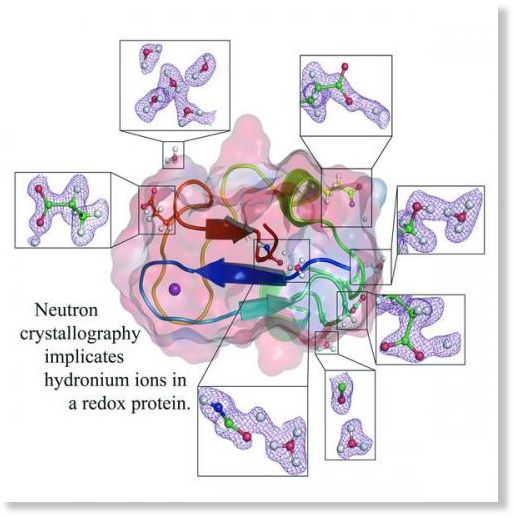
'Comet water' ions found in bacterial protein

Image
Developments arising from new science techniques at Keele University in the UK, the Institut Laue-Langevin (ILL), the flagship centre for neutron science, and the European Synchrotron Radiation Facility (ESRF), have confirmed the presence of hydronium ions in the protein rubredoxin. Rubredoxin is a light weight iron-sulphur protein found in some of the earliest, most basic forms of life, notably bacteria and archaea. These ions, commonly found in comet tails or interstellar space clouds, have been found to be involved in crucial interactions with the protein.

The new results, reported in Angewandte Chemie, combine the use of one of the world's most sophisticated diffractometers with a novel sample preparation process whereby the protein's hydrogen atoms are replaced with the heavier isotope, deuterium, greatly enhancing the visualisation of hydronium ions.

2 + 2 = 4

The human ear generates sounds as well as detects them

Image
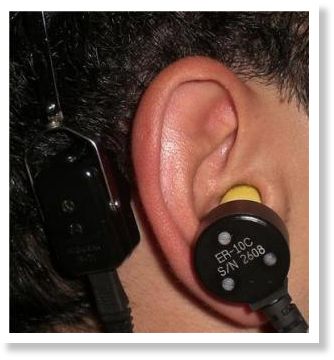
© PTBCombined stimulation of otoacoustic emissions: the first tone is transmitted via air conduction (probe speaker in the ear), the second tone is conveyed via bone conduction (bone vibrator behind the ear).
Not only can the human ear detect sounds, it can also generate them. If the ear hears the two upper tones of a major triad, it produces the fundamental of the chord which can then be measured. This phenomenon, called "otoacoustic emission" (OAE), is used by otologists for objective audiometric tests, e.g. in newborns. Investigations at the Physikalisch-Technische Bundesanstalt (PTB) have shown that an OAE audiometric test becomes even more reliable if the two sounds are transmitted to the ear not via a loudspeaker, but by bone conduction.

Regardless of where people come from, whether they are Europeans or Asians, the human ear is always tuned to a major scale. If the ear hears the two upper tones of a major triad, the ear itself produces the third, lowest, tone of the chord. This tone is called "distortion product otoacoustic emission (OAE)" and is generated due to anatomic and physical laws: if the hair cells in the inner ear are healthy and sound, they are stimulated by the two matching tones to vibrate at a third frequency. This lower tone comes out of the ear again and can be measured by means of a highly sensitive microphone. With the aid of this phenomenon, it is possible to check objectively whether the hearing of newborns or infants is intact.

Meteor

Asteroid Apophis more massive than first thought

Image
© msnbc.msn.com
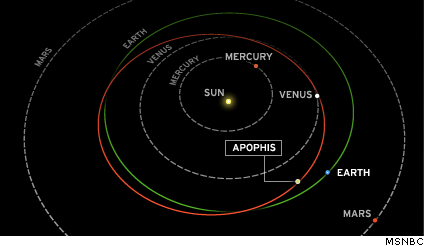
Astronomers following the so-called doomsday asteroid Apophis, which will be whizzing past Earth on Thursday morning, have found the rock is much larger than had previously been assumed. Since the asteroid could hit Earth in 2036, that's a problem.

The asteroid, named after an Egyptian god of death, had been thought to be around 885 feet (270 meters) wide, plus or minus a couple of hundred feet (60 meters). But as Apophis approached last weekend, astronomers at the Herschel Space Observatory took new observations and have concluded that astronomers have seriously underestimated both its size and its mass.

"The 20 per cent increase in diameter, from 270 to 325m, translates into a 75 per cent increase in our estimates of the asteroid's volume or mass," said Thomas Müller of the Max Planck Institute for Extraterrestrial Physics in Garching, Germany.

"These numbers are first estimates based on the Herschel measurements alone, and other ongoing ground-based campaigns might produce additional pieces of information which will allow us to improve our results."

Laptop

Corporate fraudsters beware! Software now can find you

Image
© ABC News
Crooks, when committing crime, leave trails - some verbal, some numerical. Now a new generation of super-snooper software adapted from the military gives employers the power to detect documents, transactions or emails that smell fishy.

David Remnitz, head of Ernst & Young's forensic technology business and fraud investigation services in North and South America, says the technology is so new to the private sector that it has has come into use only in the past 18 months. Until now, fraud-hunters have had to rely on their own perspicacity - or on the kindness of whistleblowers. Now, however, wrongdoers can be fingered electronically and automatically, with computer programs scanning vast quantities of data in seconds.

Predicts industry information source Compliance Week, "Catching fraudsters may soon become more a matter of learning how to properly interrogate a computer program rather than putting gumshoes on the case." It goes on to say that while fraud-detection software is not new, it previously has lacked the ability to sift through non-numerical, unstructured data - such as text documents, social media and email.

Ice Cube

About 12 killer whales trapped in ice near Quebec

Image
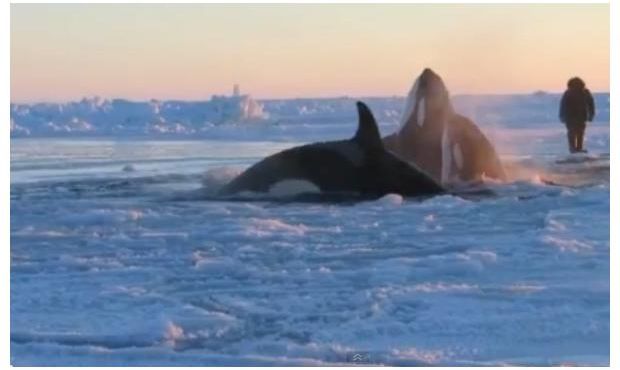
© Photograph by: The Kayuk, YouTubeAbout 12 killer whales remain trapped in a small breach in the ice near a northern Quebec fishing village.
Ice breaker needed to free captive animals; winter sighting 'strange' and unheard of, mayor says.

About 12 killer whales remain trapped in a small breach in the ice near a northern Quebec fishing village.

Miles of ice separate the whales from open water, which means it will take an ice breaker to free the captive animals. They have been stranded near Inukjuaq since Monday, according to Sarollie Weetalutuk, the village's mayor.

"People here have mixed feelings about the situation," he told The Gazette. "We want to see them free but we also want them to go away. Killer whales eat seals and belugas. The seal hunt is a huge part of our economy."


Evil Rays

Federal court rules in favor of Texas school's expulsion of Andrea Hernandez over religious belief objections to RFID tracking badge

Andrea Hernandez
© http://www.nowtheendbegins.comAndrea Hernandez protesting the RFID badges
Declaring that a Texas student's refusal to wear a chipless RFID tracking badge is "not grounded in her religious beliefs" and is a "secular choice rather than a religious concern," U.S. District Judge Orlando L. Garcia for the Western District of Texas in San Antonio has denied The Rutherford Institute's request for a preliminary injunction preventing school officials from expelling Andrea Hernandez until the case is decided.

According to the judge's order, Hernandez, a sophomore in a science and engineering magnet school housed in John Jay High School, has until the end of the current semester to provide written notice to Northside Independent School District officials as to whether she will accept the school's accommodation of wearing the Smart ID badge without a chip, which Andrea, a Christian, objects to on the grounds that it represents the "mark of the Beast." The badges, part of the school's "Student Locator Project," include tiny Radio Frequency Identification ("RFID") chips that produce a radio signal, enabling school officials to track students' location on school property.

In coming to Andrea's defense, Rutherford attorneys have alleged that the school's attempts to penalize, discriminate and retaliate against Andrea violate her rights under Texas' Religious Freedom Act and the First and Fourteenth Amendments to the U.S. Constitution. Institute attorneys intend to appeal the judge's ruling.

Comet 2

Another new comet discovered: P/2013 A2 (SCOTTI)

Cbet nr. 3376, issued on 2013, January 08, announces the discovery of a new comet (discovery magnitude 19.5) by J. Scotti with the 691 Steward Observatory, Kitt Peak, on images obtained with the 0.9-m f/3 reflector + CCD on January 06.2. The new comet has been designated P/2013 A2 (SCOTTI).

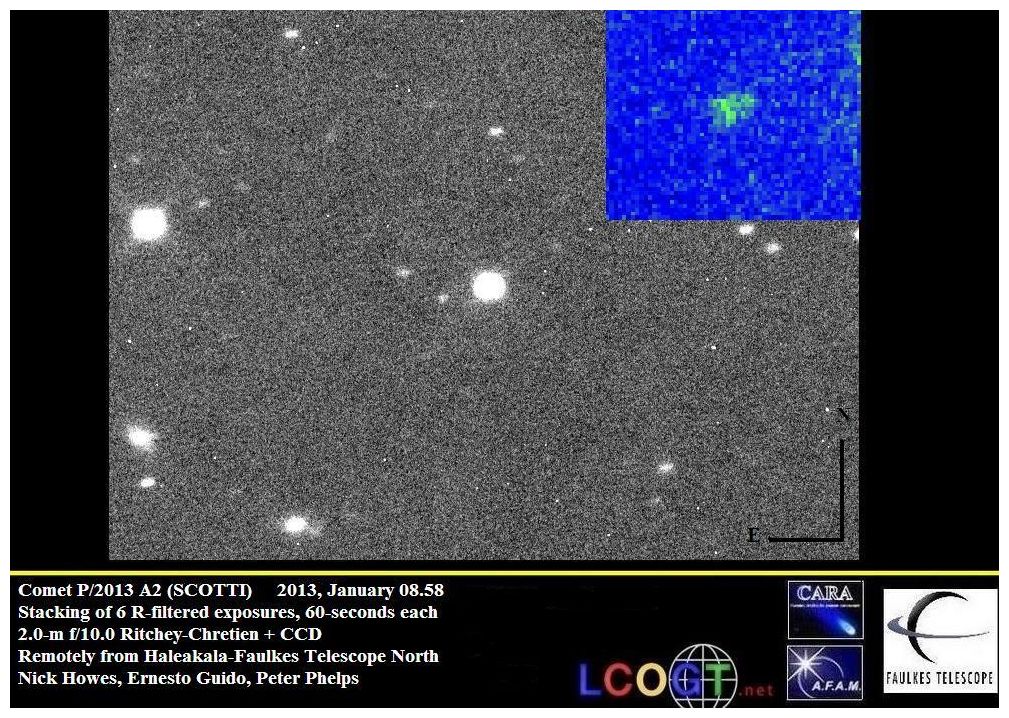
We performed some follow-up measurements of this object, while it was still on the neocp. Stacking of 6 R-filtered exposures, 60-sec each, obtained remotely, from the Haleakala-Faulkes Telescope North on 2013, Jan. 08.6, through a 2.0-m f/10.0 Ritchey-Chretien + CCD, shows that this object appears "soft" compared to the nearby field stars of similar brightness and elongated toward PA 290. Our observations combined with those of Peter Phelps of Hazelmere School in the UK, using Faulkes South later in the day helped confirm the nature of the object.

Our confirmation image:

P/2013 A2
© Remanzacco Observatory
M.P.E.C. 2013-A45 assigns the following preliminary elliptical orbital elements to comet P/2013 A2: T 2013 May 16.14; e= 0.57; Peri. = 182.74; q = 1.98 AU; Incl.= 3.89.

Black Cat 2

The weird tale of Oscar, the death predicting cat

The Steere House
© Who Forted?The Steere House seen in a vintage postcard.
In a rehabilitation center in Providence Island, Rode Island there is a cat named Oscar.

While almost everyone loves our furry feline friends (as one glance at the internet can tell us), reactions to Oscar are a bit different. Unfortunately for him, many of the patients at the Steere House Nursing and Rehabilitation center turn the other way and run as fast as their bad hips can take them when Oscar crosses their path. You see, between the years of 2005 - 2010, Oscar the cat had accurately predicted so many deaths of the residents at the Steere House, that little Oscar has been deemed the angel of death. So far he's got a reported 50 patient deaths under his collar.

Oscar's past isn't quite as interesting as his present. He was brought to Steere House as a kitten, adopted from the local animal shelter, and given a place to live on the third floor of the hospital, the area housing the end stage dementia patients. He was one of six cats adopted at that particular time, as Steere House strives to be a pet friendly environment, bringing comfort to the facility's many patients through cuddly animals.

But after many months of daily interaction with Oscar, the doctors and nurses began to notice a rather strange coincidence. Oscar, much like the staff, would do his daily rounds visiting the patients, sniffing, sleeping and cuddling with many of them, not unlike any other fickle feline. Where things get a little weird, however, are in the patients he chose to visit.

Many of those patients would just so happen to die within a two hour time span after visiting with him. Oscar, it would seem, was predicting their deaths, and staying to bring comfort to those patients in their final few hours.

Blackbox

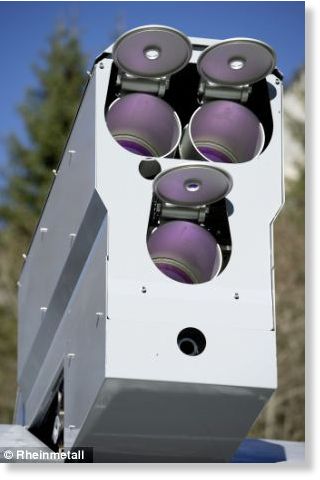
Germans unveil 'star wars' laser that can shoot a drone out of the sky from 2 miles away and cut through a steel girder at 700 yards

Image
© Rheinmetall Defence
One of the most powerful laser weapons ever fired has successfully shot drones out of the sky from two miles away. The groundbreaking weapon uses a high powered 50kW laser, and is powerful enough to cut through a steel girder from 1km away, yet accurate enough to hit a target the size of a mortar round.

Rheinmetall Defence, the firm who developed it, say it could eventually become commonplace on the battlefield, and are developing a smaller version that could be taken to the front line to protect troops.

The latest test was conducted at Rheinmetall's Ochsenboden Proving Groud (EZO) in Switzerland, in snowy conditions and blinding sunlight, and engineers are already drawing up plans to double the power of the laser before its next test. 'The demonstration delivered compelling evidence for the 50kW weapon technology,' a spokesman said. 'A massive, 15mm-thick steel girder was cut through at a distance of 1,000 metres, and the successful shooting down of several nose-diving target drones at a range of two kilometres formed the second major highlight.'