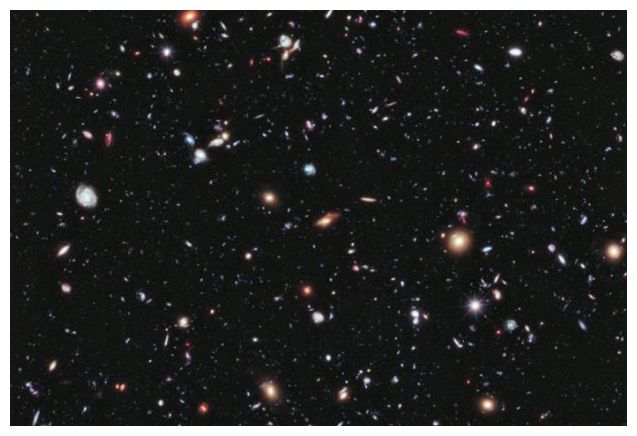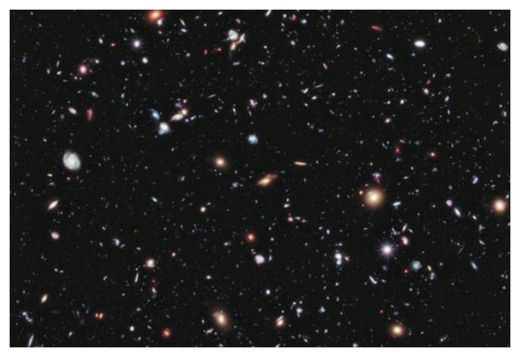
© NASA; ESA; G. Illingworth, D. Magee, and P. Oesch, University of California, Santa Cruz; R. Bouwens, Leiden University; and the HUDF09 Team The accelerating expansion of the galaxies observed in the Hubble Ultra Deep Field may conform more to Albert Einstein’s “cosmological constant” than a popular alternative theory of dark energy.
A popular theory that relies on dark energy, thought to be the main contributor to the accelerating expansion of the Universe does not fit newly obtained data with regards to one fundamental constant - the proton to electron mass ratio.
Rodger Thompson, a University of Arizona astronomy professor, disclosed his findings Wednesday at the American Astronomical Society (AAS)
meeting in Long Beach, California. He argues that dark energy theories, which have emerged as variations on Einstein's theory of general relativity, do not support newly obtained results on the relative masses of protons and electrons during the earliest stages of the Universe.
He computed the ratio predicted by dark energy models, a hypothetical form of energy believed to be found throughout space, and found that these theories (which add a scalar field to Einstien's equations to account for the acceleration o the Universe) did not fit the new data. Thompson's findings "impact our understanding of the universe and point to a new direction for the further study of its accelerating expansion," the university said in a recent statement.
In work that was honored with the
2011 Nobel Prize in Physics, researchers demonstrated that the expansion of the universe was speeding up, not slowing down, as had previously been thought. That acceleration could be accounted for by reinstating the "cosmological constant" into Einstein's theory of General Relativity - originally introduced by Einstein to balance the expansion predicted by his original equations, as he believed at the time that the Universe was static.