
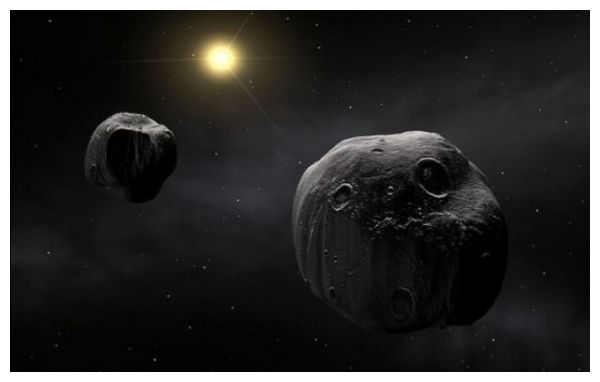
© ESOAn artist’s conception of two tidally locked objects orbiting the Sun from afar. The system: 2010 WG9 may likely look like this.
Imagine what astronomers could learn about the early Solar System by sending a probe to the Oort cloud! Unfortunately 1-2 light years is more than a little beyond our reach. But we're not entirely out of luck. 2010 WG9 - a trans-Neptunian object - is actually an Oort Cloud object in disguise. It has been kicked out of its orbit, and is heading closer towards us so we can get an unprecedented look.
But it gets even better! 2010 WG9 won't get close to the Sun, meaning that its icy surface will remain well-preserved. Dr. David Rabinowitz, lead author of a paper about the ongoing observations of this object told Universe Today, "This is one of the Holy Grails of Planetary Science - to observe an unaltered planetesimal left over from the time of Solar System formation."















Comment: Dr. Vandana Shiva has written and lectured extensively regarding the failed science surrounding the biotechnology industry, the genetic modification on plant and animal genes, read the following articles written by Dr. Shiva to learn more about biopiracy and the control and corruption of the world's food markets based on corrupt GMO science: