Welcome to Sott.net
Fri, 05 Nov 2021
The World for People who Think

Science & Technology
Map

Beaker

How Did Human Brains Get to Be So Big?

Human brain
© Gaetan Lee
Human brain
New research points to an ancient energy tradeoff that meant more fuel for brains, and less fuel for muscles

Recently while visiting the National Museum of Natural History in Washington, D.C., I found myself pondering the noggins of some very, very, old apes.

Along one wall of the Hall of Human Origins - an exhibit on human evolution that opened in 2010 - were 76 fossil skulls from 15 species of early humans. Looking at these skulls, one thing was clear: millions of years of evolution have given us much bigger brains.

In the 8 to 6 million years since the ancestors of humans and chimps went their separate ways, the human brain more than tripled in size. If the earliest humans had brains the size of oranges, today's human brains are more akin to cantaloupes.

As for our closest primate relatives, the chimps? Their brains haven't budged.

Saturn

Researchers Say Galaxy May Swarm with "Nomad Planets"

Image
© Greg Stewart / SLAC National Accelerator Laboratory
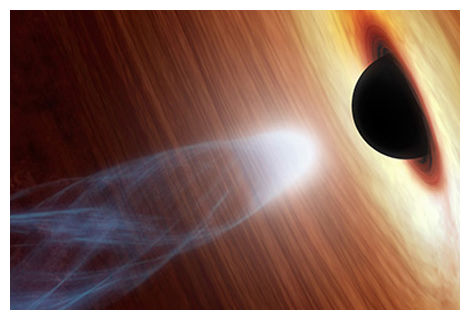
This image is an artistic rendition of a nomad object wandering the interstellar medium. The object is intentionally blurry to represent uncertainty about whether it has an atmosphere. A nomadic object may be an icy body akin to an object found in the outer solar system, a more rocky material akin to asteroid or even a gas giant similar in composition to the most massive solar system planets and exoplanets.
Our galaxy may be awash in homeless planets, wandering through space instead of orbiting a star.

In fact, there may be 100,000 times more "nomad planets" in the Milky Way than stars, according to a new study by researchers at the Kavli Institute for Particle Astrophysics and Cosmology (KIPAC), a joint institute of Stanford University and the SLAC National Accelerator Laboratory.

If observations confirm the estimate, this new class of celestial objects will affect current theories of planet formation and could change our understanding of the origin and abundance of life.

"If any of these nomad planets are big enough to have a thick atmosphere, they could have trapped enough heat for bacterial life to exist," said Louis Strigari, leader of the team that reported the result in a paper submitted to the Monthly Notices of the Royal Astronomical Society. Although nomad planets don't bask in the warmth of a star, they may generate heat through internal radioactive decay and tectonic activity.

Cookie

NASA Will Pay You to Eat Astronaut Food for 4 Months

NASA
You read that right. NASA wants volunteers for their four-month simulation to Mars. But instead of conducting tests on confinement and psychological stress, NASA just want to study your tastebuds.

According to Mashable,
The space agency is looking for applicants to eat astronaut food for four months during a simulated trip to the Red Planet. Participants will try instant foods, and ones with shelf-stable ingredients, and scientists will record their reactions. The goal of the experiment is to discover what foods people like to consume consistently.
Astronaut ice cream aside, limited supplies (such as flour, sugar and dried meat), and no chance of fresh food limits the space-based diet. This study will gauge if participants can avoid "menu fatigue," that is, becoming tired of eating the same foods. The study background states that if menu fatigue occurs, astronauts' "overall food intake declines, putting them at risk for nutritional deficiency, loss of bone and muscle mass, and reduced physical capabilities."

Info

Is Another Mass Extinction Event on the Way?

Dinosaur
© Mr Kimberley / Flickr
You have to go back to the time of the dinosaurs to see where Earth is heading.

Why have mass extinctions of species occurred since the late Proterozoic (from 580 million years ago) and repeatedly through the Phanerozoic? Integral to these extinctions were abrupt changes in the physical and chemical properties of the atmosphere, ocean and land, inducing environmental changes at a pace to which many species could not adapt.

The best documented example to date is the 65 million years-old K-T boundary asteroid impact and extinction event. But several other mass extinctions were associated with volcanic eruptions and asteroid/comet impacts (see Figure 1).

Instantaneous effects of impacts (initial fireball flash as the asteroid or comet enters the atmosphere, crater explosion, seismic shock, tsunami waves, incandescent ejecta, dust plumes, greenhouse gas release from carbon-rich limestone and shale) occurred over periods ranging from seconds to weeks and months.

As shown in figure 1, Phanerozoic history (since about 540 million years ago) is marked with a number of mass extinction events. About 80% of genera were lost at the ~251 Ma Permian-Triassic boundary event. This was a consequence of both volcanic eruptions (known as the Siberian Norilsk traps) and an asteroid impact near Araguinha, Brazil (Araguinha: 40 km-diameter; 252.7+/-3.8 Ma).

Info

Blood Mystery Solved

Bryan Ballif
© Joshua Brown, University of Vermont, 2012
With skilled handling of this mass spectrometer, University of Vermont biologist Bryan Ballif unraveled the mystery of two little-understood blood types. Now he and his international colleagues are looking for more.

You probably know your blood type: A, B, AB or O. You may even know if you're Rhesus positive or negative. But how about the Langereis blood type? Or the Junior blood type? Positive or negative? Most people have never even heard of these. Yet this knowledge could be "a matter of life and death," says University of Vermont biologist Bryan Ballif.

While blood transfusion problems due to Langereis and Junior blood types are rare worldwide, several ethnic populations are at risk, Ballif notes. "More than 50,000 Japanese are thought to be Junior negative and may encounter blood transfusion problems or mother-fetus incompatibility," he writes.

But the molecular basis of these two blood types has remained a mystery - until now.

In the February issue of Nature Genetics, Ballif and his colleagues report on their discovery of two proteins on red blood cells responsible for these lesser-known blood types.

Ballif identified the two molecules as specialized transport proteins named ABCB6 and ABCG2.

"Only 30 proteins have previously been identified as responsible for a basic blood type," Ballif notes, "but the count now reaches 32."

The last new blood group proteins to be discovered were nearly a decade ago, Ballif says, "so it's pretty remarkable to have two identified this year."

Telescope

Dual Interpretations: Milky Way's Outer Fringe of Stars Sparks Disagreement

Image
© Bullock & Johnston (2005)
HOW MANY HALOS? A simulation of halo formation by the accretion of large numbers of galaxies.
It's well known that the Milky Way is a spiral galaxy, a swirl of stars in an extended, many-armed disk. But the structure of the galaxy is far from two-dimensional. Above and below those familiar spiral arms is a lesser-known feature, a spherical swarm of stars that makes up a halo around the disk.

For decades the presence of the halo has prodded astronomers to ask big questions about its nature: How is it structured? How do stars in the halo compare with disk stars such as our sun, or to stars elsewhere in the halo? And just how did the halo get there? In recent years a group of astronomers has suggested an answer to some of those big questions by drawing on a large telescopic survey of the sky.

The halo, they have concluded, is composed of at least two distinct populations of stars, with different chemical makeups and different orbits. One group of stars, dubbed the inner halo, generally orbits closer to the galactic center, and its members tend to contain more heavy elements such as iron than do stars farther out. (Halo stars as a whole are depleted in these heavy elements, relative to stars in the galactic disk.) Stars of the outer halo occupy somewhat wider orbits around the galactic center, contain lower levels of heavy elements, and - unlike the inner halo - tend to follow retrograde orbits, circling the Milky Way in a direction counter to the rotation of the galactic disk.

Eye 1

Mind-Controlled Skateboard is Literally Powered by Your Thoughts


You don't have to be Professor X or Yoda to control the Board of Imagination with your mind. This futuristic skateboard by Chaotic Moon Labs can read your brain waves and take you to where you want to go, even if you're not a mutant or a Jedi.

Chaotic Moon Labs originally created a motion-control skateboard equipped with Microsoft Kinect that can turn your hand into a steering wheel. People loved the aptly-named Board of Awesomeness so much that it eventually broke down after being taken for numerous test drives (including the 2012 Consumer Electronics Show in January). Instead of rebuilding it, they decided to enhance and redesign it to become the even more amazing invention known as the Board of Imagination

Info

Body's 'Doomsday Clocks' Count Down to Death, or Cancer

Telomeres
© Hesed Padilla-Nash and Thomas Ried, National Institutes of Health
The 46 human chromosomes are shown in blue, with the telomeres appearing as white pinpoints. The DNA has already been copied, so each chromosome is actually made up of two identical lengths of DNA, each with its own two telomeres.

Every cell in your body has its own Doomsday Clock, ticking down the number of times it can safely divide. This clock takes the form of a cap on the ends of each chromosome, called a telomere. Like the plastic aglets on the tips of shoelaces, telomeres keep the chromosome from fraying. However, they get shorter every time the cell splits.

When the telomeres have shrunk to a certain point, the cell can go one of two ways. It's supposed to die. But in the case of cancer, the cell keeps living. If scientists could make drugs to control telomeres, they could perhaps treat diseases of aging as well as cancer.

Telomeres Aplenty

Researchers have known since the 1930s that telomeres cap chromosomes, but it was not until the 1970s that they figured out what those caps are made of. The scientists who first described telomere composition, led by Elizabeth Blackburn at the University of California, San Francisco, needed a rich source of telomeres to study. They found it in a pond-dwelling organism called Tetrahymena. This critter is made of just one cell, and it's covered in little projections called cilia that give it a fuzzy appearance under the microscope. But for telomere researchers, it's what's inside the cell that counts: approximately 20,000 chromosomes, each with telomeres on their ends. Human cells, in contrast, have a mere 46 chromosomes.

Blackburn, Carol Greider of Johns Hopkins University in Baltimore, and Jack Szostak of Harvard Medical School in Boston shared the Nobel Prize in physiology or medicine in 2009 for their National Institutes of Health-funded research on telomeres.

Syringe

US: UC San Diego Develops Injectable Hydrogel for Cardiac Tissue Repair

What's unique about the hydrogel is that it can be injected via catheter
Image
© UC San Diego Jacobs School of Engineering
Liquid hydrogel

A new hydrogel meant to repair tissue damage after a heart attack has been developed and tested by University of California - San Diego scientists.

Karen Christman, study leader and professor in the Department of Bioengineering at UC San Diego, along with a team of researchers, have successfully developed an injectable hydrogel that can treat tissue damage after a heart attack.

"It helps to promote a positive remodeling-type response, not a pro-inflammatory one in the damaged heart," said Christman.

The hydrogel is made of cardiac connective tissue. The connective tissue is eliminated of its heart muscle cells through a cleansing process, and then it is freeze-dried and milled into a powder-like material. The powder is then made into a fluid that can be injected directly into the heart tissue.

When the liquid enters the body, human body temperature turns it into a porous gel that manipulates cells into repopulating areas where damaged cardiac tissue is located. The hydrogel helps repair the tissue and could even prevent further damage.

What's unique about the hydrogel is that it can be injected via catheter as well, which is less invasive and does not require anesthesia or surgery.

The hydrogel has already been tested on rats. In rat models, the gel was not rejected and it did not cause arrhythmic heart beating. Usually cardiac therapies are designed to be tested on animals like pigs, which have hearts sized similarly to humans. However, these therapies usually aren't suited for catheter use. However, the fact that the rats reacted positively to the gel catheter shows that it could be useful for humans one day.

This study was published in the Journal of the American College of Cardiology.

Sherlock

Total disconnect from reality, or shall we say, Solar System: Earth may have a 'pulse' every 60 million years that's been causing mysterious mass extinctions

Image
© Unknown
A mysterious cycle of booms and busts in marine biodiversity over the past 500 million years could be tied to a 'pulse of the Earth' - a periodic uplifting of continents that results in the seas being too shallow for species to survive in, according to a new study.

Researchers at the University of Kansas believe evidence for these uplifts lie in the increased amounts of an element found in the continental crust that they've subsequently detected in marine fossils whenever mass extinctions have occurred.

The fact that the element, strontium-87, is suddenly appearing in the oceans means that there must have been sudden huge tectonic movements that the researchers believe played havoc with marine life.

Comment: What is it about scientists who forget that our planet is not in isolation ward? The fact is, we are part of a Cosmic cyclic system, that brings our way periodic calamities and evolutionary boosts in form of bombardments from space or other related phenomena. In this case, a periodic 'pulse of the Earth' would be a "symptom" and not a "cause".

Read the following articles to learn more:
Tunguska, Psychopathy and the Sixth Extinction
Survival of the Fittest of the Luckiest: Cosmic Catastrophes and The Evolution of Life
The Golden Age, Psychopathy and the Sixth Extinction
Extinction, Metamorphosis, Evolutionary Apoptosis, and Genetically Programmed Species Mass Death