Science & TechnologyS


Magnify

The day before death: A new archaeological technique gives insight into the day before death

Image
© Sydvestjyske MuseerThis image shows the remains of a 10- to 13-year-old child from the cemetery Lindegaarden in Ribe, Denmark. The grave is from ca. 1200-1250 and has been excavated by Sydvestjyske Museer in Ribe.
The day before the child's death was not a pleasant one, because it was not a sudden injury that killed the 10-13 year old child who was buried in the medieval town of Ribe in Denmark 800 years ago. The day before death was full of suffering because the child had been given a large dose of mercury in an attempt to cure a severe illness.

This is now known to chemist Kaare Lund Rasmussen from University of Southern Denmark - because he and his colleagues have developed a new methodology that can reveal an unheard amount of details from very shortly before a person's death. Mercury is of particular interest for the archaeologists as many cultures in different part of the world have been in contact with this rare element.

"I cannot say which diseases the child had contracted. But I can say that it was exposed to a large dose of mercury a couple of months before its death and again a day or two prior to death. You can imagine what happened: that the family for a while tried to cure the child with mercury containing medicine which may or may not have worked, but that the child's condition suddenly worsened and that it was administered a large dose of mercury which was, however, not able to save its life", says Kaare Lund Rasmussen.

The detailed insight into the life of the child did not come from analyses of the child's bones. Instead Kaare Lund Rasmussen and his colleagues have developed a method to extract information from the soil surrounding the body of the dead child in the cemetery in Ribe, Denmark.

"When the body decays in the grave a lot of compounds are released to the surrounding soil - by far most of them organic compounds. Also most of the inorganic elements are transformed to other compounds and later removed by the percolating groundwater throughout the centuries that follows. If we can localize an element in the soil in the immediate vicinity of the skeleton which is not normally found in the soil itself, we can assume that it came from the deceased and this can tell us something about how the person lived. We are not interested in death, but in the life before death", Kaare Lund Rasmussen explains.


Fireball 3

Newly discovered asteroid whizzes past Earth today

Some more confirmation that asteroids go around in pairs. Discovered just 48 hours ago, asteroid 2013 PS13 is whizzing by Earth today at only 0.5 Lunar Distances from Earth alongside asteroid 2005 WK4, which is only 8.1 Lunar Distances away from Earth! Slooh tracked both asteroids this morning from the Canary Islands observatory - come check out the spectacular results along with Paul Cox.
Asteroid Flyby
© Tallbloke's Talkshop

Info

What twins reveal about the science of faith

Twins and Faith
© DreamstimeTwins and the "faith gene".
I am frequently asked by journalists to recall the most surprising finding of our twin studies. The study of religion and belief in God is the one that always comes to mind, and the results are not easily accepted by many people. Most people can accept diseases or height and even weight being genetically heritable to some extent, but when it comes to our personal beliefs we tend to be more skeptical. For many, the idea that there is a genetic component to our faith--or lack of it--is a stretch too far and damages the concept of self-determination that we hold so dear.

Nevertheless science has shown us clearly that one level of belief in God and overall spirituality is shaped not only by a mix of family environment and upbringing--which is not surprising--but also by our genes. Twin studies conducted around the world in the U.S., the Netherlands and Australia as well as ours in the U.K. show a 40 to 50 percent genetic component to belief in God.

What is striking is that these findings of a genetic basis for belief are consistent even across countries like the U.S. and the U.K., with their huge differences in beliefs and church attendance. For example, in the latest surveys in the U.S., when asked, 61 percent of white Americans say they firmly (ie. without any doubt) believe in God, compared with only 17 percent of firm believers in similar populations in the U.K.--greater than a threefold difference. The opposite scenario of non-belief is also true--only a tiny 3 percent of the U.S. population report being firmly atheist compared with 18 percent in the U.K. As well as belief, participation follows separate trends in the two countries. Some form of weekly church attendance is now nearly three times higher in the U.S. than the U.K.

Skeptics among you might say that the twin studies showing similarity for belief are just reflecting some cultural or family influence that wasn't properly corrected for in the study design. However in one study of adopted twins, the researchers looked at religious belief in a number of adopted twins raised apart. They found exactly the same result--greater similarity in identical twin pairs, even if raised apart. The conclusion is unavoidable: faith is definitely influenced by genes.

Info

Genetic evidence shows recent population mixture in India

Indian Genetics
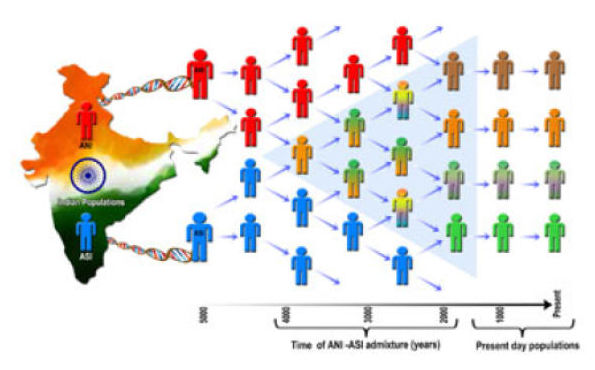
© Kumarasamy ThangarajBetween 4,000 and 2,000 years ago, intermarriage in India was rampant.
Scientists from Harvard Medical School and the CSIR-Centre for Cellular and Molecular Biology in Hyderabad, India, provide evidence that modern-day India is the result of recent population mixture among divergent demographic groups.

The findings, published August 8 in the American Journal of Human Genetics, describe how India transformed from a country where mixture between different populations was rampant to one where endogamy -- that is, marrying within the local community and a key attribute of the caste system -- became the norm.

"Only a few thousand years ago, the Indian population structure was vastly different from today," said co-senior author David Reich, professor of genetics at Harvard Medical School. "The caste system has been around for a long time, but not forever."

In 2009, Reich and colleagues published a paper based on an analysis of 25 different Indian population groups. The paper described how all populations in India show evidence of a genetic mixture of two ancestral groups: Ancestral North Indians (ANI), who are related to Central Asians, Middle Easterners, Caucasians, and Europeans; and Ancestral South Indians (ASI), who are primarily from the subcontinent.

However, the researchers wanted to glean clearer data as to when in history such admixture occurred. For this, the international research team broadened their study pool from 25 to 73 Indian groups.

Info

Latino genomes point way to hidden DNA

DNA
© NaturalSociety
Hidden in the tangled, repetitious folds of DNA structures called centromeres, researchers from Harvard Medical School and the Broad Institute have discovered the hiding place of 20 million base pairs of genetic sequence, finding a home for 10 percent of the DNA that is thought to be missing from the standard reference map of the human genome.

Mathematician Giulio Genovese, a computational biologist in genetics at HMS and at the Broad Institute, working in the lab of geneticist Steven McCarroll, HMS assistant professor of genetics and director of genetics for the Stanley Center for Psychiatric Research at the Broad Institute, found a way to use the genomes of Latinos to interpolate the locations of these missing pieces. Their findings will be published in The American Journal of Human Genetics on August 8.

"In nature, polymerase, the molecular machinery that copies DNA within living cells, can sequence hundreds of millions of base pairs of DNA. The techniques we've developed to sequence DNA in the lab can only do relatively short segments, and we need to stitch those pieces together after the fact," Genovese said. "So while we wait for sequencing technology to catch up with nature, we wanted to see if we could use mathematical patterns to find a place for some of the missing pieces."

By using the genomes of admixed populations -- populations, such as Latinos and African Americans that derive ancestry from more than one continent -- the team developed a sophisticated mathematical method to help fill in the uncharted regions on the human genome map. The map is a key tool that geneticists rely on to find disease genes and identify the functional genetic variations at the core of human diversity. The unmapped DNA also sometimes resembles known, mapped genes, which can interfere in attempts to study similar sequences.

Best known as the molecular hinges that help chromosomes divide, centromeres have been widely considered structural elements that were unlikely to harbor protein-coding genes, the researchers said. For this reason, their finding -- that nearly half of the unmapped sequences contained in available genomic reference libraries, including many protein-coding genes, were located in the centromeres -- was unexpected.

Meteor

Can you hear a meteor?

Image
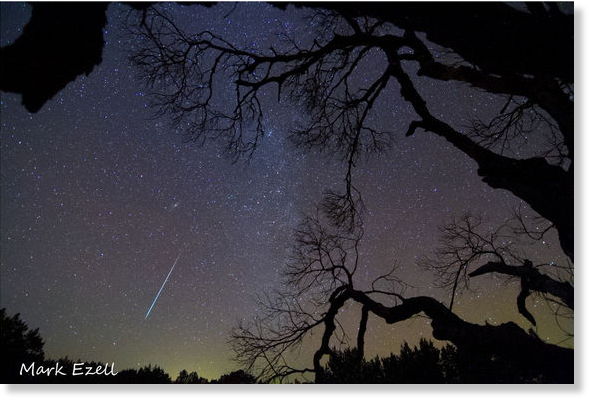
© Mark EzellAstrophotographer Mark Ezell sent in this photo of a Geminid meteor taken Dec. 13, 2012, in Lometa, TX.
When the Perseid meteor shower bursts across the sky later this month, will people be able to hear it?

For centuries, people have reported hearing a sound made by meteors as they streaked across the skies overhead. And with the Perseids about to dazzle skywatchers with a meteor display that will earn it the title "fireball champion," some researchers are wondering if the Perseid meteor shower will be heard as well as seen.

In A.D. 817, as a meteor shower passed over China, many observers reported hearing buzzing, sizzling or hissing sounds, according to a 1992 report by Colin Keay, a physicist at the University of Newcastle in Australia. [When Space Attacks: The 6 Craziest Meteor Impacts]

Comet

Cosmic propaganda alert! 'Massive solar flare narrowly misses Earth, EMP catastrophe barely avoided', says Washington lobby group

Image
Comet-clusters, the real threat to civilization
The earth barely missed taking a massive solar punch in the teeth two weeks ago, an "electromagnetic pulse" so big that it could have knocked out power, cars and iPhones throughout the United States.


Comment: Wow, that was close! How come we haven't heard about this until now?


Two EMP experts told Secrets that the EMP flashed through earth's typical orbit around the sun about two weeks before the planet got there.


Comment: 2 "EMP experts", really?

Uhm, what's an "EMP expert"?!


"The world escaped an EMP catastrophe," said Henry Cooper, who led strategic arms negotiations with the Soviet Union under President Reagan, and who now heads High Frontier, a group pushing for missile defense.


Comment: Missile defense, interesting. No conflict of interest there then, right?

But pray tell us, how does a politician-cum-arms industry lobbyist get to be an 'EMP expert'?

We can hear Cooper, in this YouTube video of the Washington, D.C. lobbying event that he, Woolsey and Pry attended on July 29th, describe 24 minutes in a "near-miss of a solar emission in the last several months"...


It's pretty clear that Cooper is not an 'expert' on solar activity. He next says, "We missed that, but we're still in the window of solar maximum and will be for the rest of this year." If Cooper knew what he was talking about, he would surely be aware that NASA has said we are going through the quietest solar maximum in 100 years.

However, from his recounting of U.S. military experiments detonating high-altitude and underground nuclear weapons and testing their electromagnetic pulse capabilities as strategic offensive weapons, we can see that Cooper is indeed 'expert' in this kind of man-made EMP.

But that is a whole other ball-game to solar flares and solar activity in general.

So what gives here? What are these technocrats really trying to tell us?

Comment: Here's the YouTube 'About' blurb of the High Frontier conference:
Washington, D.C.: On July 29th, President Bill Clinton's former Director of Central Intelligence, R. James Woolsey, led a panel discussion on the growing -- and perhaps imminent -- threat of a natural or nuclear electromagnetic pulse (EMP) to the U.S. electric grid and other critical infrastructures that sustain modern civilization and the lives of millions of Americans. The event was sponsored by the newly established EMP Coalition, of which Mr. Woolsey is the Honorary Co-Chair along with former House Speaker Newt Gingrich.

Other participants were Ambassador Henry Cooper and Dr. Peter Vincent Pry. Ambassador Cooper led strategic arms control negotiations with the USSR under President Reagan and served as the Director of the Strategic Defense Initiative Organization under President George H.W. Bush. His is currently the Chairman of High Frontier, an organization dedicated to protecting the United States from nuclear attack. Dr. Pry served on the Congressional EMP Threat Commission, as a professional staff member on the House Armed Services Committee and as an analyst in the CIA. He is now the Executive Director of the Task Force on National and Homeland Security, a congressional advisory board dedicated to national resiliency in the face of EMP and other threats.
This two-pronged effort by servants of the Military-Industrial Complex and intelligence community to 'warn the American people' about the (hyped) threats to its critical infrastructure from potential 'catastrophic' damage due to electromagnetic pulse blasts caused by the Sun and Iran/North Korea are a timely distraction from the real threat posed by 'civilization-destroying' Near-Earth Objects; specifically cometary debris exploding in our atmosphere, evidence for which is all around us as fireballs are now seen and heard on a daily basis.

Conflating EMP-generating solar flares with non-existent Iranian/Korean plans to detonate nukes high in the atmosphere above the U.S. smacks of desperation. Such implausible scenarios suggest that their only option, once overhead airbursts such as we saw in Russia happen more frequently, is to try to pull the wool over people's eyes by misinforming them about the real source of the threat, and to pretend that they are in a position to do anything about it.

This all brings to mind a prescient quote from British astronomer Victor Clube:
"We do not need the celestial threat to disguise Cold War intentions; rather we need the Cold War to disguise celestial intentions!"


Arrow Down

Researchers propose new experiments on mutant bird flu

Bird Flu
© Agence France-PresseNepalese health workers carry sacks of dead chickens at a farm with a suspected bird flu outbreak near Kathmandu, August 1, 2013.
Scientists proposed developing a more potent strain of the deadly H7N9 bird flu on Wednesday to examine how mutant forms might spread among humans, a topic that has stoked global alarm in the past.

The announcement came a day after Chinese scientists reported the first likely case of person-to-person transmission of the H7N9 virus, which has killed 43 of the 134 people infected since March according to official figures.

US health authorities said any new H7N9 experiments that seek US funding would undergo a new, strict safety review, after concerns over such research on another bird flu, H5N1, in December 2011 raised fears that terrorists could unleash a virulent lab-grown strain and cause mass deaths.

Those concerns led to a year-long halt to the research being led by Ron Fouchier of Erasmus Medical Center in The Netherlands and US colleagues in Wisconsin.

That voluntary moratorium was lifted earlier this year by a group of 40 scientists around the world.

Fouchier told AFP that his lab has resumed work on an engineered H5N1 virus, but that US labs have not and are awaiting a final decision by American health authorities, expected in the coming weeks.

Info

Pregnancy due dates can vary by 5 weeks

Pregnancy
© Getty Images
Forget setting your hopes on a single due date when you get pregnant: A new study suggests that pregnancies naturally vary by as much as five weeks.

Until now, due dates have been a source of guessing games at baby showers and inaccurate dates often take center stage in birth stories. But errors were attributed in large part to miscalculations. The study published today in the journal Human Reproduction suggests that even with incredibly accurate information, choosing a due date is largely a guessing game - something that surprised the researchers.

"We found that the average time from ovulation to birth was 268 days - 38 weeks and two days," Dr. Anne Marie Jukic of the National Institutes for Health, said in a press release. "Even after we had excluded six pre-term births, we found that the length of the pregnancies varied by as much as 37 days."

Pregnant women usually get a due date that's 280 days after the first day of their most recent menstrual period. Using that method, 4 percent of women deliver on their due dates.

Fireball 4

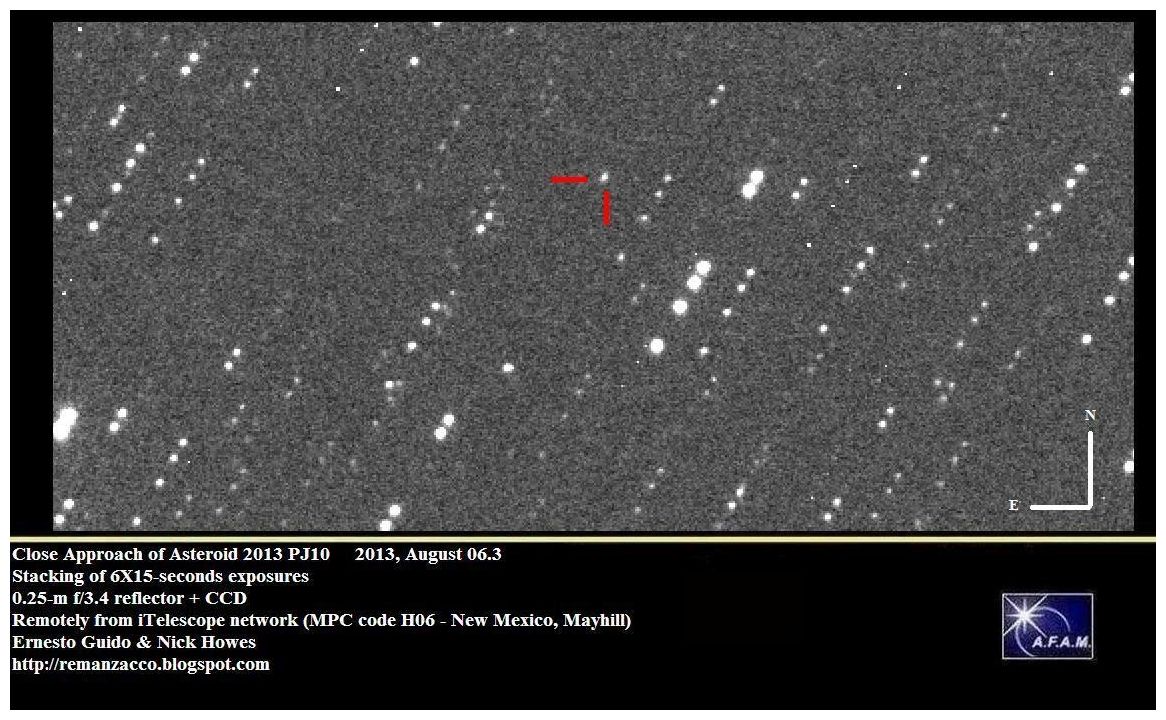
Close approach of asteroid 2013 PJ10

M.P.E.C. 2013-P39, issued on 2013 August 06, reports the discovery of the asteroid 2013 PJ10 (discovery magnitude 14.8) by La Sagra Sky Survey (MPC code J75) on images taken on August 04.9 with a 0.45-m f/2.8 reflector + CCD.

2013 PJ10 has an estimated size of 31 m - 70 m (based on the object's absolute magnitude H=24.6) and it had a close approach with Earth at about 1 LD (Lunar Distances = ~384,000 kilometers) or 0.0025 AU (1 AU = ~150 million kilometers) at 0218 UT on 2013, August 04. This asteroid reached the peak magnitude ~13.0 on August 04.

We performed some follow-up measurements of this object on 2013, August 06.3, while it was still on the neocp, remotely from the H06 iTelescope network (New Mexico, Mayhill), through a 0.25-m f/3.4 reflector + CCD. Below you can see our image, stack of 6X15-second exposures, taken with the asteroid at magnitude ~15.3 and moving at ~ 19.0 "/min. At the moment of the close approach 2013 PJ10 was moving at ~ 218"/min. Click on the image below to see a bigger version. North is up, East is to the left
Asteroid 2013 PJ10
© Remanzacco Observatory