Science & TechnologyS


Magnify

Armpit odor says a lot about who you are, and not just how many times a day you shower

Image
© LEONID ANDRONOV/SHUTTERSTOCKThe structure of a pheromone
We, people, typically think of ourselves as people. It can be jarring to remember that we're also mammals who, like most other mammalian species, unconsciously send odor signals to each other carrying information about our gender, our health, our reproductive state, our mood, and even our potential to be a compatible mate. If the idea that your secretions say something about you creeps you out, then you won't welcome the news that the revealing scent signals we emit may actually be the end-products of microbial fermentations carried out in our bodies' damp, low-oxygen creases. A recent study of scent signals in hyenas presents the best evidence to date that bacteria are responsible for producing pheromones in a mammalian species. The implication of these results is that the bacteria in our underarms may have a surprisingly complex role in our social lives.

That microbes are actually the makers of mammalian pheromones is an idea that dates back to the 1970s when several scientists proposed the "fermentation hypothesis." Their idea was that, because scent glands are typically found in warm, damp, low-oxygen areas of the body, microbes that thrive in those areas ferment the body's nutrient-rich secretions into the odorous chemical signals used by most mammals to communicate.

What we communicate likely depends, at least in part, on the microbes we're harboring.

Sun

Giant plasma spirals found on the Sun

Plasma Spirals
© David Hathaway/NASAThis image depicts giant plasma cell flow paths on the sun for June 8, 2010. The underlying cell pattern shows westerly winds in red and easterly winds in blue.
Colossal spiral-shaped flows of super-hot plasma have been discovered on the sun, completing a nearly 50-year quest to confirm their existence, scientists say.

These giant solar plasma spirals - each of which is at least 60,000 miles (100,000 kilometers) wide - could help spark the formation of strongly magnetic regions on the sun that have been linked with solar flares and other sun eruptions, researchers added.

The sun's internal heat causes matter to rise to its surface, where the material cools when near the cold of space, and then sinks back downward. This cycle of motion is altogether known as convection, and zones where it takes place are known as convection cells.

The rotation of the sun on its axis causes the largest convection cells to form circular, spiraling patterns.

"These are a lot like weather patterns seen on Earth - vortices that spiral and turn all over the place," study author Lisa Upton, a solar scientist at Vanderbilt University in Nashville, told SPACE.com. Convection in Earth's atmosphere is ultimately driven by heat from the sun; the rotation of the Earth then makes convecting air on Earth spiral.

Cassiopaea

Institute discovers supernovae

Supernovae
© William H. Lowry
Former University of Maine Professor Jack Battick alerted me to the doings of the Eagle Hill Institute in the field of astronomy. The institute is a scholarly research center located on the coast of Maine between the Schoodic Point section of Acadia National Park and the Petit Manan National Wildlife Refuge.

Among its many activities is the Eagle Hill Supernova Search Project, a team headed up by 10-year supernova hunter Doug Rich, who has a total of 23 supernova discoveries to his credit.

The latest find by the team is supernova SN2013ga discovered on Oct. 20, 2013 in a galaxy in the constellation Lacerta about 200 million light years from Earth.

Robot

Robot Apocalypse: The Robots are taking our jobs

Google has just announced a huge new push into robotics. And they're not the only ones. We seem to hear about new, exciting robotics companies every day. But as Trace tells us, these next-gen robots could be after your job.


Comment: These new technological developments raise the question of humans role in this robotic future. Will these greedy psychopathic companies that replace humans with robots to increase profit care for humans? History tells us that ruling elite never cared for humanity except for their slave labor. If the robots perform the slave labor, do they need humans? Are we supposed to believe the PTB haven't figured this out? How many signs are needed to know that we are becoming an obsolete race?


Info

Saturn's mysterious hexagon behaves like Earth's ozone hole

Saturn's Hexagon
© NASA/JPL-Caltech/SSI/HamptonAt Saturn, NASA’s Cassini spacecraft snapped pictures showing a high-resolution view of a hexagon-shaped jet stream.
A raging hurricane is creating a "suck zone" at Saturn's north pole. The handy Cassini spacecraft recently captured a bunch of images of the six-sided jet stream surrounding the storm, which mission managers then put together into an awesome animation showing the wind currents shifting. (You can see the animation here.)

The feature is pretty in a picture, but NASA has a special interest because there is nothing else like this anywhere in our solar system, the agency stated. The immense storm stretches 20,000 miles (30,000 kilometers) across with winds whipping in its jet stream at 200 miles per hour (322 kilometers per hour). And despite all the turbulence, the storm is staying put at the north pole for reasons scientists are still trying to understand.

"The hexagon is just a current of air, and weather features out there that share similarities to this are notoriously turbulent and unstable," said Andrew Ingersoll, a Cassini imaging team member at the California Institute of Technology in Pasadena. "A hurricane on Earth typically lasts a week, but this has been here for decades - and who knows - maybe centuries."

Bulb

A single spray of oxytocin improves brain function in children with autism

oxytocin molecule
© WikipediaSpacefilling model of oxytocin. Created using ACD/ChemSketch 8.0, ACD/3D Viewer and The GIMP.
A single dose of the hormone oxytocin, delivered via nasal spray, has been shown to enhance brain activity while processing social information in children with autism spectrum disorders, Yale School of Medicine researchers report in a new study published in the Dec. 2 issue of Proceedings of the National Academy of Sciences.

"This is the first study to evaluate the impact of oxytocin on brain function in children with autism spectrum disorders," said first author Ilanit Gordon, a Yale Child Study Center postdoctoral fellow, whose colleagues on the study included senior author Kevin Pelphrey, the Harris Professor in the Child Study Center, and director of the Center for Translational Developmental Neuroscience at Yale.

Gordon, Pelphrey, and their colleagues conducted a double-blind, placebo-controlled study of 17 children and adolescents with autism spectrum disorders. The participants, between the ages of 8 and 16.5, were randomly given either oxytocin spray or a placebo nasal spray during a task involving social judgments. Oxytocin is naturally occurring hormone produced in the brain and throughout the body.

Comment: Every human being functions better when there is more oxytocin in their system. The stress-relieving program Eiriu Eolas enhances oxytocin levels, while lowering cortisol and other stress hormones.


Question

In ISON's wake, a trail of questions

Image
I always find that writing the first line in a blog post is the hardest, and this has never been truer that now as I struggle to decide where I should even begin. My @SungrazerComets Twitter feed, and my email accounts, are all blowing up with questions about comet ISON. Many of them have already been answered, and many of them have unsatisfying answers, but I'll do my best. First, a little personal note...

All of us in the CIOC have been overwhelmed by the positive feedback we have received from the public through both our website, and our emails and, for me, my Twitter feed. I truly wish I could respond to every message, but I simply can't, so instead say to every single one of you who have sent us messages of support, encouragement and thanks, or simply visited out site and read our thoughts and information... we THANK YOU! Truly and sincerely! Astronomy and science is our passion, and we are simply delighted and honored to have had such a broad and receptive audience to share that passion with. On the past couple of nights, as exhaustion has started to get the better of me, the supportive messages have definitely kept me going. [*sniffle*]

OK, back to more serious but still awesome stuff, and before I get to those questions I hinted at earlier, I should probably share with you a couple of new movies!

I'm sure you've all seen the LASCO movies by now - everyone is talking about them. But these movies are from STEREO and are pretty fresh, as we only just got back the high-resolution data.

For the 2 animated images, click HERE and HERE. WARNING: These are big animated gif and might take a minute to load... please be patient as they're totally worth it!

Question

Microsoft developing a 'smart bra' to detect women's moods and combat overeating

smart bra

It's no longer enough to have smartphones, smartwatches, smart TVs and smart cars. Now a tech company wants to bring artificial intelligence to lingerie.

Researchers at Microsoft are developing a "smart bra" embedded with physiological sensors that would monitor a woman's heart activity to track her emotional moods and combat overeating. The sensors would signal the wearer's smartphone, which would flash a warning message to help her step away from the fridge and make better diet decisions.

So -- why a bra, exactly?

"First, we needed a form factor that would be comfortable when worn for long durations," said scientists in a research paper published online. "The bra form factor was ideal because it allowed us to collect (electrocardiogram data) near the heart."

Research has shown that many people reach for calorie-rich foods like doughnuts when they're feeling stressed, bored, discouraged or on edge. There's a reason it's called comfort food.

For the research paper, scientists from Microsoft, the University of Rochester and the University of Southampton in the UK interviewed women who said that interventions -- being alerted to their emotional states -- helped them identify triggers for binge eating.

Comment: What's next? Will the bra be updated to deliver an electric shock?


Cassiopaea

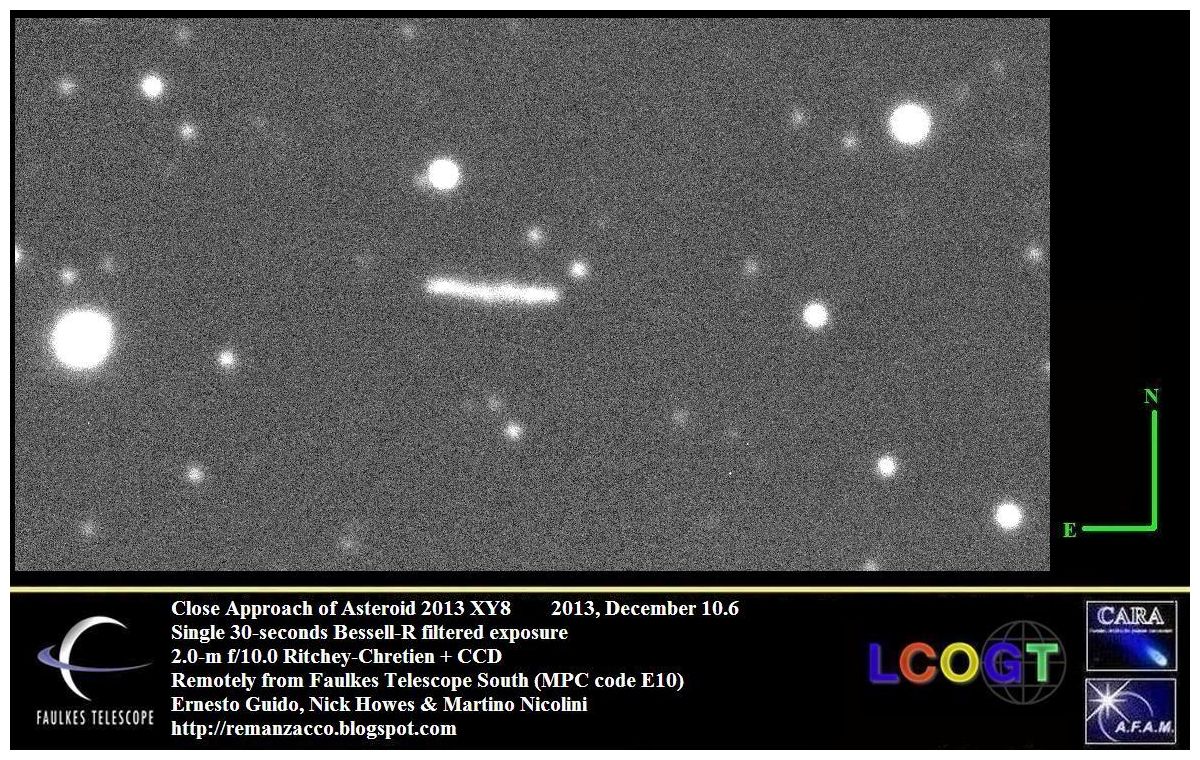
Possible bright Nova in Centaurus

Following the posting on the Central Bureau's Transient Object Confirmation Page about a possible Nova in Centaurus (TOCP Designation: PNV J13544700-5909080) we performed some follow-up of this object remotely through the 0.50-m f/6.8 astrograph + CCD + focal reducer of iTelescope network (MPC Code Q62 - Siding Spring, AU).

On our images taken on December 03.68, 2013 we can confirm the presence of an optical counterpart with unfiltered CCD magnitude ~5.0 at coordinates:

R.A. = 13 54 45.22, Decl.= -59 09 04.5 (equinox 2000.0; UCAC-3 catalogue reference stars).

According to Vizier the nearest star (located at 1.538 arcsecond from the transient) to this position in the USNO-B1.0 catalogue is:

USNO-B1.0 0308-0442031 (J2000) 13 54 45.374 -59 09 03.52 mag. B2=15.52 R2 =15.12

Our confirmation image (click on it for a bigger version):
Nova in Centaurus
© Remanzacco Observatory
Here is an animation showing a comparison between our confirmation image and the archive POSS2/UKSTU plate (R Filter - 1999).

Galaxy

Five alien worlds with water detected by Hubble Space Telescope

Alien Worlds
© NASA's Goddard Space Flight CenterNASA scientists found faint signatures of water in the atmospheres of five distant planets orbiting three different stars. All five planets appear to be hazy. This illustration shows a star's light illuminating the atmosphere of a planet.
NASA said its Hubble Space Telescope has detected subtle traces of water in the atmospheres of five distant alien worlds.

Two teams of scientists have discovered faint signatures of water in the atmospheres of five exoplanets. This is the first study to conclusively measure and compare the profiles and intensities of these signatures on multiple worlds.

"We're very confident that we see a water signature for multiple planets," Avi Mandell, a planetary scientist at NASA's Goddard Space Flight Center in Greenbelt, Md, and lead author of an Astrophysical Journal paper, said in a statement. "This work really opens the door for comparing how much water is present in atmospheres on different kinds of exoplanets, for example hotter versus cooler ones."

Scientist use space telescopes like Hubble to not only spot exoplanets, but also analyze their atmospheres. As a planet passes between its star and the Earth, researchers are able to analyze the atmosphere by determining which wavelengths of the star's light are transmitted and which are partially absorbed. During the latest study, the scientists used Hubble's high-performance Wide Field Camera 3, which is one of a few cameras capable of looking into the atmospheres of exoplanets trillions of miles away.