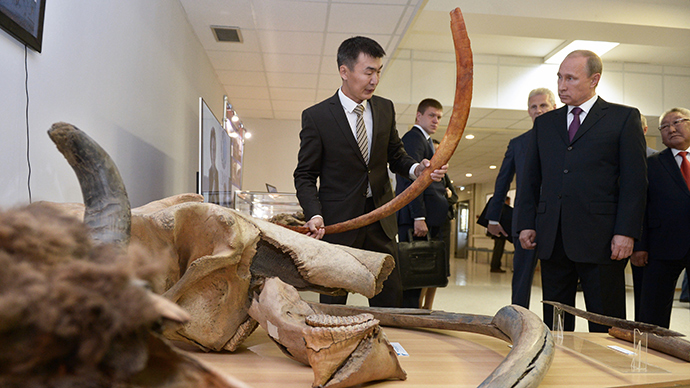
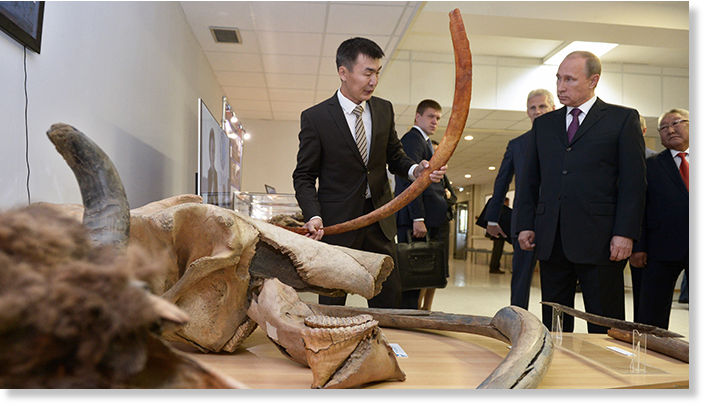
© RIA Novosti / Alexey NokolskySeptember 1, 2014. Russian President Vladimir Putin, second right, visits the P. Lazarev Mammoth Museum at the M. K. Ammosov North-Eastern Federal University in Yakutsk
Upon meeting a 28,000-year-old mammoth mummy in a museum in the Russian Far East, Russian President Vladimir Putin wondered if the preserved soft tissues of the ancient animal could help clone it.
The mammoth museum in Russia's Yakutia is a unique place, hosting the rarest findings of the ancient animals' remains discovered over the last decade.
But the main treasure of the museum is the so-called Mamolyakhovsky mammoth, which was found along the Kolyma River shores in 1977. The 28,000-year-old discovery is not only a full skeleton of a baby mammoth (which means over 75 percent of bones belong to the same animal), but also boasts soft tissues and even liquid blood preserved in the animal's mummy.
The mammoth was about seven or eight months old when it died, and the scientists named him Dima.
Upon seeing Dima on Monday, President Putin, who arrived in Yakutsk to participate in a meeting on regional development, became very interested in whether the mammoth's remains could pave way for its cloning.
"The soft tissues are preserved, so can it be cloned?" he asked.














Comment: Not only does every cell in our body contain reams of information, our very neurons are capable of performing complex feats of information processing. And yet mainstream science tells us all this information and creativity is the result of bits of matter randomly bumping into other bits of matter. What is the source of information, if not intelligence?