
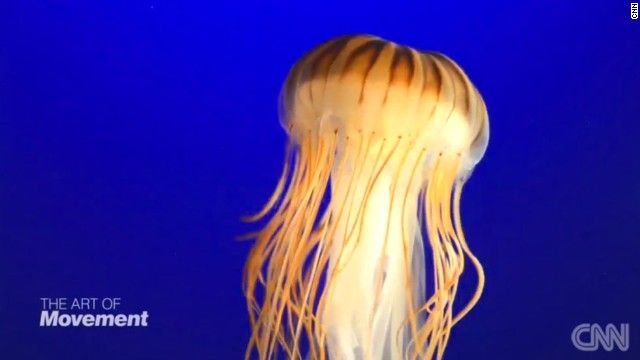
For many beach-goers, jellyfish are a nuisance that blights the seashore. But some scientists believe they could hold the key to immortality.
But perhaps they were going about it the wrong way. Instead of searching for answers on land, maybe they should have been looking to the sea.
In the seaside town of Shirahama, in Japan, one man thinks he knows what holds the key to everlasting life: jellyfish.

Professor Shin Kubota is an expert in marine biology and has been studying jellyfish since 1979. One tiny wonder in particular has become Kubota's life's work: the Japanese scarlet jellyfish, popularly referred to by the mysterious moniker "the immortal jellyfish."
"They don't die," Kubota says, "they rejuvenate." He adds that they are one of three jellyfish species in japan that are considered "immortal."
"One day in my plankton net, there was a small scarlet jellyfish from (the) south, which had many sharp sticks stuck into its body," he recalls. "I thought 'poor thing' and removed all of the sticks, hoping it may become better and swim again. But it didn't and shrunk. However, it rejuvenated!"
It's less immortality and more regeneration, but Kubota believes these tiny marine animals could hold the secret to perpetual life.
When an adult scarlet jellyfish -- or medusa -- is injured, it goes to the bottom of the ocean floor. From there, it morphs back into its infant state, known as a polyp. Then the polyp becomes a new medusa, allowing the jellyfish to move between an adult and infant state in about two months.
Kubota has succeeded in making one jellyfish rejuvenate an incredible 12 times in the lab. But there remain many unanswered questions.
"There should be a key to rejuvenation in the system of scarlet jellyfish," says Kubota. "I'd like to believe it could be applied to human beings, because genetically, jellyfish and humans are not so different."


Perhaps the 'price' of such 'rejuvenation' is the loss of the 'self'? How many of those singing this song called 'Who Wants To Live Forever' realize that it won't be 'them' that 'rejuvenates'? Just the body... gaining on one side usually means losing on the other... to maintain balance.