
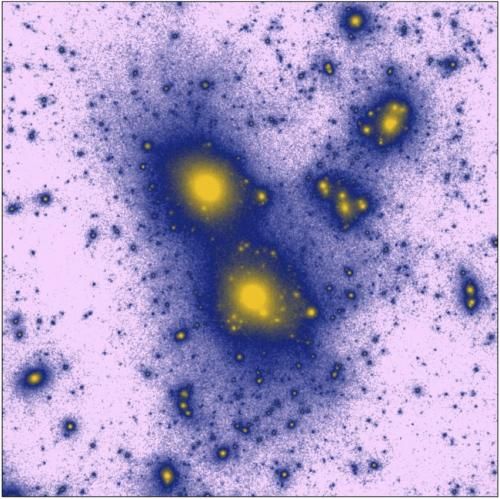
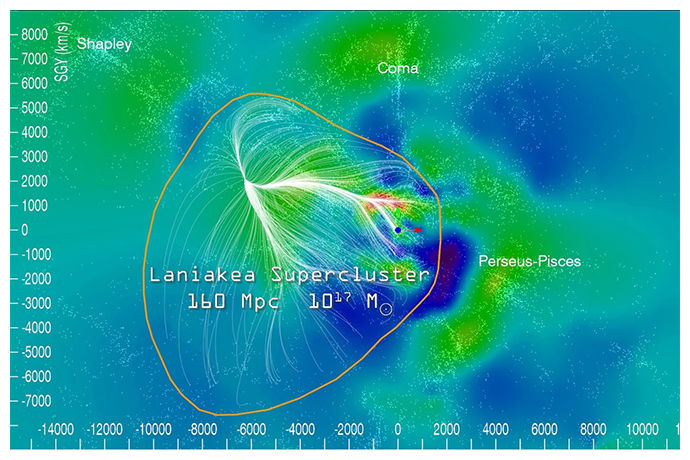
© Credit: University of Kansas / KU News ServiceThe distribution of dark matter in the universe as computed within the two-component flavor-mixed dark matter paradigm.
"Dark matter has not yet been detected in a lab. We infer about it from astronomical observations," said Mikhail Medvedev, professor of physics and astronomy at the University of Kansas, who has just published breakthrough research on dark matter that merited the cover of Physical Review Letters, the world's most prestigious journal of physics research.
Medvedev proposes a novel model of dark matter, dubbed "flavor-mixed multicomponent dark matter."
"Dark matter is some unknown matter, most likely a new elementary particle or particles beyond the Standard Model," Medvedev said. "It has never been observed directly, but it reveals itself via gravity it produces in the universe. There are numerous experiments around the world aimed at finding it directly."
Medvedev's theory rests on the behavior of elementary particles that have been observed or hypothesized. According to today's prevalent Standard Model theory of particle physics, elementary particles - categorized as varieties of quarks, leptons and gauge bosons - are the building blocks of an atom. The properties, or "flavors," of quarks and leptons are prone to change back and forth, because they can combine with each other in a phenomenon called flavor-mixing.



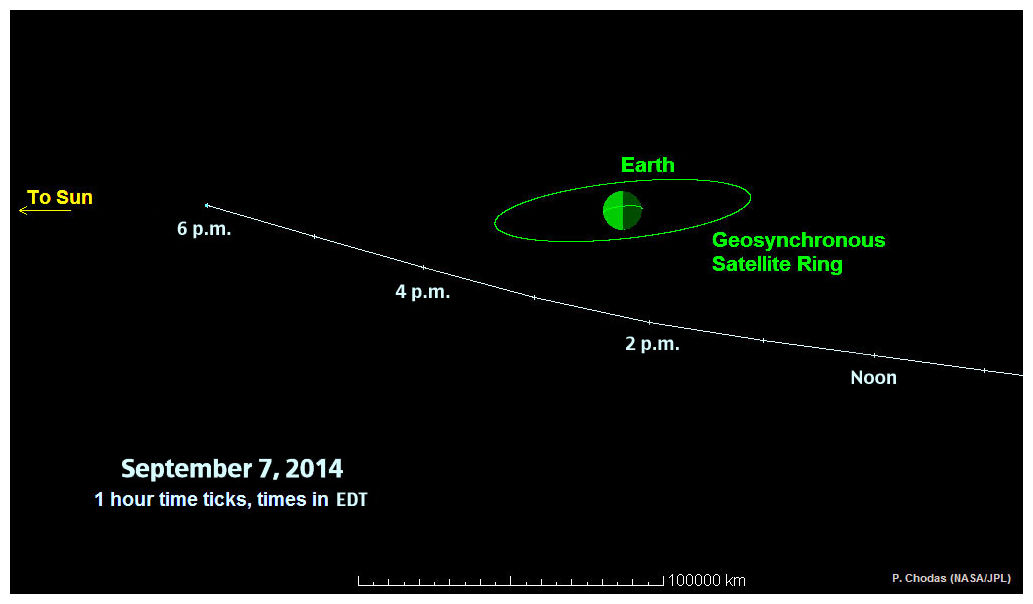









Comment: Back in March, 2013, NASA told Congress to "pray" if a meteor similar to the one that hit Russia is ever three weeks away from the U.S. During that House Committee hearing, NASA administrator Charles Bolden Jr. told Congress that the U.S. doesn't have the proper equipment to identify a small meteor (the size of Russia's meteor). Bolden said, "The reason I can't do anything in the next three weeks is because for decades we have put it off. We are where we are today because, you know, you all told us to do something and between the administration and the Congress, the funding to do that did not - the bottom line is always - the funding did not come." [This is pathetic. Let's start a war.]
As a species, we will not rise above a doomsday scenario as long as we allow lies, injustice and propaganda to blind us to what is real and secret agendas for the few to take priority over what is in all mankind's best interest and longevity. We apparently do not learn from our mistakes. If we haven't figured out why we are here and how to genuinely progress for the good of all, how will we stay the course, find our place in the balance of the universe and our connection to the realm of the cosmos? We will do what we will do...perhaps too little, too late. There are lessons...and apparently they are worth repeating.