Science & TechnologyS


Info

Languages are being wiped out by economic growth

Chief Marie
© Natalie Fobes/Corbis ImagesChief Marie Smith Jones, the last speaker of the Eyak language in Alaska, died in 2008 at age 89.
The world's roughly 7000 known languages are disappearing faster than species, with a different tongue dying approximately every 2 weeks. Now, by borrowing methods used in ecology to track endangered species, researchers have identified the primary threat to linguistic diversity: economic development. Though such growth has been shown to wipe out language in the past on a case-by-case basis, this is the first study to demonstrate that it is a global phenomenon, researchers say.

Many people know about the threatened polar bear and extinct passenger pigeon, but few have heard of endangered and extinct languages such as Eyak in Alaska, whose last speaker died in 2008, or Ubykh in Turkey, whose last fluent speaker died in 1992, says Tatsuya Amano, a zoologist at the University of Cambridge in the United Kingdom and lead author of the new study.

It's well known that economic growth or the desire to achieve it can drive language loss, he notes - dominant languages such as Mandarin Chinese and English are often required for upward mobility in education and business, and economic assistance often encourages recipients to speak dominant languages.

Whereas specific case studies demonstrate such forces at work, such as the transition from Cornish to English in the United Kingdom and from Horom to English in Nigeria, this is the first study to examine losses worldwide and rank economic growth alongside other possible influences, he says.

Galaxy

Welcome to Laniakea, our new cosmic home

Laniakea Supercluster
© SDvision interactive visualization software by DP at CEA/Saclay, FranceA slice of the Laniakea Supercluster in the supergalactic equatorial plane.
Using a new mapping technique that takes into account the motions -- and not just the distances -- of nearby galaxies, astronomers discovered that the Milky Way is located in the suburb of a massive, previously unknown super-cluster they named Laniakea, a term from Hawaiian words meaning "immeasurable heaven."

Actually, Laniakea's girth is measurable, though difficult to conceptualize. The super-cluster spans 520 million light-years in diameter, more than five times larger than the cluster previously believed to be the Milky Way's cosmic home.

A light-year is the distance that light, moving at a speed of 186,000 miles per second, travels in one year. One light-year is about 5.88 trillion miles.

Astronomers were able to identify the boundaries of Laniakea by charting the flow of more than 8,000 galaxies surrounding the Milky Way. By that yardstick, they discovered that the Milky Way, along 100,000 other galaxies, is sailing toward a region named the Shapley super-cluster.

Solar Flares

NASA imagery shows a late summer "flurry of flares" bursting from the sun

Image
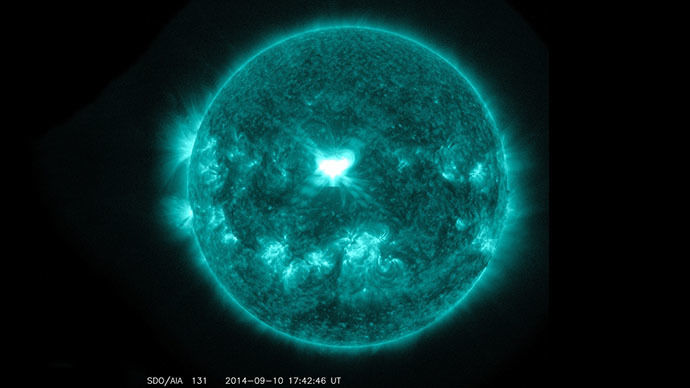
© NASA/SDOAs summer is ending, NASA captures a series of solar flares, making for a fitting end to a sizzling season. Solar flares may affect communication signals but nothing major was reported during the event.
The sun produced a flurry of flares this week says NASA, unleashing over half a dozen in one day alone.

As summer draws to a close, the Sun decides to finish the season with a bang, releasing a number of solar flares as August winds down.

NASA's Solar Dynamics Observatory captured all the action which peaked on Aug. 24. A mid-level solar flare started the event and soon more than half a dozen solar flares happened on the Sun's left side.

Solar flares are highly powerful bursts of radiation. The Sun had been experiencing increased activity lately and this has manifested in more than a handful of solar flares taking place in the past few days.

The biggest solar flare was the first solar flare reported for the event, an M-class flare which is known to be about 10 times smaller than the largest flare ever recorded, an X-class flare.

2 + 2 = 4

Neurons in human skin perform advanced calculations

Image
© Credit: Mattias PetterssonWork performed in Andrew Pruszynski's lab.
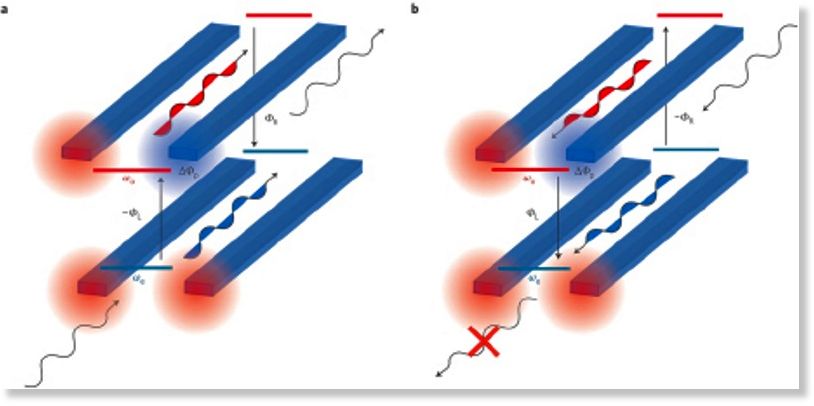
Neurons in human skin perform advanced calculations, previously believed that only the brain could perform. This is according to a study from Umeå University in Sweden published in the journal Nature Neuroscience.

A fundamental characteristic of neurons that extend into the skin and record touch, so-called first-order neurons in the tactile system, is that they branch in the skin so that each neuron reports touch from many highly-sensitive zones on the skin.

Comment: Not only does every cell in our body contain reams of information, our very neurons are capable of performing complex feats of information processing. And yet mainstream science tells us all this information and creativity is the result of bits of matter randomly bumping into other bits of matter. What is the source of information, if not intelligence?


Rocket

Russia to begin building record-setting space rocket capable of lifting super heavy load into orbit

Image
© RIA Novosti / Andrey MorgunovSpace booster Angara 1.2PP during launch
Vladimir Putin has given his preliminary approval for the development of a Russian-designed rocket capable of lifting a record 150 tons of cargo into orbit, to rival similar projects from NASA and Elon Musk's SpaceX.

"Today we heard the first concrete words about commencing work on the project. Previously, there was discussion and expert roundtables, but today President Putin gave the preliminary go-ahead for the new rocket," declared Deputy Prime Minister Dmitry Rogozin, who curates the country's space industry, after touring the Vostochny cosmodrome in the east of the country with the Russian leader.

The news comes on the back of a successful test launch of the long-gestating Angara rocket earlier this summer. The rocket, which is capable of delivering up to 35 tons of cargo into the Low Earth Orbit in its most powerful modification, is the first launch vehicle developed entirely after the fall of the Soviet Union.

Rogozin said that work on the new super-heavy rocket would begin as soon as Angara is in regular use.

Comment: From a very low base due to widespread destruction of the country during the 1990s, Russia under Putin is fast catching up with the US in almost every key aspects while the US and its client states are in rapid decline. It is the result that counts and these results speak better than words ever could.


Sherlock

Big Brother: Google's Location History is still recording your every move

Image
Google could be tracking and recording your every location on your Android device, and you may not even know it!

The culprit is a largely ignored feature in Android called Google Location history. The actual location service isn't unusual. It uses information like Cell IDs and Wi-Fi routers to locate and place your device. Other companies such as Apple and Microsoft use similar services for their devices.

The existence of Google's Location history is nothing new, in fact other sources have reported it previously, but it's still surprising how few people know or realize what it is and how it works. What isn't surprising are the reactions to it, which usually range from "creepy" to "scary" and a few others between.

Comment: How very interesting that Google make it so difficult for people to even know this facility exists as well as the serious ramifications for privacy. If you must use a mobile phone, turn off the location tracking and history service immediately.


Beaker

Putin visits mammoth museum, openly wonders if preserved soft tissue would allow scientists to clone the extinct creature

Image
© RIA Novosti / Alexey NokolskySeptember 1, 2014. Russian President Vladimir Putin, second right, visits the P. Lazarev Mammoth Museum at the M. K. Ammosov North-Eastern Federal University in Yakutsk
Upon meeting a 28,000-year-old mammoth mummy in a museum in the Russian Far East, Russian President Vladimir Putin wondered if the preserved soft tissues of the ancient animal could help clone it.

The mammoth museum in Russia's Yakutia is a unique place, hosting the rarest findings of the ancient animals' remains discovered over the last decade.

But the main treasure of the museum is the so-called Mamolyakhovsky mammoth, which was found along the Kolyma River shores in 1977. The 28,000-year-old discovery is not only a full skeleton of a baby mammoth (which means over 75 percent of bones belong to the same animal), but also boasts soft tissues and even liquid blood preserved in the animal's mummy.

The mammoth was about seven or eight months old when it died, and the scientists named him Dima.

Upon seeing Dima on Monday, President Putin, who arrived in Yakutsk to participate in a meeting on regional development, became very interested in whether the mammoth's remains could pave way for its cloning.

"The soft tissues are preserved, so can it be cloned?" he asked.

Question

Earth has multiple moons? Hunting for "minimoons" orbiting Earth

PanSTARRS
© Bryce Bolin/University of Hawaii, used with permissionPanSTARRS on patrol.
It's an engaging thought experiment.

What if Earth had multiple moons? Our world has one large natural satellite, just over a quarter the diameter, 1/50th the volume, and less than 1/80th the mass of our fair world. In fact, the Earth-Moon system has sometimes been referred to as a "binary planet," and our Moon stands as the largest natural satellite of any planet - that is, if you subscribe to bouncing Pluto and Charon out of "the club" - in contrast to its primary of any moon in our solar system.

But what if we had two or more moons? And are there any tiny "moonlet" candidates lurking out there, awaiting discovery and perhaps exploration?

While historical searches for tiny secondary moons of the Earth - and even "moons of our Moon" - have turned up naught, the Earth does indeed capture asteroids as temporary moons and eject them back into solar orbit from time to time.

Now, a recent paper out of the University of Hawaii written in partnership with the SETI Institute and the Department of Physics at the University of Helsinki has looked at the possible prospects for the population of captured Near-Earth asteroids, and the feasibility of detecting these with existing and future systems about to come online.

Info

Cave carving may be 1st known example of Neanderthal rock art

Neanderthal rock art
© Stewart FinlaysonThis abstract cave carving is possibly the first known example of Neanderthal rock art. The etching covers an area of about 47 square inches (300 square centimeters).
Around 39,000 years ago, a Neanderthal huddled in the back of a seaside cave at Gibraltar, safe from the hyenas, lions and leopards that might have prowled outside. Under the flickering light of a campfire, he or she used a stone tool to carefully etch what looks like a grid or a hashtag onto a natural platform of bedrock.

Archaeologists discovered this enigmatic carving during an excavation of Gorham's Cave two years ago. They had found Neanderthal cut marks on bones and tools before, but they had never seen anything like this. The researchers used Neanderthal tools to test how this geometric design was made - and to rule out the possibility the "artwork" wasn't just the byproduct of butchery. They found that recreating the grid was painstaking work.

"This was intentional - this was not somebody doodling or scratching on the surface," said study researcher Clive Finlayson, director of the Gibraltar Museum. But the discovery poses much more elusive questions: Did this engraving hold any symbolic meaning? Can it be considered art? [Video: First Neanderthal Rock Art Revealed]

Black Magic

This Google Glass app that measures human emotions is so, so creepy


It's not like we need any more reminders about how creepy Google Glass can be, but developers never stop surprising us. An new app from Germany's Fraunhofer Institute that uses facial tracking, proprietary tools and Glass, can measure human emotions. In real time.

The technology, dubbed SHORE (Sophisticated High-speed Object Recognition), gauges emotions such as anger, happiness, sadness and surprise and projects this information directly onto the screen of your Glass, right across the face of the person you're looking at. It doesn't just stop there. It also estimates their age and their gender, a feature, Fraunhofer says, can lead to applications in interactive gaming and market research. This is like RoboCop, but real, and on your face. Now.

If there are multiple people in a frame, you will get separate emotional attributes for all of them. All processing happens directly on the Glass CPU, which means that your Glass device is probably going to last you all of 20 minutes as Geek.com points out.

Comment: Google Glass is at the top of the list for creepy apps.

Just when you thought Google Glass couldn't get creepier: New App allows strangers to ID you just by looking at you
Google Glass face recognition app - all the world's a stage
Orwellian: Google 'pay per gaze' advertising looks to log user emotions via Glass
Google Glass 'eye wear' distracting, potentially dangerous, and causes privacy concerns