
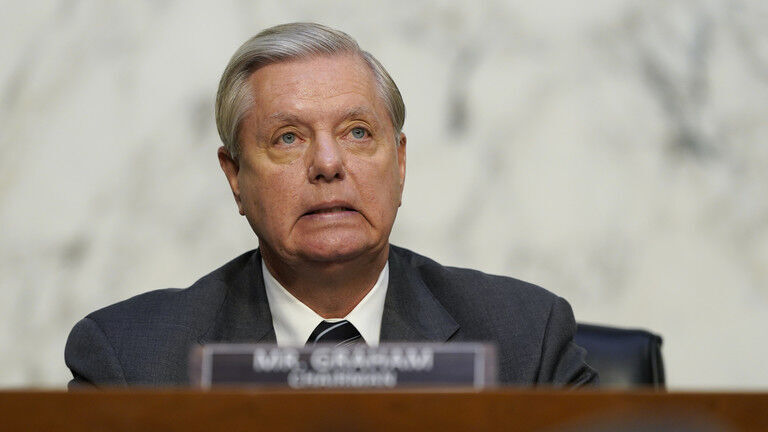
© Susan Walsh - Pool / Getty ImagesFILE PHOTO: Lindsey Graham.
In particular, Graham made three claims: First, that Russian control over this "gold mine" would enrich Moscow and enable it to share the extracted minerals with China; second, that Ukraine, if it retains control over them, could be "the richest country in all of Europe" and "the best business partner we ever dreamed of"; and, third, that therefore the outcome of the war in Ukraine is a "very big deal." Indeed, according to Graham, the stakes are so high that the US must help Kiev win "a war we can't afford to lose."
There were other striking statements in that interview, but it is this passage that has attracted most attention and condemnation: Graham, critics point out, has revealed what the Hindustan Times, for instance, calls the "real reason why the US is aiding Ukraine." That reason, as it turns out, is commercial, selfish, and strategic. So much for all that talk about Kiev's "agency," "democracy," and "freedom."
Ukraine, for the US, is an asset to be used - and used up - in a much greater, global geopolitical game, or to be precise a collection of assets: Apart from a strategic location, critical minerals, black-earth soil, and some gas as well, there are, of course, people. Graham also has a record of calling for more military mobilization in Ukraine. He is infamous as well for his May 2023 comment, in a conversation with Vladimir Zelensky, that "Russians are dying" in the war, while US aid was the "best money we've ever spent." Apart from the general nastiness of Graham's proudly brutal way of thinking, to make those Russians "die," plenty of Ukrainians, of course, have to die as well. Zelensky did not seem to mind.
Graham's critics are, of course, correct. But most of them, I suspect, would also acknowledge that there is nothing surprising or unique here. In essence, the senator's statement is simply a form of brutal honesty: While he is provocatively shameless about his cold and mercenary approach to politics, he represents the mindset of the Washington elite. At the same time, however, there is also something deeply misleading about his position, if in less obvious ways. Let's try to separate the cynical frankness from the persisting dishonesty.
Disregarding his specific figures, Graham is right that, unlike most other European countries, Ukraine has substantial reserves of critical minerals, and there is no doubt that these raw materials are of great significance. In general, the term refers to "elements necessary to produce the chips and batteries found in high-tech devices such as smartphones and laptops" and "for the manufacturing of renewable energy technologies such as wind turbines, electric vehicles and solar panels." At the same time, the global supply of many critical minerals is complicated because they are concentrated in limited locations, which makes them objects of geopolitics. Oil 2.0, if you wish.
The importance of these substances for the US, for instance, is so great that its Secretary of Energy has established a precise list of 50 minerals considered "critical" (mostly overlapping with a second list of 18 "critical materials for energy"). Driven by its desire to diminish its reliance on China, the EU as well has shown intense interest in Ukraine's critical minerals, which are at the core of its official strategic partnership on raw materials with Kiev, formally set up in 2021. Since 2022, the Ukrainian Geological Survey has partnered with the European Bank of Reconstruction and Development, to, in essence, catalogue and digitize Ukrainian deposits for Western investors. Ukraine's environmental impact assessments rules have been "simplified" for the purpose, that is, most likely, loosened. In 2024, the EU solidified these operations with its Critical Raw Materials Act.
At the same time, even despite the ongoing war, international investors from the West have already been lining up, including from as far away as Australia. Indeed, it is an American-Ukrainian venture, the BGV Group, "that has the largest and most diverse stake in Ukraine's critical minerals."
So, here is the first point Graham is wrong about: If anyone has been busy securing Ukraine's critical minerals (and, more broadly, materials), it is actually the West. We see a classic case of projection, with a loud accusation directed at Moscow betraying what the West has been up to. Nothing very surprising there, either. Consider "spheres of influence," for instance, a thing Russia must not be allowed to claim - even right up on its border - while that of the US extends to east of Kiev and Taiwan, for instance.
Yet there is a larger point here, beyond the senator's run-of-the-mill hypocrisy. What is perhaps most fundamentally misleading about his claims is their implicit premise, namely that there cannot be a way in which the West and Russia - and others - could share Ukraine's resources, obviously under conditions of international trade and investment no worse than usual, so that Ukraine as well would benefit. It is not Russia that has insisted on making economic warfare a routine tool of geopolitical competition, but the West. Graham is not only a rather vile cynic. He is also shortsighted; blinded by his poor man's realpolitik. He has lost sight of the simple option of cooperation, even among competitors. In that respect as well, he is representative of America's sadly declining elite.







Comment:
1) The article is a comment on the news announced in this article:
The empire needs resources: Ukraine is a 'gold mine' - US senator
Not only the natural resources of Ukraine are interesting for Western investors, the US and allies would like to balkanize Russia.
NATO state's PM calls for breakup of Russia
'West wants to defeat Russia militarily to get access to its wealth' - Hungarian premier Orban
2) While Western politicians will be the first to shout democracy, they tend to forget the Greek context and its mythology in which topics like Nemesis and Hubris were a part. About Nemesis, the Wiki begins: About Hubris, the Wiki has: 3) There is also a saying: "Whom the gods would destroy, they first make mad" The Wiki begins: While it might be presumptuous to pass fast and general judgements on political elites, there is still a trend and even Western commentators with a philosophical leaning, might reluctantly agree that it is an interesting exercise to consider where the classical terms have a better fit. From this perspective, statements like those from Lindsey Graham on the usefulness of Ukraine for the US, are helpful for removing doubts, though others might say, Graham adds nothing new, since it was "Washington's worst kept secret about Ukraine", rather than Washington's best kept, whatever that might be.