
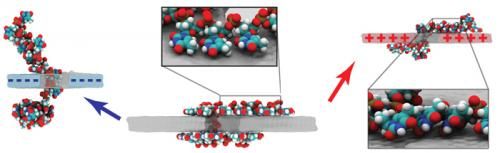
© Photo courtesy Alek AksimentievDNA interacts with charged graphene and contorts into sequence-specific shapes when the charge is changed.
Fast, accurate and affordable DNA sequencing is the first step toward personalized medicine. Threading a DNA molecule through a tiny hole, called a nanopore, in a sheet of graphene allows researchers to read the DNA sequence; however, they have limited control over how fast the DNA moves through the pore. In a new study published in the journal Nature Communications, University of Illinois physics professor Aleksei Aksimentiev and graduate student Manish Shankla applied an electric charge to the graphene sheet, hoping that the DNA would react to the charge in a way that would let them control its movement down to each individual link, or nucleotide, in the DNA chain.
"Ideally, you would want to step the DNA through the nanopore one nucleotide at a time," said Aksimentiev. "Take a measurement and then have another nucleotide in the sensing hole. That's the goal, and it hasn't been realized yet. We show that, to some degree, we can control the process by charging the graphene."















Comment: Torpor is a condition that can happen naturally from hypothermia. It shuts down most non-vital body processes and dramatically slows down the metabolism. The torpor state would be achieved by lowering body temperatures to somewhere between 89 and 93 degrees Fahrenheit. For every single degree the body temperature drops, its metabolic rate drops 5 to 7 percent. Researchers hope to get a 10 degree drop which would mean a 50 to 70 percent reduction in metabolic rate. The coma would be induced by letting the spaceship cool down in the freezing cold of space bringing the astronauts' body temperatures down, too. During interplanetary transit, the crew would receive low-level electrical impulses to key muscle groups to prevent muscles wasting away while in hibernation.